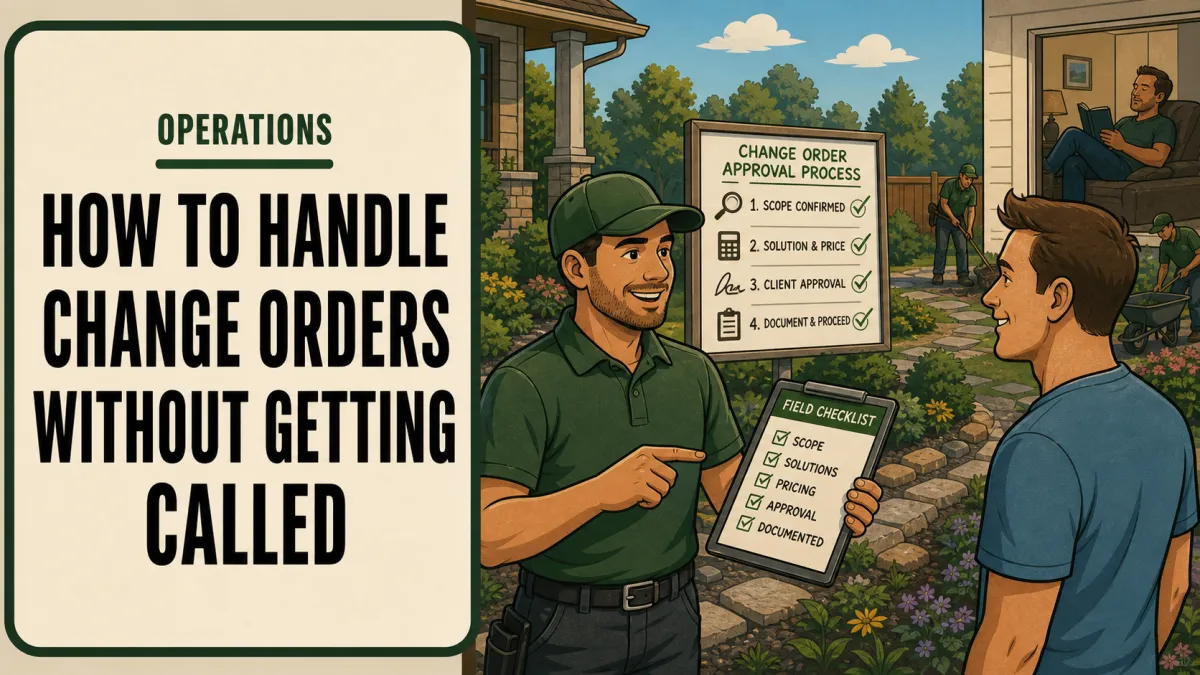
Landscaping Change Orders: Give Crews a Clear Approval Process
A landscaping change order process lets crews recognize extra work on site, price small items from an approved list, get written customer sign-off, and send the change to billing the same day, without calling the owner. The key is deciding in advance what a crew leader may approve, what goes to the office, and what needs a formal proposal. Without that, crews either do the extra work for free or stop and wait for you.
Updated October 9, 2026
What free extras cost you
The customer walks out while the crew is finishing and asks, "While you're here, can you pull that dead shrub?" The crew leader wants to be helpful and has no way to price it, so he either does it free or tells the customer he will have the owner call. Both answers cost you.
Example: a crew does $150 of unbilled extra work four times a week. Over a 30-week season that is $18,000 of labor and disposal that never reaches an invoice. If each of three crews does the same, it is $54,000. Free extras also distort your job costs, because the hours land on the original job and make the estimate look wrong when it was not. That pattern is one of the causes of landscaping labor overruns.
The fix is a process the crew can run on site in a few minutes.
Set approval tiers for field changes
Crews do not need unlimited authority. They need to know exactly where their authority ends. Write the tiers down, train them, and put them on the back of the run sheet.
| Tier | Examples | Who approves | Customer sign-off |
|---|---|---|---|
| Tier 1: Price-list items | Remove one small shrub, add a yard of mulch, extra bed edging | Crew leader, using the field price list | Signature or text approval on the form before work starts |
| Tier 2: Small custom changes | Work not on the list, roughly under $500 | Office or estimator, by phone or app, same day | Written approval of the quoted price |
| Tier 3: Scope or design changes | New beds, hardscape changes, irrigation modifications | Estimator or owner, formal proposal | Signed proposal or contract addendum |
Tier limits should match your contracts and your margin. A company with tighter margins may keep Tier 1 to a handful of items. The broader skill of drawing these lines is covered in setting decision boundaries for crews, and the handoff itself can be documented with the delegation handoff template.
Approval and contract requirements vary by state and by agreement. Have your change process and contract language reviewed by an attorney rather than relying on a universal verbal-approval rule.
Price small changes on site
A crew leader cannot estimate from scratch in a customer's driveway, and should not try. Give them a short field price list built from your real costs.
Limit it to 15 to 25 common add-ons your crews see every week.
Price each item as a flat rate that covers labor at your loaded rate, materials, disposal, and margin.
Set a minimum charge so tiny add-ons still cover setup and travel within the site.
Review the list twice a year against actual hours from completed changes.
Build the rates from the same numbers you use for bidding. The landscaping job-cost worksheet shows how to get loaded labor cost per person-hour, which is the base for every line on the list.
The field change order form
Paper or app, the form should take two minutes to complete. It needs:
Job or work-order number, customer name, and date.
Description of the requested work and its location on the property.
Tier, and either the price-list item and price or "sent to office for pricing."
Effect on schedule, such as extra time today or a return visit.
Before photo where it helps explain the work.
Customer approval: signature, or a reply to a text or email showing the price.
Crew leader name and time submitted.
No signature, no work, unless your separate emergency procedure covers a situation like an active leak or a safety hazard. If the customer is not home, the crew leader records the request and the office follows up. The crew does not guess.
Get every approved change billed
A signed change order that never reaches the invoice is still free work. Close the loop the same day:
The crew leader lists every change on the structured end-of-day crew report, approved or not.
The office matches each approved change to the job, updates the work order, and adds it to the next invoice.
Pending requests get an owner and a follow-up date.
At the weekly review, check that every change order from the week has a matching invoice line.
Watch for customers who generate a stream of small requests and push back on every charge. Some of them turn out to be unprofitable landscaping clients once you add up the real time.
Frequently asked questions
Can a crew leader approve landscaping changes?
Only within written authority, such as pricing items from an approved field price list. Larger or custom changes go to the office or estimator. Knowing how to do the work does not automatically include authority to change price or scope.
What information belongs in a change request?
The job number, requested work, location, tier and price or pricing status, schedule effect, photos where useful, and the customer's written approval. That gives billing and scheduling everything they need without a phone call.
How do we prevent approved changes from going unbilled?
Require every change on the end-of-day report, have the office update the work order and invoice the same day, and reconcile change orders against invoices during the weekly review.
Explore 7 Figure Landscape Network's business systems programs or book a strategy call to discuss the operating problem you want to work on. Learn about Jim Wertz and the network.
For the broader crew operations and delegation process, use How to Delegate Landscaping Work: A Practical Handoff Template as your starting guide, then return to the specific issue covered here.
