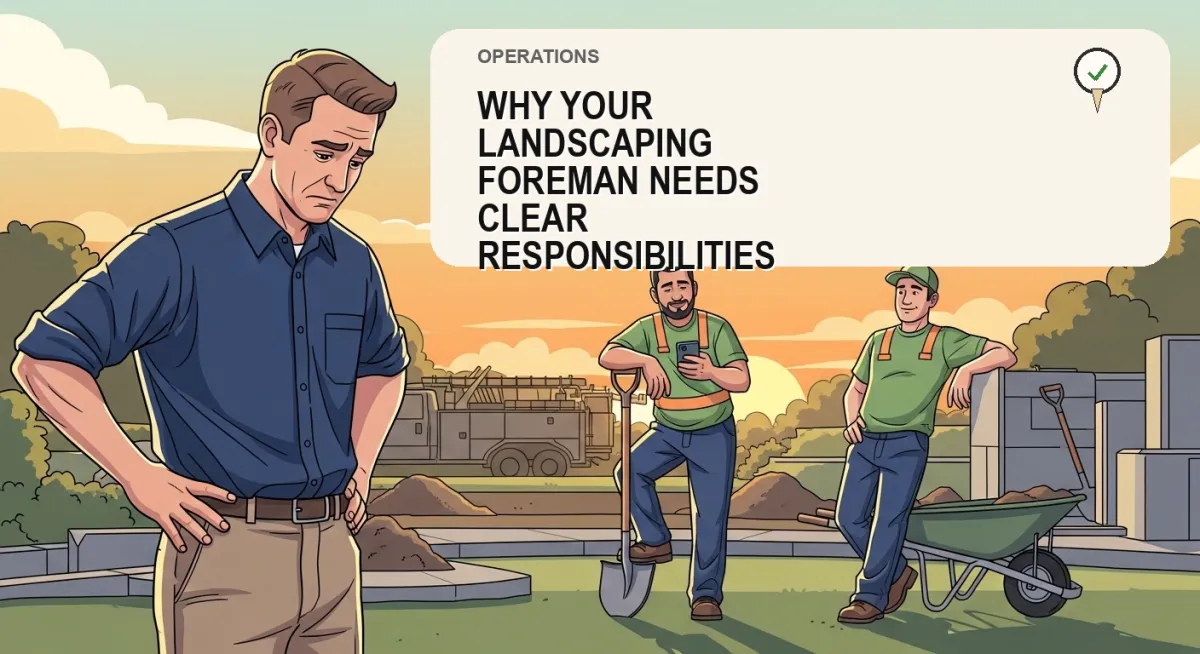
Landscaping Foreman Responsibilities: Duties and Scorecard
A landscaping foreman coordinates the crew, translates the approved work plan into daily assignments, monitors quality, and reports exceptions. Define the decisions the role owns and the limits that require approval. Promoting a skilled technician works better when leadership responsibilities are explicit and supported by training.
Updated September 14, 2026
Use a weekly foreman scorecard
| Responsibility | Evidence to review |
|---|---|
| Daily readiness | Scope, materials, crew assignments, and site constraints reviewed |
| Production coordination | Actual person-hours compared with the approved plan and explained |
| Quality | Inspections and rework causes recorded |
| Communication | Scope changes and unresolved issues reported to the right person |
| Closeout | Photos, checklist, and remaining tasks submitted |
Agree on targets from actual job history. A delay caused by missing material should not be treated the same as an unexplained departure from the plan. Pair the role with a written delegation handoff.
If your landscaping foreman is just the best worker on the crew, your business will keep running into the same wall.
Jobs start late. Quality drifts. Small issues turn into callbacks. The crew keeps looking to you for answers. And even when you promote someone into leadership, nothing really changes because the role is still undefined.
That is the problem in a lot of landscaping companies. The owner thinks, “I put someone in charge.” But from the crew’s perspective, nobody actually owns the result.
Clear landscaping foreman responsibilities fix that.
When your foreman knows exactly what they are responsible for, your crew performs with more consistency, decisions get made faster, and you stop being the default manager on every job site.
The Foreman Role Is Usually Too Vague
Most foremen get promoted because they are experienced, reliable, or technically strong. That part makes sense.
But then the owner gives them a truck, a crew, and a loose instruction like “run the job,” and hopes leadership just happens.
It usually does not.
Without clear expectations, the foreman keeps thinking like a technician. They focus on doing their own tasks well, not on managing production, quality, pace, communication, and follow-through across the whole site.
That creates a dangerous middle ground. The owner assumes the foreman is leading. The foreman assumes the owner will step in if something important comes up. And the crew learns to wait for direction instead of taking initiative.
What a Landscaping Foreman Is Really Supposed to Do
A strong foreman is not just another pair of hands. They are the field-level operator responsible for turning the plan into a finished result.
That means they own more than production. They own execution.
In a healthy landscaping business, the foreman is responsible for five things:
- Starting the day with clarity
- Keeping the crew moving
- Maintaining job quality
- Solving small problems before they become owner problems
- Closing out the site the right way
If those responsibilities are not clearly defined, the foreman role becomes reactive instead of proactive.
1. The Foreman Owns the Start of the Day
Good crews do not drift into a productive day by accident. Somebody has to establish the target early.
Your landscaping foreman should know the scope, the plan, the priorities, the site constraints, and what success looks like before the crew starts working.
That means the foreman should be responsible for:
- Reviewing the day’s scope before arrival
- Setting the first priorities on site
- Assigning work clearly by person
- Making sure materials, tools, and equipment are ready
When the day starts sloppy, the rest of the job usually follows it. That is why morning clarity is not optional. It is a leadership responsibility.
2. The Foreman Owns Crew Pace
One of the biggest differences between an average foreman and a strong one is pace control.
The foreman is not there to run around doing the most work. They are there to keep the whole crew moving in the right direction.
That includes noticing when someone is stuck, when work is happening out of sequence, when the crew is bunching up around one task, or when the site is losing momentum because nobody is directing the flow.
If your landscaping crew works hard but still loses time, the issue may not be effort. It may be that nobody owns the rhythm of the job.
3. The Foreman Owns Quality in Real Time
A lot of owners still act like the quality-control department because the foreman role has never been tied to quality clearly enough.
That needs to change.
The foreman should be expected to catch mistakes while the job is happening, not after the customer sees them and not after you show up to clean up the last 10 percent.
That means they own:
- Checking layout and alignment
- Watching finish details
- Making corrections before the crew moves on
- Using the job site checklist before closeout
If nobody owns quality during execution, the business ends up paying for the same work twice.
4. The Foreman Owns Small Decisions
Owner-dependent companies train everyone to escalate simple problems upward.
A strong landscaping foreman should be able to handle normal field decisions without calling you every hour.
That does not mean they never ask questions. It means they know which decisions belong to them and which decisions belong to you.
Examples of foreman-level decisions might include:
- Adjusting crew assignments when someone falls behind
- Reordering the work sequence based on site conditions
- Handling minor customer questions on site
- Flagging material shortages early enough to avoid a delay
When those boundaries are not clear, every minor issue turns into another interruption for the owner.
5. The Foreman Owns the Finish
The end of the job is where a lot of landscaping companies leak credibility.
The install may be fine, but the cleanup is rushed, the walkthrough is incomplete, and nobody takes responsibility for the final impression. Then the owner ends up returning to handle what should have been finished the first time.
Your foreman should own the last phase of the job completely.
That includes:
- Running the final walkthrough
- Using the closeout checklist
- Confirming cleanup is complete
- Taking final photos
- Flagging unresolved issues before the customer does
This is where role clarity turns into margin protection. Clean finishes reduce callbacks, save time, and protect the customer experience.
What Happens When Foreman Responsibilities Are Not Clear
When the role is vague, a few predictable things happen:
- The foreman defaults to doing instead of leading
- The crew waits for constant direction
- Problems get noticed too late
- The owner keeps getting pulled back into field management
- The company struggles to scale beyond the owner’s personal oversight
This is why many landscaping businesses feel busy but unstable. They have workers. They have jobs. They even have a foreman title. But they do not have true field leadership.
How to Define the Role Without Creating Bureaucracy
You do not need a 14-page management manual. You need a simple written standard.
Start by giving your foreman a one-page responsibility document that answers these questions:
- What are you fully responsible for on every job?
- What must you check before the crew leaves?
- What decisions are yours to make without approval?
- What problems must be escalated immediately?
- How will performance in this role be measured?
That one page can do more for field accountability than another motivational speech ever will.
Measure the Foreman Role the Right Way
If you want the role to improve, you need to measure what matters.
Not just whether the crew worked hard. Not just whether the day felt busy.
Measure outcomes tied to foreman responsibility, such as:
- Callback rate
- Job completion against schedule
- Site readiness at the start of the day
- Closeout quality
- Number of preventable owner interruptions
Once the role has defined responsibilities and visible scorekeeping, leadership becomes trainable instead of theoretical.
Final Thought
If your landscaping foreman is still acting like your best technician, do not blame the person too quickly. Look at the role you gave them.
People cannot consistently win inside a position that has no clear definition.
Clear landscaping foreman responsibilities create better jobs, stronger crews, fewer callbacks, and less owner dependence. And if you want a business that runs without you controlling every field detail, that role clarity is not optional.
It is one of the systems that makes scale possible.
Connect quality checks with safe work
Use the job-cost worksheet to review production without confusing hours on site with person-hours. Build safety procedures with reference to OSHA landscaping hazard guidance. This closeout or role template does not replace task-specific safety training.
Frequently asked questions
What is the difference between a landscaping foreman and a crew member?
A crew member carries out assigned work. A foreman also coordinates the group, checks progress and quality, handles authorized routine decisions, and communicates exceptions. The exact role depends on company size and job complexity.
Should a landscaping foreman approve change orders?
Only within explicitly granted authority and the agreed process. Define who can approve scope, price, and schedule changes. Field observations can come from the foreman without giving unlimited authority to commit the company.
How should foreman performance be measured?
Review readiness, explained labor variances, quality checks, communication, and closeout records. Account for site conditions and resources, and avoid rewarding speed at the expense of safety or agreed workmanship.
Explore 7 Figure Landscape Network's business systems programs or book a strategy call to discuss the operating problem you want to work on. Learn about Jim Wertz and the network.
For the broader crew operations and delegation process, use How to Delegate Landscaping Work: A Practical Handoff Template as your starting guide, then return to the specific issue covered here.
