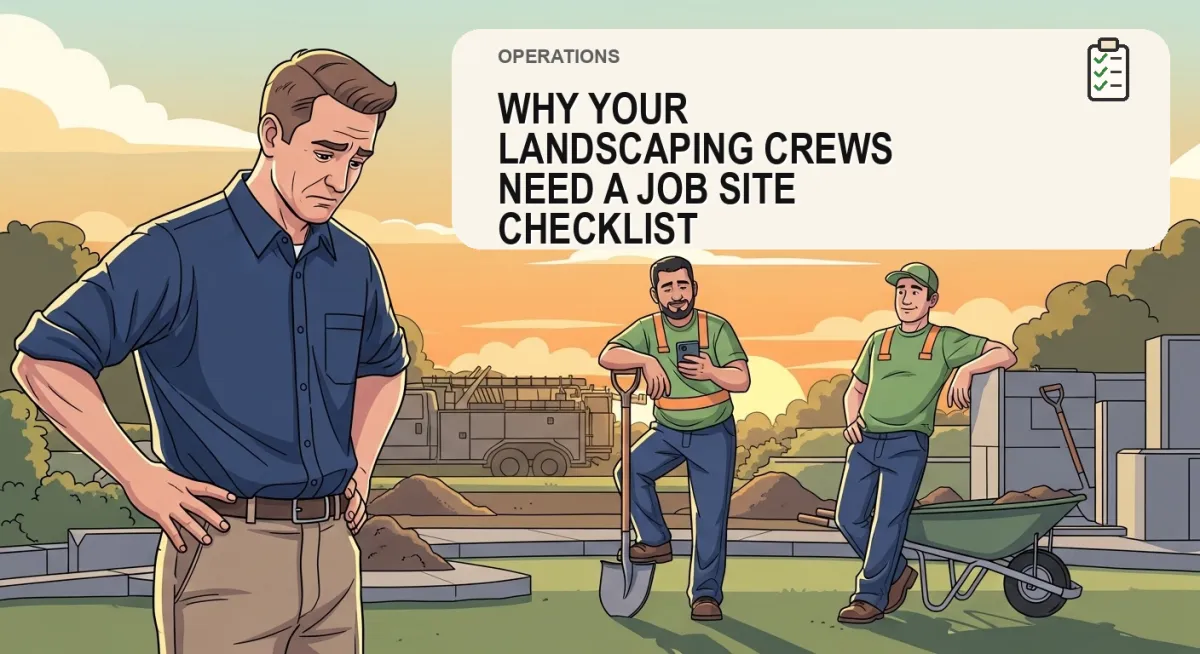
Landscaping Jobsite Checklist: Closeout Steps for Crews
A landscaping jobsite checklist defines what the crew must verify before leaving: the agreed work, cleanup, tools, photos, and unresolved issues. Assign one person to confirm closeout and adapt the checklist to the service. It supports consistent inspection without replacing technical standards or required safety procedures.
Updated September 14, 2026
A closeout record to use on the next job
| Check | Evidence |
|---|---|
| Approved scope complete | Work order reviewed; exceptions listed |
| Quality inspected | Applicable installation or maintenance checks recorded |
| Site restored | Debris removed and moved items returned |
| Tools accounted for | Equipment and materials checked before departure |
| Customer handover ready | Photos, care information, and follow-up owner recorded |
| Signoff | Job ID, date, crew leader, and open items |
Record incomplete items honestly. Connect missed checks to the callback register so the checklist changes when evidence shows a recurring problem.
When the job is almost done, a rushed closeout can create an avoidable return visit.
The mulch is down. The plants are in. The customer is mostly happy. So the crew starts packing up and moving on. But that final stretch is where details get missed, tools get left behind, beds get blown poorly, gates stay open, irrigation gets skipped, and the owner ends up doing one more “quick stop” to clean it up.
If that sounds familiar, your problem is not effort. It is not attitude. And it is not that your team “just needs to care more.”
Your problem is that there is no clear definition of done.
A simple landscaping job site checklist fixes that. It gives your crew a visible finish line. It reduces callbacks. It protects your margins. And it helps your landscaping business run with more consistency when you are not standing on the job site yourself.
The Real Problem Is Ambiguity
Most crews are not trying to do a bad job. They are trying to move fast in an environment where the standard lives in the owner’s head.
You walk a finished property and immediately notice the crooked edge, the missed debris behind the condenser, the paver dust left on the driveway, or the irrigation head that never got adjusted. Your crew does not see those things the same way because nobody translated your standard into a repeatable system.
That is why one crew finishes strong and another crew creates a callback on the same kind of job. It is not random. One had clarity. The other had assumptions.
A landscaping crew checklist removes the guesswork. Instead of “make sure it looks good,” your team gets a specific closeout process they can follow on every site.
Why a Landscaping Job Site Checklist Matters
The right checklist does more than keep people organized. It changes how the business runs.
It improves quality control before the customer sees the finished work.
It reduces callbacks that quietly eat profit.
It makes crew accountability easier because the standard is visible.
It helps foremen lead without waiting for the owner to inspect everything.
It creates a repeatable customer experience across different crews and job types.
Most owners think they have a labor problem when they really have a systems problem. If your team only performs at your level when you are physically there, the business is still owner-dependent.
What to Put on a Job Site Checklist
Your checklist should be short enough to use in the field and specific enough to matter. Start with the non-negotiables that affect customer perception, callbacks, and rework.
1. Site Cleanup
All debris, trash, and excess materials removed
Driveways, walkways, patios, and curb line blown clean
Street and trailer area checked before leaving
2. Work Quality Review
Plant spacing checked
Edges clean and consistent
Grade and finish match scope
Pavers, stone, or hardscape lines reviewed for alignment
3. Irrigation and Watering
New material watered in
Irrigation heads adjusted and tested if applicable
Wet spots, broken lines, or runoff issues checked
4. Equipment and Material Check
All tools loaded
Fuel cans, hand tools, and safety gear accounted for
Unused materials either removed or staged correctly
5. Customer-Visible Finish Details
Gates closed
Furniture or decor returned if moved
Final presentation reviewed from the customer’s point of view
6. Documentation
Take final photos
Log job notes while details are fresh
Flag any issues that need follow-up before the customer finds them first
This is where many landscaping businesses win back control. The checklist is not just a reminder. It is a standard that turns your expectations into a process the crew can actually follow.
Keep It Short or It Will Not Get Used
A checklist that is difficult to use on site is less likely to become a habit.
The goal is not paperwork. The goal is consistency.
Start with the recurring checks that matter for the service. Allow enough time to perform them properly. Once the habit is built, you can create job-specific versions for maintenance, installs, enhancements, or hardscape work.
But do not begin with complexity. Begin with the repeatable issues that cost you the most.
Give One Person Ownership of the Final Walkthrough
A checklist only works when somebody owns it.
Do not make it the team’s job in general. Make it the foreman’s job specifically.
At the end of the day or end of the job, one person should walk the checklist, confirm the closeout, and be responsible for the final standard. That creates accountability without constant owner intervention.
If you want your landscaping foreman to think like a leader, give them a process that leadership can live inside.
Track Callbacks by Job, Cause, and Crew
If you really want to improve operations, connect your checklist to your callback data.
When a customer issue comes in, ask:
Which crew did the work?
Which foreman signed off on the checklist?
What kind of issue was missed?
Does that issue belong as a checklist item?
This is how you build a quality control system in a landscaping business. Not by hoping people care more. By making misses visible and tightening the standard over time.
The Goal Is Not Perfection. It Is Reliability.
You do not need flawless crews. You need a reliable process.
The businesses that scale are not built on heroic owners doing one last walkthrough at every site. They are built on simple systems that define what good looks like and make it easier for ordinary people to execute consistently.
If your landscaping crews slow down, miss details, or leave you cleaning up behind them, do not start by giving another speech.
Start by giving them a checklist.
Final Thought
A landscaping job site checklist might feel small, but small systems are often the beginning of big operational freedom.
Because once your team can finish a job without you playing quality-control cop, you are one step closer to running a landscaping business that does not depend on your constant presence to deliver a great result.
Connect quality checks with safe work
Use a clear handoff to assign inspection responsibility and escalation rules. Build safety procedures with reference to OSHA landscaping hazard guidance. This closeout or role template does not replace task-specific safety training.
Frequently asked questions
Should maintenance and installation crews use the same checklist?
Use common closeout items for cleanup, tools, and records, then add checks specific to the service. Irrigation commissioning, planting care, and hardscape tolerances need different technical checks.
Who signs off a landscaping jobsite checklist?
Assign a named crew leader or other qualified person. Record the job and date, and identify who owns unresolved work. A general instruction for everyone to check the site often leaves the final decision unclear.
Does a closeout checklist replace a safety inspection?
No. Closeout quality checks and safety procedures serve different purposes. Include appropriate references and use qualified people for technical inspections, following applicable requirements and manufacturer instructions.
Explore 7 Figure Landscape Network's business systems programs or book a strategy call to discuss the operating problem you want to work on. Learn about Jim Wertz and the network.
For the broader crew operations and delegation process, use How to Delegate Landscaping Work: A Practical Handoff Template as your starting guide, then return to the specific issue covered here.
