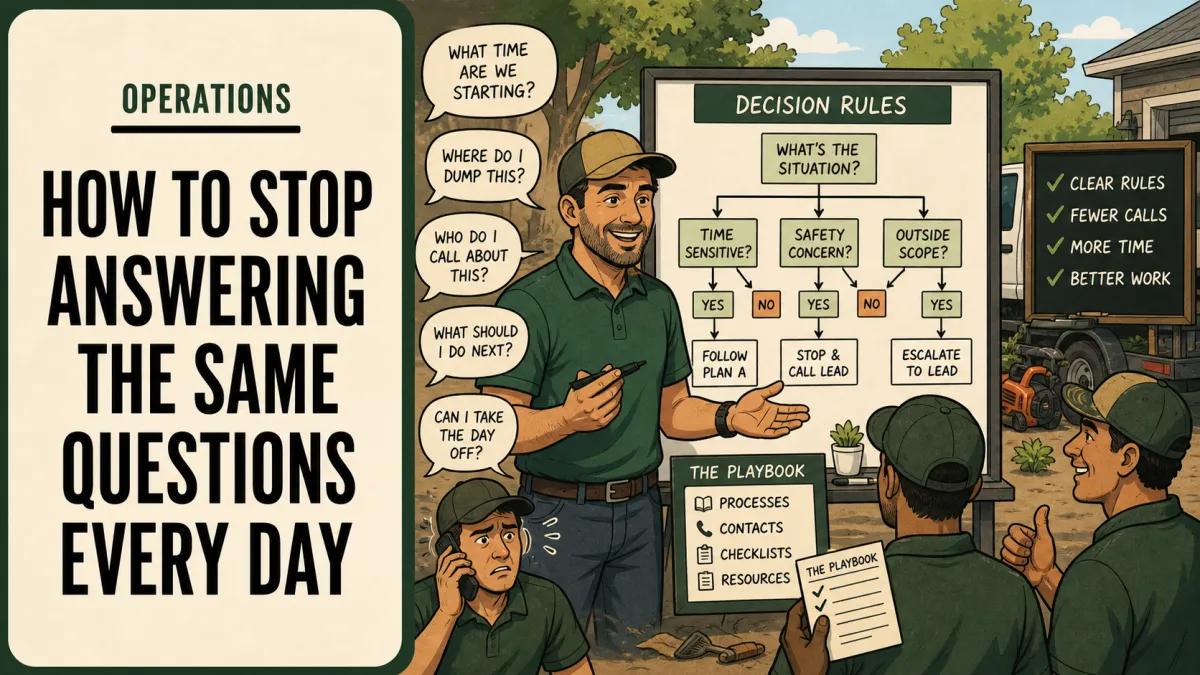
Build a Landscaping Team Knowledge Base for Repeat Questions
A landscaping company knowledge base is a short set of one-page answers to the questions your crews and office ask you over and over, stored where anyone can pull them up on a phone in the field. Build it from real questions: log every repeat question for two weeks, write a one-page answer for the most common ones, and assign someone to keep each answer current. Twenty good pages beat a 200-page manual nobody opens.
Updated October 9, 2026
Log every repeat question for two weeks
Start by counting, not writing. For two weeks, every time someone calls, texts, or walks up with a question, note the question, who asked, and what the wait cost. A phone note is fine. Have your office manager log theirs too.
One week misses things that come up every other week, like a dump-site question on a biweekly route. At the end, group the questions by task and count them.
| Repeat question | Times asked | Asked by | What it cost |
|---|---|---|---|
| Customer wants extra work on site. Can we do it? | 9 | Crew leaders | Crew waits for a price |
| How deep does mulch go, and how do we edge this bed? | 8 | Newer crew members | Inconsistent quality, callbacks |
| Where do we dump debris on this route? | 7 | Crew leaders | Drive time, wrong site fees |
| Customer not home, gate locked. What now? | 6 | Crew leaders | Skipped stop or long wait |
| Can I swap a shift or leave early? | 5 | Crew members | Owner interruption |
| Mower broke. Who do we call? | 4 | Crew leaders | Crew idle |
| Total | 39 |
That is 39 interruptions in ten working days, about four a day, from six questions. Answer those six once, in writing, and most of the noise goes away. Interruptions like these are often what wreck your mornings; reducing morning interruptions covers the rest of that problem.
Prioritize questions that cause waiting, inconsistent customer answers, or preventable mistakes. Which full processes deserve a formal SOP first is a separate decision.
Write one-page answers
Each answer gets one page, written the way you would explain it on the tailgate:
The situation. One line: "Customer asks for extra work while we are on site."
What to do. Three to six steps, in order.
Your limit. What the crew leader can decide alone, and where they must stop.
Who to call if it goes past the limit. A name and a number, and a backup who is not you.
Links. The current form, a photo of the standard, or a short video.
Owner of the page and last review date.
Take the extra-work question. The page points to the change-request form, lists the details to collect (photos, measurements, what the customer asked for), and names who approves the price. It does not tell every crew member to negotiate. The routine routing question disappears, and the approval boundary stays where it belongs. Keep added work separate from approved scope with a documented change-order process.
The "your limit" line is where most of your time comes back. If crews keep calling because they are not sure they are allowed to decide, the fix is a clear boundary; see why landscaping crews wait for approval.
Store it where crews can reach it
If a crew leader cannot find the answer in under a minute from the truck, they will call you. Storage has to work on a phone with a weak signal.
A shared cloud folder that opens in a phone app, one file per question, named with the question itself.
Your field software's notes or documents section, if your crews already use it every day.
A printed binder in each truck as backup for dead zones, reprinted when a page changes.
Pick one home; two copies means one is wrong. Keep passwords and sensitive customer details out of a widely shared folder. Keep safety training separate, in your normal training process.
Roll it out so people use it
Walk through the first six pages in a short crew meeting. Have each crew leader find one answer on their own phone.
Test it with a scenario: "The gate is locked and the customer is not answering. What do you do?" If they cannot find and apply the answer, rewrite the page.
For the first month, when someone asks a question that is in the knowledge base, answer it and send them the link. Then stop answering it directly.
Add a page whenever a new question shows up three times.
This only works if roles are clear; if everything still routes to you, start with defining roles before delegating owner tasks.
Keep it current
An outdated answer is worse than no answer, because people follow it with confidence. Every page has a named owner. When a process, price, supplier, or dump site changes, that person updates the page that week and deletes the old version. Review the whole set before the season and again mid-season, starting with pages crew leaders found confusing.
When you hand off ownership of a page, use the delegation handoff template to set the outcome, authority, and review point.
Frequently asked questions
What should go in a landscaping team knowledge base?
Start with the repeat questions you logged: on-site extra work, quality standards, dump sites, access problems, breakdowns, and scheduling requests. Add the current forms, decision limits, and escalation contacts. Organize pages by the task the employee is trying to finish.
Who should maintain operating instructions?
Assign a named owner to each page, usually the person closest to the work, like an operations manager or senior crew leader. They update it when the process changes or when employees report confusion, and they remove old versions.
How do I know employees can use the knowledge base?
Test it. Give a crew leader a realistic scenario and ask them to find the answer on their phone and explain what they would do. If they cannot, the page or the storage needs work.
Explore 7 Figure Landscape Network's business systems programs or book a strategy call to discuss the operating problem you want to work on. Learn about Jim Wertz and the network.
For the broader crew operations and delegation process, use How to Delegate Landscaping Work: A Practical Handoff Template as your starting guide, then return to the specific issue covered here.
