Define Landscaping Business Roles Before Delegating Owner Tasks
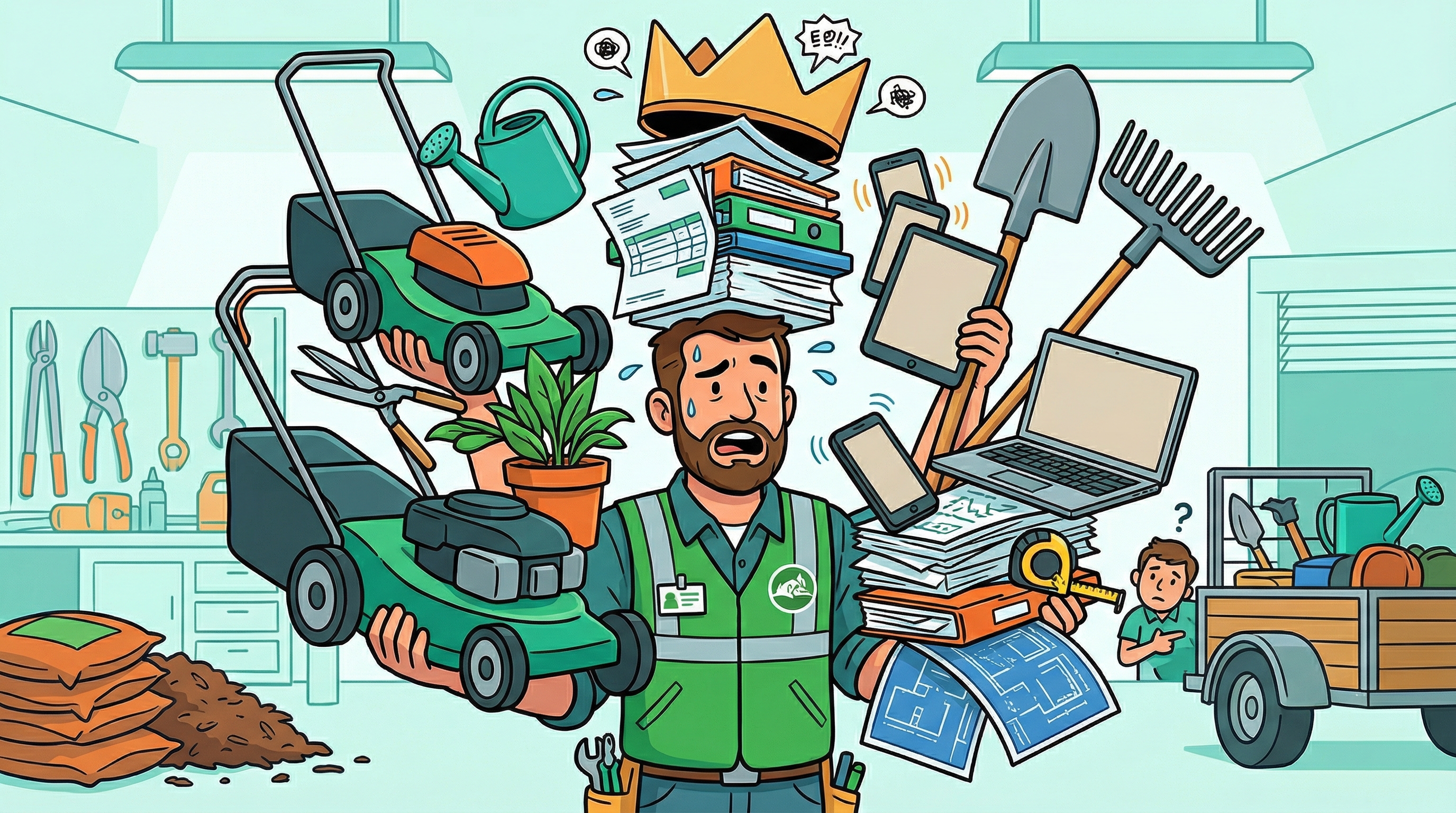
A landscaping company org chart is most useful when it's drawn by function: sales, operations, crews, office, and finance, each with the outcomes it owns. In most owner-run companies, the owner's name sits in nearly every box. Draw that honestly, decide which boxes your name leaves in the next 12 months, and define each role before you delegate a single task.
Updated October 9, 2026
Draw the chart by function
Most small-company org charts are a list of people with titles. That tells you who works there. It doesn't tell you who is accountable for what. An accountability chart starts with the work instead.
For a typical landscaping company, five functions cover almost everything:
Sales: leads, site visits, estimates, closing, renewals.
Operations: scheduling, dispatch, materials, equipment, quality.
Crews: doing the work to standard, on time, within the hours estimated.
Office: customer communication, billing prep, collections follow-up, records.
Finance: pricing rules, job costing, cash, payroll approval, the numbers review.
Each box gets the outcomes it owns, not a list of chores. "Next-day work packets complete by 3 p.m." is an outcome. "Help with scheduling" is not.
Names in the boxes: today and in 12 months
Now write a name in each box. Be honest. If you approve every schedule change, your name goes in operations even if someone else types the schedule.
| Function | Key outcomes | Name today | Name in 12 months |
|---|---|---|---|
| Sales | Estimates out within 48 hours, renewals signed by March | Owner | Owner, with office handling follow-up |
| Operations | Complete work packets, crews dispatched on time, equipment ready | Owner | Operations manager or lead foreman |
| Crews | Work to standard within estimated hours | Owner plus three crew leaders | Three crew leaders |
| Office | Customer calls returned same day, billing out weekly | Owner and spouse, evenings | Office administrator |
| Finance | Weekly job cost review, cash forecast, pricing rules | Owner, when there's time | Owner, with outside bookkeeper |
In this example the owner is in all five boxes today and two in a year. That second column is the plan. It doesn't happen by accident.
Define the role before you delegate
Handing over a pile of miscellaneous tasks is how delegation fails. Before anyone takes a box, write a one-page role definition:
The outcomes the role owns, in measurable terms.
The recurring tasks that produce those outcomes.
Decision authority: what they can decide alone, and the dollar or risk limit where they check in.
The two or three numbers that show whether the role is working.
Who they report to and when you review together.
The hours the role needs, so it fits someone's actual week.
Example: instead of asking an office employee to "help with everything," assign complete next-day work packets. Define the scope details, access notes, materials status, and how to escalate gaps. The owner then reviews exceptions instead of rebuilding each packet. For a field example, see landscaping foreman responsibilities and scorecard. Once the role is written, the actual handoff follows its own process in the delegation handoff template.
Move your name out one box at a time
Start with the box that eats the most owner hours for the least owner-level judgment. For many companies that's the office.
Decide whether an existing person can grow into it or you need to hire. If office workload is the constraint, evaluate when an office administrator is justified.
If you're hiring, write the role definition before the job ad, using the landscaping hiring process.
Give the new owner of the box 60 to 90 days with regular reviews before moving to the next one.
Update the chart every quarter.
Moving fifteen hours off your plate doesn't automatically create fifteen hours of revenue. Count the real staffing and supervision cost, and decide what the freed time is for.
Mistakes that make the chart useless
A few patterns show up again and again:
Executive titles at a small company. A $900K business doesn't need a COO. One person can cover several boxes if workload and controls support it.
Two names in one box. When two people own it, nobody does.
Boxes built around a person. Draw the function first, then find the person.
Hiding your own name. If you still approve it, you still own it.
Every box with only your name in it is a risk to the business. Reducing key-person risk covers that exposure, and the three types of owner dependence helps you see which kind is holding each box.
Frequently asked questions
Should a small landscaping company create executive roles?
Usually not. Start by defining functions and the outcomes each owns, then assign responsible people. One person may cover several boxes if workload, competence, and controls support it.
What makes a role handoff clear?
A defined outcome, the information needed, written authority limits, enough capacity in the person's week, and a review schedule. A title alone doesn't establish any of those.
How do I measure the benefit of delegation?
Track delivery quality, actual costs, how often you're interrupted, and what you do with the released time. Avoid assuming a fixed hourly profit return.
Explore 7 Figure Landscape Network's business systems programs or book a strategy call to discuss the operating problem you want to work on. Learn about Jim Wertz and the network.
For the broader crew operations and delegation process, use How to Delegate Landscaping Work: A Practical Handoff Template as your starting guide, then return to the specific issue covered here.
