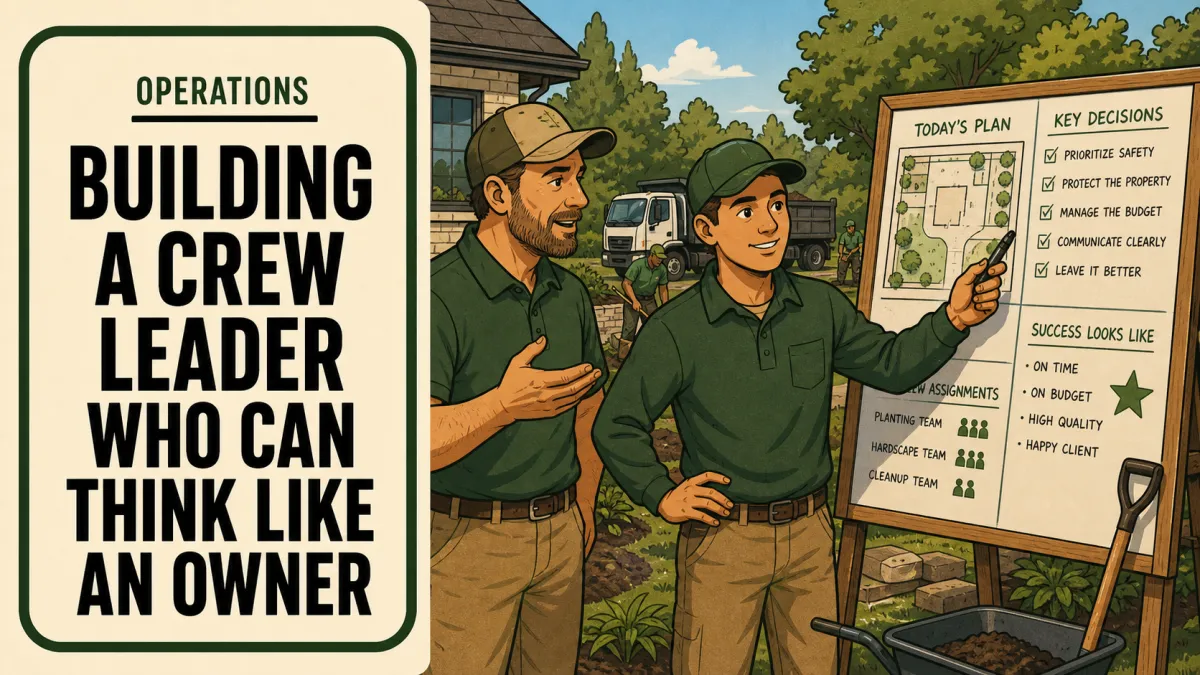
Develop Landscaping Crew Leader Judgment with Practical Scenarios
The fastest way to train a landscaping crew leader to make good calls is to practice decisions before they happen in the field. Use realistic scenarios, explain the reasoning you want behind each answer, run a short drill every week, and grade the thinking as well as the result. Owner-like judgment means weighing safety, quality, the customer, time, and cost within the leader's role. It does not mean unlimited authority or carrying the owner's financial risk.
Updated October 9, 2026
What judgment training covers
Most crew leader training stops at tasks: run the mower, read the run sheet, fill out the report. That covers the 80% of days that go to plan. Judgment is for the other 20%, when a delivery is late, a customer changes their mind, or something breaks and you are not there.
Before you train judgment, the leader needs two things in writing. First, their duties and how they will be measured; a foreman duties list and scorecard covers that. Second, the decisions they own and where the limits are; clear decision boundaries for crews covers that. Scenario training teaches how to think inside those limits, and how to recognize situations no checklist covers.
Six field scenarios and the reasoning you want
Use situations your crews actually face. Here are six to start with. The right answer matters, but the reasoning matters more, because the next situation will be slightly different.
| Scenario | Good response | Reasoning to look for |
|---|---|---|
| Materials delivery is two hours late on an install | Continue approved prep work that can proceed safely, update the office, record the delay | Protects the schedule without guessing at substitutions |
| Customer asks for "a few extra shrubs while you're here" | Acknowledge, explain it needs a quick approval, log it as a change | Free work erodes the job margin; the customer still feels heard |
| Mower breaks down mid-route | Follow the breakdown plan, re-sequence stops, notify the office of what moves | Keeps the crew productive instead of everyone waiting |
| Crew member is not wearing required PPE near a trimmer | Stop the task until PPE is on, then address it privately | Safety is never traded for speed |
| Irrigation line nicked while edging a bed | Shut off the zone if possible, photograph, tell the customer and office the same day | Early honesty costs less than a complaint later |
| Job will finish 90 minutes late due to scope that was underestimated | Call the office by midday with the revised finish time and reason | Gives the office time to adjust the next stop and customer expectations |
Two of these have their own systems behind them. For breakdowns, give leaders a written equipment breakdown plan. For extra work, give them a clear change order approval process so scenario two has a known answer.
Notice what a good leader does not do in scenario one: substitute unapproved materials or promise free extra work to keep everyone busy. Good judgment balances progress with the project's limits.
Run a weekly scenario drill
Fifteen minutes a week is enough. Do it at the same time every week, such as Monday morning before crews roll or during the weekly meeting.
Pick one scenario. Use a real situation from last week whenever you can.
Describe it in two or three sentences. Leave out the answer.
Ask the leader: what information is missing, what can proceed safely, and who needs to know?
Let them answer completely before you say anything.
Explain the reasoning you would use and where their answer matched or differed.
Write the agreed answer into the team's reference notes so the next leader learns it too.
When several crew leaders attend, have each answer before discussing. Differences between them show you where your standards are unclear.
How to grade judgment
Grade the decision process, not only how it turned out. A good call can still end badly because of bad luck, and a careless call can work out fine. Score each scenario answer and real decision from 1 to 3 on four points:
Safety first: did they identify any safety risk and handle it before anything else?
Stayed inside authority: did they act within their limits and escalate what was outside them?
Communicated early: did the office and customer hear about it the same day, before it became a problem?
Weighed the cost: did they consider time, materials, and margin, not just getting the job done?
Track the scores over a couple of months. A leader consistently scoring 3s on a type of decision is ready for more authority there. Make follow-up on low scores specific using clear crew accountability standards.
Expand authority as judgment proves out
Review real decisions without taking back every task. Recognize sound reasoning out loud, correct gaps precisely, and widen limits one category at a time when the scores support it. Document each expansion, including the outcome, authority, and review point, using the delegation handoff template.
Leadership development takes time and deserves recognition, including pay that reflects the bigger role. A leader who asks for clarification is usually showing good judgment, not a lack of commitment.
Frequently asked questions
What does owner-like judgment mean for a crew leader?
It means thinking about how a decision affects safety, quality, the customer, time, and cost while staying within the role's authority. It does not mean assuming the owner's financial risk or making every call alone.
How can I teach decision-making to a new crew leader?
Run a short weekly drill using real scenarios, ask them to reason out loud, and explain the standards behind your answer. Pair practice with written approval limits and field support so they are never guessing what they are allowed to do.
When should a crew leader receive more authority?
When they show consistent judgment and reliable reporting in their current scope, ideally over several weeks of scenario scores and real decisions. Expand one decision category at a time, and keep higher-risk or unfamiliar decisions supervised.
Explore 7 Figure Landscape Network's business systems programs or book a strategy call to discuss the operating problem you want to work on. Learn about Jim Wertz and the network.
For the broader crew operations and delegation process, use How to Delegate Landscaping Work: A Practical Handoff Template as your starting guide, then return to the specific issue covered here.
