Do Landscaping Business Coaches Work? Results, Timelines, and ROI Math
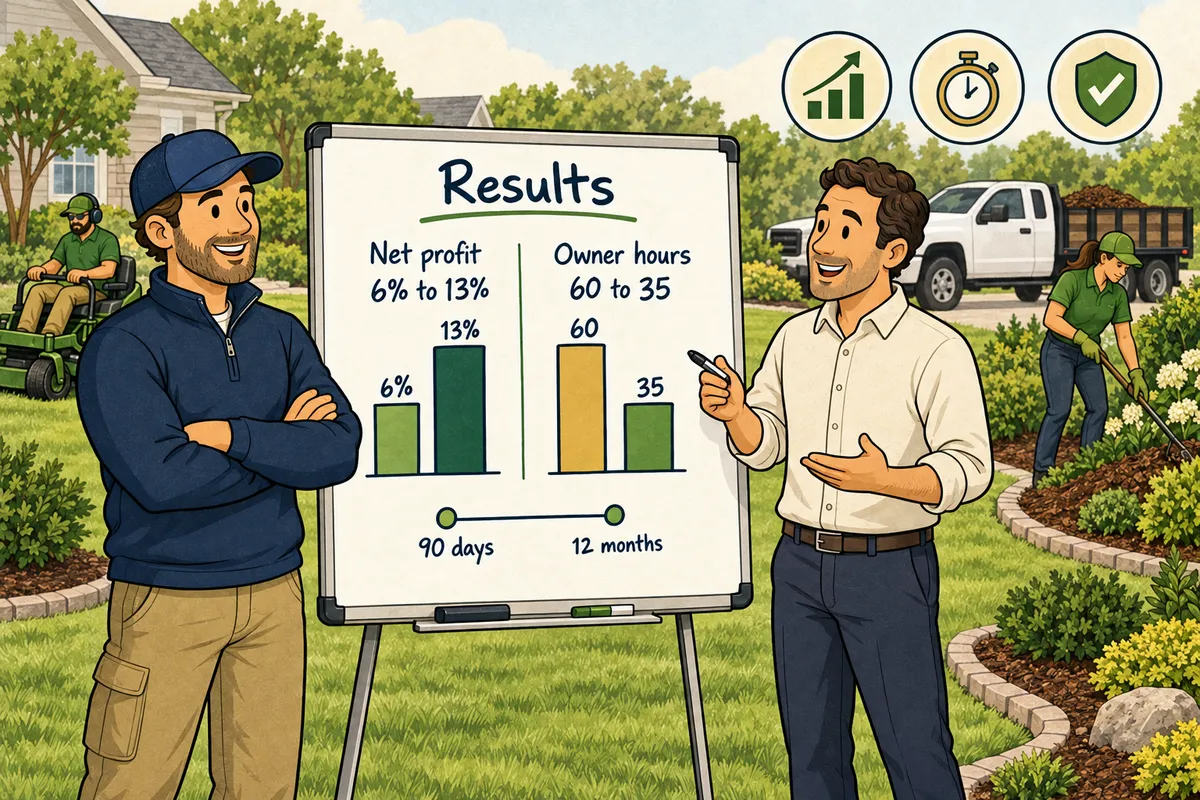
Landscaping business coaching works when three things are true: the company is big enough to systemize (roughly $500K and up), the coach audits real numbers instead of selling motivation, and the owner does the homework. When those hold, typical verified results are a 5-to-10-point gain in net margin within a year and a 30-to-40 percent cut in owner field hours. When they do not hold, coaching is an expensive way to feel busy.
Updated September 30, 2026
What results look like when it works
Ignore revenue. Anyone can add revenue by underpricing. The results that matter to a landscaping owner are margin, hours, and whether the business is worth anything without them in it.
| Measure | Common starting point | Typical 12-month result |
|---|---|---|
| Net profit margin | 4 to 8 percent | 12 to 18 percent |
| Owner hours in the field or on the phone per week | 40 to 60 | 15 to 25 |
| Labor cost as a share of revenue | 38 to 45 percent | 30 to 35 percent |
| Decisions escalated to the owner per week | 30 or more | Under 10 |
| Business value (EBITDA multiple) | Little to none; owner-dependent | 3 to 5 times EBITDA once systems transfer |
Across the 150-plus companies the network has worked with, the average is about a 40 percent reduction in owner involvement and 25-plus hours a week reclaimed, verified against tax returns and P&Ls rather than surveys. Your numbers will differ. The pattern does not.
When each result shows up
The most common reason owners say coaching "did not work" is that they judged it at day 45. Results arrive in a fixed order because each depends on the one before it.
- Days 1 to 30: clarity, not money. The audit tells you where the leaks are. Nothing on the P&L moves yet. Owners who quit here paid for a diagnosis and skipped the treatment.
- Days 30 to 90: margin. Repricing hits new quotes immediately, and labor controls tighten the worst job types. This is where the first two to four points of net show up. Read how labor overruns get diagnosed to see what changes.
- Months 3 to 6: fewer calls. Roles, decision boundaries, and SOPs settle in. The phone rings less. Your foreman starts making calls you used to make.
- Months 6 to 12: owner hours and business value. Only once systems have survived a full busy season can you step out of the field for real. This is the result you actually wanted, and it is the last one to arrive.
A coach who promises everything by day 60 has either never watched a crew through July or is counting on you not tracking it.
How to verify results without trusting anyone
Do not take results from the coach's dashboard, and do not take them from your own gut. Use three sources you control.
- Your P&L, same month year over year. Net margin percentage, not dollars, so growth does not hide a leak. Your bookkeeper produces this; the coach does not touch it.
- A time log you keep yourself. Two weeks at the start, two weeks at day 90, two weeks at day 180. Count hours in the field, hours on the phone with crews, and hours on planning. See how to measure owner freedom for the exact categories.
- The test day off. Take one full weekday off at the start and one every quarter. Write down every call. The count is the score.
If the coach resists any of these, that is your answer. A coach who is confident in the work wants you to measure it.
The three reasons coaching fails
Wrong stage. Under $300K there is not enough business to build systems on. The owner is the business, and the fix is to grow first or price better on your own.
Wrong coach. Never ran crews, sells revenue growth, no verified numbers, no real audit. The vetting questions catch this before you pay.
Wrong owner. This is the one nobody likes to hear. The plan requires you to reprice, to let a foreman make mistakes, to stop running to every fire. If you will not do that, the best coach in the country cannot help. "I will just do it myself" ends more coaching engagements than any other sentence.
The ROI math on one company
| Line | Before | After |
|---|---|---|
| Net margin | 6 percent ($90,000) | 13 percent ($195,000) |
| Owner field hours per week | 50 | 20 |
| Coaching cost | — | $20,000 |
| Net profit gain after fee | — | $85,000 |
| Return on fee | — | 4.25 to 1 |
| Business value at 4x EBITDA | Roughly $0 (buyer would be buying the owner) | Roughly $780,000 |
The last row is the one owners underestimate. The profit gain pays for the coaching four times over in year one. The transferable business is worth ten times that, and it did not exist before the systems did. See why most owners build a job instead of a business.
Frequently asked questions
How long does it take to see results from a landscaping business coach?
The first margin gains typically show on the P&L within 60 to 90 days from repricing and labor controls. Fewer owner interruptions follow at three to six months. A real reduction in owner field hours takes six to twelve months because it depends on people and systems surviving a busy season.
What is a realistic ROI on business coaching?
A structured program on a $1M to $2M company should return three to five times its fee in first-year net profit, verified on your own books. Programs that cannot point to the specific leaks funding that return in the initial audit rarely deliver it.
Why did coaching not work for my landscaping business?
Almost always one of three things: the company was too small to systemize, the coach sold motivation instead of auditing numbers, or the owner did not implement. Diagnose which before trying again, because the fix is different for each.
Explore 7 Figure Landscape Network's business systems programs or book a strategy call to discuss the operating problem you want to work on. Learn about Jim Wertz and the network.
For the broader strategy process, use Landscaping Business Strategic Plan: A One-Page Framework as your starting guide, then return to the specific issue covered here.
