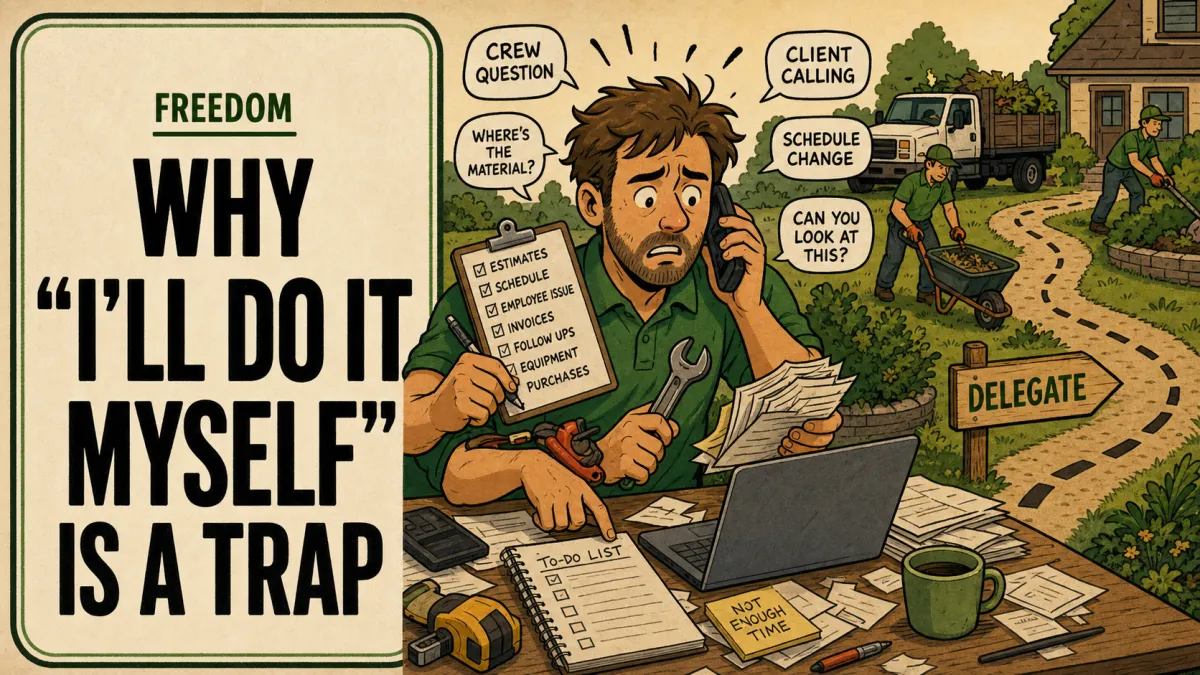
When Doing Landscaping Tasks Yourself Becomes a Bottleneck
Business owners struggle to delegate because doing the task yourself really is faster the first time, and the cost of never handing it off is spread across hundreds of small repeats you never add up. In a landscaping company, "I'll just do it myself" makes sense in an emergency or when specialist expertise is needed. It becomes a bottleneck when the same repeatable work keeps coming back to you because training never happens. Run the payback math once and the choice usually gets easy.
Updated October 9, 2026
Why owners struggle to delegate
Most owners do not hold on to work because they are control freaks. They hold on because each individual decision to keep a task looks reasonable. The usual reasons sound like this:
"It's faster if I do it." True for this one occurrence.
"Nobody does it as well as I do." Often true at first, because nobody has been shown the standard.
"I can't afford to pay someone for that." Usually said without checking what your own hours cost the company.
"I tried once and it went wrong." The handoff probably had no standard, no practice, and no review.
"This is just who I am." Plenty of owners built the company by outworking everyone, and handing off work feels like giving up the thing that made them successful.
None of these reasons is stupid. They just all measure the wrong thing. They compare one occurrence of the task, when the real comparison is the next two years of it.
Speed now versus capacity later
Every time you do a repeatable task yourself, you buy speed today and pay with capacity tomorrow. The task gets done in 20 minutes. Next week it comes back, and the week after. Your calendar fills with small jobs that someone else could do, and the work only you can do, like pricing strategy, hiring, and key client relationships, gets pushed to Sunday night.
Being needed for routine work also trains your team to bring routine work to you. That is the quiet part of the trap. How hands-on habits turn into an operational bottleneck covers what that looks like in the field.
The training-time payback calculation
The math is simple. Add up the hours to teach the task and review the first attempts. Divide by the hours per week the handoff gives back. That is your payback in weeks.
Example: a routine weekly preparation task takes you 45 minutes. Over twelve weeks that is nine hours. If writing instructions and coaching a replacement takes three hours up front, the handoff pays back in about four weeks, as long as the new process produces reliable results. Include review time, because training rarely removes every future involvement.
| Task | Owner hours per week | Training plus review hours | Payback | Hours back per season |
|---|---|---|---|---|
| Morning material and load prep | 2.5 | 6 | About 2.5 weeks | 69 |
| Customer schedule confirmations | 1.5 | 4 | About 3 weeks | 41 |
| Timesheet review and invoice prep | 2 | 8 | 4 weeks | 52 |
| Total | 6 | 18 | 162 |
"Hours back per season" is the weekly hours times 30 weeks, minus the training and review time. In this example, 18 hours of effort returns about 162 hours. That is four full 40-hour weeks. Use your own numbers, and if a task only comes up twice a year, the math may tell you to keep it.
To find which tasks are actually eating your week before you run this, start with an owner time audit.
The first three tasks to hand off
Pick tasks that repeat often, have a clear finish standard, carry low risk, and have a capable person ready to learn them. For most landscaping owners, these three fit:
Material and load prep. A written load list per job type lets a crew leader or yard person stage trucks the night before.
Customer schedule confirmations. The office calls or texts customers about service days and weather delays from a short script.
Timesheet and invoice prep. The office matches timesheets to completed jobs and drafts invoices. You approve the batch instead of building it.
For each one, show the standard, let the person practice while you watch, then review their first few rounds. Expect the first attempts to be slower and a little different from how you would do it. Hold them to the result and let the method vary. Setting delegation standards instead of an 80 percent rule explains how to draw that line. For the handoff itself, document the outcome, authority, and review point using the delegation handoff template.
Delegation is no excuse to lower critical standards. Keep required safety, contractual, and technical checks intact, and involve qualified people where the task needs them.
Protect the time you get back
Reserve the recovered time for a specific purpose before you hand anything off. If those hours fill up with another routine task, the company has not gained any owner capacity. You just swapped one errand for another.
Decide now what the six hours a week are for: pricing reviews, developing a crew leader, or planning next season. Choosing owner priorities when everything feels urgent helps you pick.
Frequently asked questions
When should I still do a task myself?
When the work requires your current expertise or authority, during a genuine exception, or when transferring it is not yet safe or economical. Review repeated exceptions so they do not become permanent habits.
Why does doing it myself feel faster?
Because it is faster for that single occurrence. The real comparison includes how often the task repeats and whether a trained replacement can handle future occurrences reliably. Over a season, a task that repeats weekly almost always pays back the training time.
What is a good first task to hand off?
Choose a recurring task with a clear result, low risk, and a person who can learn it. Material and load prep is a common first choice. Demonstrate the standard and review the initial attempts.
Explore 7 Figure Landscape Network's business systems programs or book a strategy call to discuss the operating problem you want to work on. Learn about Jim Wertz and the network.
For the broader owner independence and continuity process, use How to Build a Landscaping Business That Runs Without You as your starting guide, then return to the specific issue covered here.
