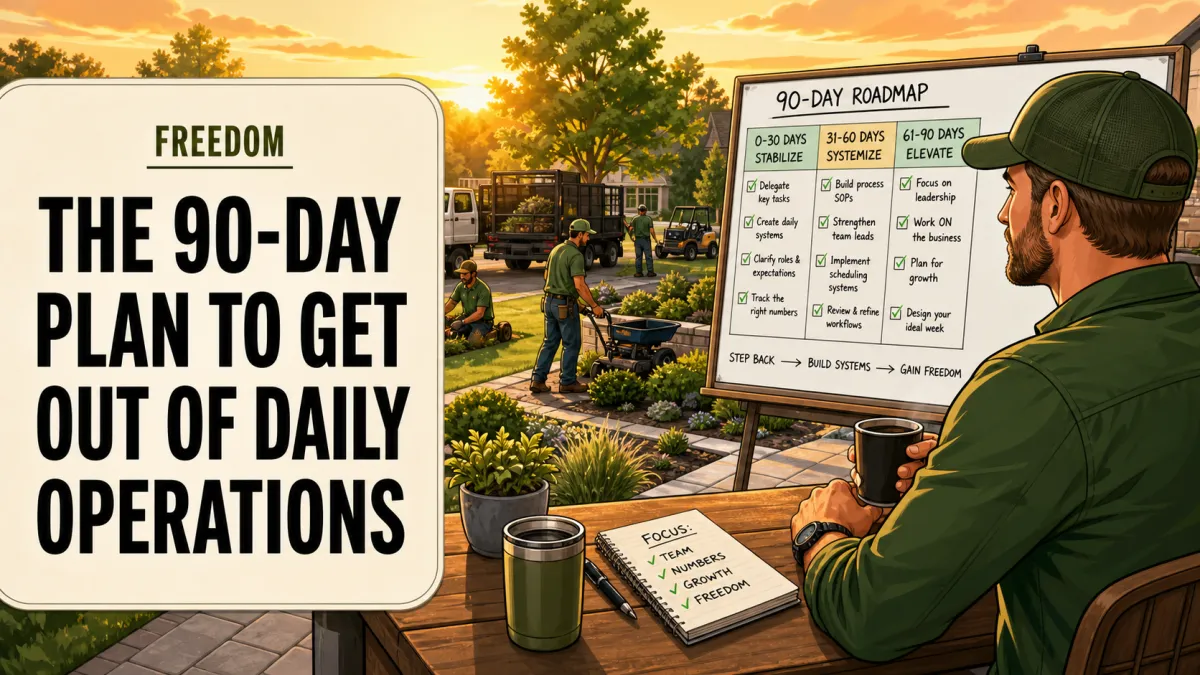
A 90-Day Plan to Reduce Daily Landscaping Owner Involvement
To step back from day-to-day operations, give yourself 90 days and a fixed sequence: two weeks measuring where your time goes, four weeks defining roles and writing procedures, four weeks handing the work off, and three weeks testing it with planned days away. Track progress weekly so you judge it by evidence. Some handoffs will finish inside 90 days and some will not, and the tracking shows you which.
Updated October 9, 2026
Before day one: pick the season and the target
Do not start this in April. Changing how work flows during peak season means nobody has time to train or review. Late summer, fall, or winter gives you room. The pace will still depend on your team's capability, how complex your services are, and how much of the operation currently lives in your head.
Pick three specific handoffs as the target, not a vague goal like "work less." Good first candidates are morning dispatch, job closeout and billing, and routine customer calls. A measurable outcome looks like this: a complete closeout and billing handoff for one installation crew that works without daily owner prompting by week 10.
Weeks 1 to 2: measure where your time goes
Log every task, call, and interruption for ten working days. Note what it was, how long it took, and whether anyone else could have handled it with the right information or authority. The detailed method for this step is in the landscaping owner time audit.
Milestone for week 2: a baseline. You should know your weekly operational hours, average calls per day, and the five recurring tasks that eat the most time. Choose your three handoffs from that list.
Weeks 3 to 6: define roles and write the procedures
Each handoff needs a clear owner before it needs a procedure. If nobody's job description includes dispatch, dispatch will drift back to you. Defining roles before delegating covers how to assign them.
Then write one procedure per handoff. Keep each to a page or two. Every procedure should include:
- The outcome: what done looks like, in one sentence.
- The steps, in the order they happen.
- The standard: how anyone can tell the work was done right.
- Decision limits: what the person can approve and the dollar ceiling.
- Who to ask when something falls outside the procedure, and it should not be you by default.
- A review point: when you will check results together.
Milestone for week 6: three procedures drafted, walked through with the people who will use them, and corrected.
Weeks 7 to 10: hand off the work
Hand off one or two procedures in weeks 7 and 8, and the third in weeks 9 and 10. Demonstrate the task, watch them do it, then let them run it with a scheduled review. Document the outcome, authority, and review point using the delegation handoff template.
The biggest risk here is you. The first time the work comes back at 80 percent of how you would do it, the urge to take it back is strong. Correct the procedure or the training instead. Count every time you step in; that number is your main measure for these four weeks.
If something keeps failing, check for missing resources, unclear authority, or a skipped step before blaming the person.
Weeks 11 to 13: test days and the 90-day review
Run a full day away in week 11 with an interruption log, fix the top items in week 12, and run a second test day in week 13. The setup and rules for those days are in how to run a test day off.
Finish with a 90-day review. Compare operational hours and calls per day against your week 2 baseline. For each handoff, decide one of three things: it is done, it needs another 30 days, or it needs a different owner. Then pick the next three handoffs and start again. If you want outside help running the next round, decide first whether you need a business coach or a consultant.
Track the plan every week
Put this table on the wall or in a shared sheet and update it every Friday. The targets are examples; set yours from your own baseline.
| Week | Milestone | What to measure | Example target |
|---|---|---|---|
| 1 to 2 | Time and interruption log | Operational hours, calls per day | Baseline recorded |
| 3 | Three handoffs chosen, owners named | Hours per week those tasks take | Owners agree |
| 4 to 6 | Procedures written and walked through | Procedures finished | 3 of 3 |
| 7 to 8 | First handoffs live | Times you stepped in | 2 or fewer per week |
| 9 to 10 | Third handoff live | Times you stepped in | 2 or fewer per week |
| 11 | First test day | Log items that needed you | Logged and sorted |
| 12 | Fix week | Top fixes closed | Top 3 done |
| 13 | Second test day and review | Hours and calls vs. baseline | Clear drop in both |
For the full process of building a company that runs without you, place this plan within the broader owner-independence plan.
Frequently asked questions
Can a landscaping business become owner-independent in 90 days?
Some handoffs can be finished in that window, but full independence usually takes several rounds. Use the 90 days to build and test three specific capabilities, then run the next round on the gaps that remain.
What should happen in the first thirty days?
Log your time for two weeks, pick three handoffs from the results, name an owner for each, and start writing the procedures. That baseline is what lets later test days show what actually changed.
What if the ninety-day plan is not finished?
Find out why: scope, skill, resources, authority, or inconsistent follow-through. Keep the parts that work and adjust the next 30 days instead of declaring success or failure from the calendar alone.
Explore 7 Figure Landscape Network's business systems programs or book a strategy call to discuss the operating problem you want to work on. Learn about Jim Wertz and the network.
For the broader owner independence and continuity process, use How to Build a Landscaping Business That Runs Without You as your starting guide, then return to the specific issue covered here.
