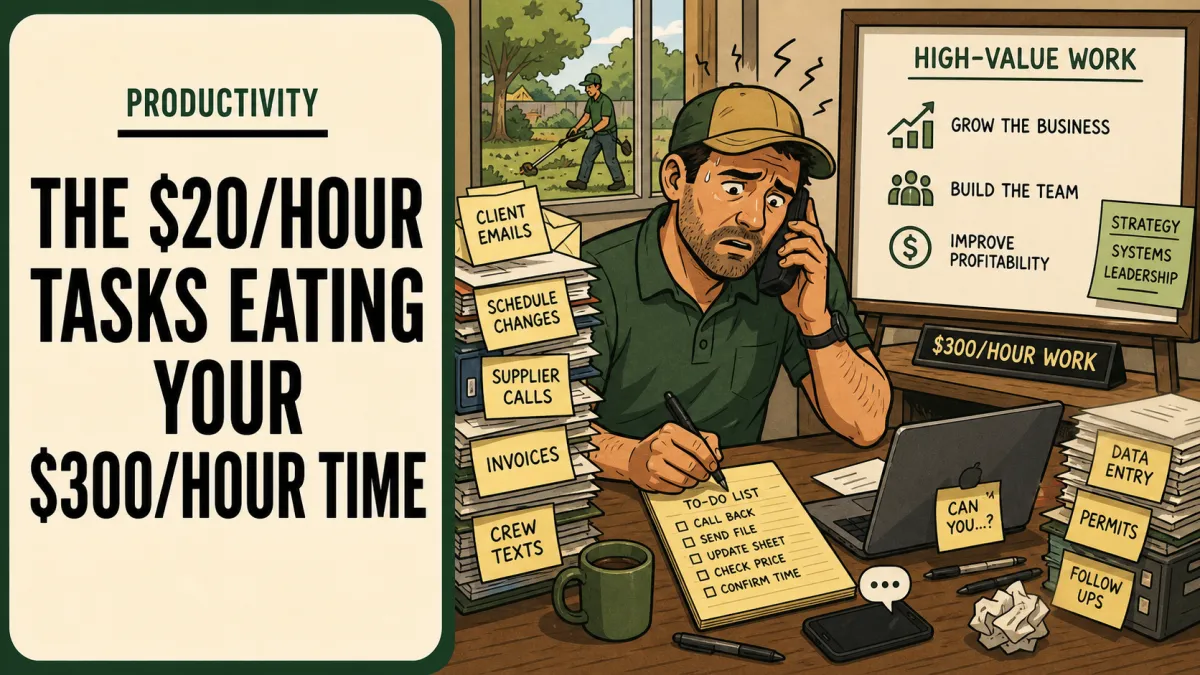
Landscaping Owner Time Audit: Decide What to Delegate
A business owner time audit is two weeks of honest logging that shows where your hours actually go, followed by a sort into delegate, automate, or keep. In a landscaping company it usually shows that most of the owner's week goes to work someone else could do at a fraction of the cost. The audit tells you what to hand off first and what the freed time should produce.
Updated October 9, 2026
Why two weeks, and when to run it
One week misses too much. Payroll may run every other week, a rain day scrambles the schedule, and the Monday after a storm looks nothing like a normal Thursday. Two weeks gives you a fair sample.
Pick two ordinary in-season weeks. Avoid the week of a big install or a vacation, because you want to see the job you actually do, not the exception. Log as you go, at least every two hours. Reconstructing a day from memory at 9 p.m. always undercounts the small stuff, and the small stuff is usually the problem.
Set up categories and the log
Keep the categories few enough that you'll actually use them:
Field work: running a crew, operating equipment, finishing a job yourself.
Crew support: calls, texts, and on-site questions.
Sales and estimating: site visits, pricing, follow-up.
Admin and billing: invoices, payroll prep, email, scheduling.
Errands: parts runs, material pickups, the dealer.
People and planning: hiring, developing leaders, reviewing numbers.
Each log entry needs five things: start time, task, category, minutes, and one honest answer to "could a trained person do this?" A notebook works. So does a spreadsheet with those five columns.
Value each task at replacement cost
Next to each category, write what it would cost per hour to have a competent person do it, including payroll taxes and overhead. That's the replacement cost. Some of your hours are $20 to $30 work. Some, like pricing a big job correctly or hiring the right crew leader, are worth far more, because the result pays back for years.
| Task | Hours (2 weeks) | Replacement cost per hour | Bucket |
|---|---|---|---|
| Running a crew in the field | 36 | $28 | Delegate |
| Answering crew questions | 16 | $30 | Delegate |
| Admin and email | 12 | $24 | Automate or delegate |
| Invoicing and billing prep | 10 | $26 | Automate or delegate |
| Parts and material runs | 9 | $22 | Delegate |
| Customer calls and complaints | 9 | $26 | Delegate, keep escalations |
| Scheduling and routing | 8 | $28 | Delegate |
| Estimating and sales | 18 | Owner-level for now | Keep |
| Hiring and leader development | 4 | Owner-level | Keep |
| Numbers and planning | 2 | Owner-level | Keep |
In this example, 100 of 124 hours went to work with a replacement cost of $30 an hour or less. Planning got two hours in two weeks. That's the pattern the audit exists to expose.
The $300 in this article's web address is shorthand, not a pay rate or a promise. Handing off an hour of invoicing creates capacity. It only becomes profit if the freed time goes somewhere that produces it: faster collections, more estimates sent, a better-priced job. To separate cash cost from capacity for the work you do yourself, use the owner-labor costing guide.
Sort into delegate, automate, or keep
Every task lands in one of three buckets.
Delegate: repeatable work with a clear standard, manageable risk, and someone capable of learning it. Field work, crew questions, and errands usually start here.
Automate: work a tool can do with light oversight, such as recurring invoices, payment reminders, and route sheets built from the schedule.
Keep: decisions that need your authority today, like pricing large jobs, hiring leaders, and setting direction. "Keep" means for now. Most of these move later.
Expect resistance, mostly from yourself. If you catch yourself saying "it's faster if I do it," read why doing it yourself becomes a bottleneck before you move a task back to the keep pile.
Turn the audit into handoffs
Pick the biggest low-risk block in the delegate bucket. In the example above, that's crew questions or parts runs, not estimating.
Price the real cost of the handoff: wages, training time, supervision, any software.
Decide in writing what the freed hours will produce, such as four more estimates a week or one planning block every Monday.
Check after 30 days whether the task is getting done to standard and whether you actually used the time as planned.
Re-run the audit each quarter. The percentages should move.
If admin and billing dominate the log, look at whether hands-on has turned into trapped and evaluate when an office administrator is justified. For a longer runway, the 90-day plan to reduce daily owner involvement sequences several handoffs.
Frequently asked questions
How do I calculate the value of delegating an owner task?
Compare the full cost and quality of the handoff with what you do with the freed capacity. Replacement cost tells you what the task is worth to hand off. Whether it pays depends on where the released hours go, so never assume every hour becomes billable revenue.
Which tasks should a landscape owner delegate first?
Start with repeatable work that has a clear standard, low risk, and a capable person ready to learn it. Parts runs, routine crew questions, and billing prep are common first moves. Keep oversight and decision limits in place while the new owner of the task proves it out.
Does reducing owner hours always increase profit?
No. It may improve capacity or give you your evenings back without changing profit right away. Decide what outcome you want from the freed time, measure it, and count the real cost of the handoff.
Explore 7 Figure Landscape Network's business systems programs or book a strategy call to discuss the operating problem you want to work on. Learn about Jim Wertz and the network.
For the broader owner time and office support process, use When to Hire an Office Administrator for Your Landscaping Business as your starting guide, then return to the specific issue covered here.
