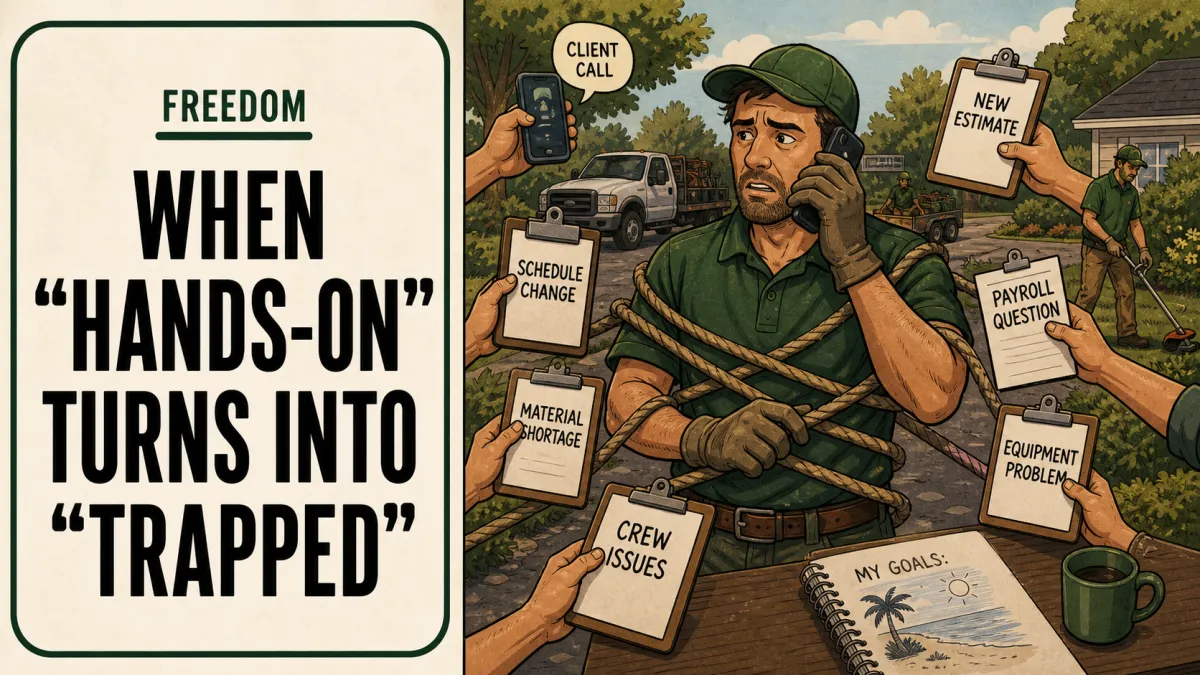
Hands-On Landscaping Owner or Operational Bottleneck? How to Tell
The clearest signs you are the bottleneck in your business are crews standing idle until you show up, quotes sitting for days because only you can price them, and routine work that stops when you are on another site. Hands-on work becomes a trap when the business requires you for everyday delivery and no qualified backup can take over. Field work can still be valuable for training, inspection, or work you choose to do. The difference is whether your involvement is planned and covered, or unavoidable every day.
Updated October 9, 2026
When being hands-on helps
Being in the field is the right call at certain stages. In the first year or two, when you are the best installer and the business cannot afford another leader, your hands on the job are the business. Nobody should feel guilty about that.
It also helps later, when it has a purpose:
Training. You work beside a new crew leader for a week to show the standard, then step away.
Planned inspection. You walk a set number of jobs each week to check quality against a written standard.
New services. You run the first few hardscape or irrigation jobs while you work out production rates and the method.
A role you choose. Some owners like running the design or sales side. That is fine if it is a decision and someone else covers the rest.
When hands-on turns into trapped
The shift is quiet. The company grows to three or four crews, but the decisions, the final walkthroughs, and the pricing still run through you. You are still working as hard as ever, and now three crews are waiting on one person instead of one.
The test is simple. If you spent next Tuesday in the office with the phone off, would work keep moving to standard? If the honest answer is no, your hands-on habit has become a constraint. Why "I'll just do it myself" keeps tasks on your plate covers the habit that usually causes it.
Signs you are the bottleneck
Look for patterns over a few weeks. One bad day proves nothing.
| Sign | What you see | What healthy looks like |
|---|---|---|
| Crews idle waiting | Crew parked at the site until you arrive to lay out the job | Crew leader starts from a written plan and photos |
| Quotes delayed | Estimate requests sit three to seven days until your weekend | Routine quotes go out in 48 hours using set pricing |
| Every walkthrough is yours | No job closes until you inspect it | Crew leader closes out against a checklist; you spot-check |
| Phone never stops | Twenty or more calls a day about routine choices | Calls are about exceptions only |
| Work slows when you are on one site | Other crews make less progress the days you are tied up | Output is about the same wherever you are |
| No backup | Nobody else can price, inspect, or approve | At least one trained person can cover each |
Two or more of these showing up every week is a strong sign the business has outgrown your current role.
What the waiting costs
The cost shows up in crew time and in lost work. Example: a three-person crew waits 45 minutes for you to arrive and mark beds. That is more than two person-hours of paid time with nothing installed. If it happens three times a week, it adds up fast, and the late quotes cost you jobs that went to whoever answered first.
For the full dollar calculation, including loaded labor rates and how to total it across a season, use the crew waiting-time cost calculation. Run it once. Most owners stop arguing with themselves after they see the number.
Step back without lowering quality
You do not have to leave the field all at once. Hand off one responsibility at a time, in this order:
List the field tasks only you currently do, and why. Identify gaps in skill, equipment authorization, documentation, or staffing instead of assuming everything can be handed off right away.
Choose one repeatable task with a clear standard, a trainable person, and manageable risk. Final walkthroughs and job layout are good first candidates.
Define the outcome, show the method, supervise practice, and confirm competence before the person works alone.
Make acceptance criteria visible through a jobsite closeout checklist.
Schedule your field time around a purpose, such as coaching or a planned inspection, and review whether work holds to standard between visits.
Here is how that works. An owner handles every final walkthrough because the acceptance criteria are not written down. A photo-supported closeout checklist plus a few supervised inspections can build a qualified crew leader's ability to check the work. That transfers one specific responsibility without lowering the promised result.
Do not accept an arbitrary percentage of quality in exchange for freedom. Safety, specifications, and customer commitments stay requirements during training and after. Setting quality standards without micromanaging shows how to separate the must-haves from your personal preferences. Document the outcome, authority, and review point using the delegation handoff template.
Frequently asked questions
Is it wrong for a landscaping owner to work in the field?
No. Field work can be a deliberate role or a useful training activity. The concern is whether routine operations stop without you and whether that fits your goals for the company.
What are the signs you are the bottleneck in your business?
Crews waiting for you to start or finish jobs, quotes that sit until you have time, every decision coming to your phone, and work slowing down whenever you are tied up somewhere else. If two or more happen every week, the business has outgrown your current role.
How do I step back without lowering quality?
Define acceptance criteria, teach them, and verify results. Allow differences in method, but not failures to meet essential requirements. Spot-check after the handoff instead of inspecting every job yourself.
Explore 7 Figure Landscape Network's business systems programs or book a strategy call to discuss the operating problem you want to work on. Learn about Jim Wertz and the network.
For the broader owner independence and continuity process, use How to Build a Landscaping Business That Runs Without You as your starting guide, then return to the specific issue covered here.
