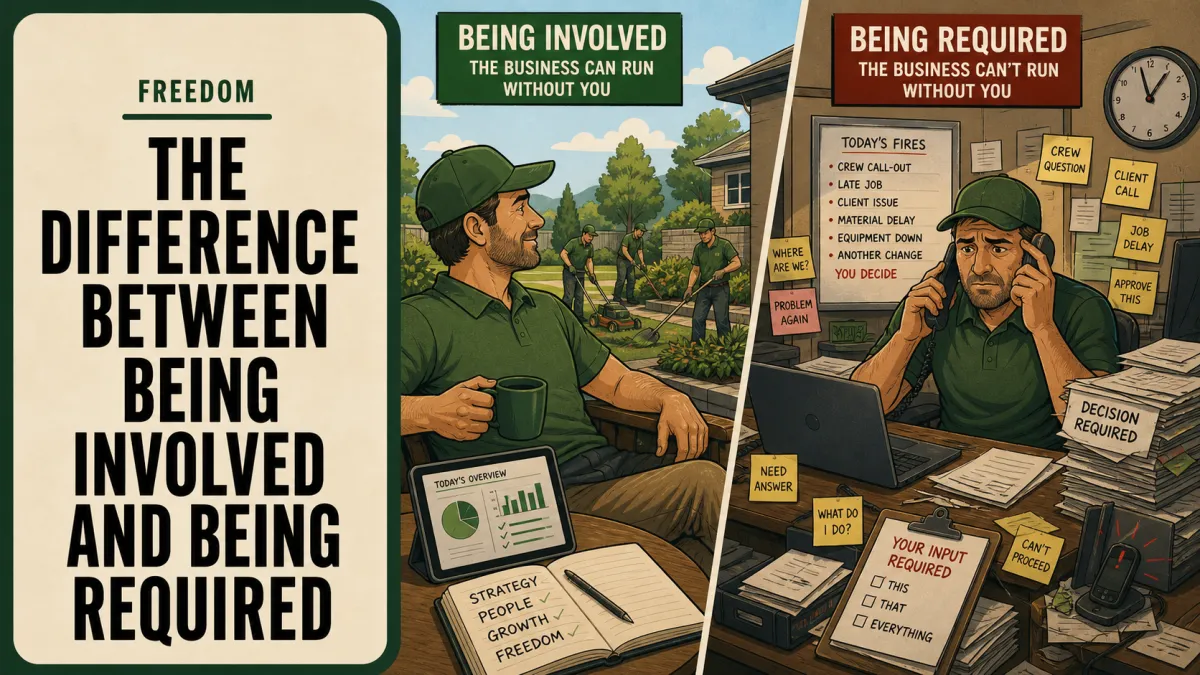
Owner Involvement vs. Owner Dependence in Landscaping
Owner dependence is when routine work in your landscaping company stops, stalls, or waits until you personally step in. An involved owner contributes by choice inside a system that would keep running without them. A required owner is the only route for everyday decisions, information, and problem-solving. The test is simple: if you disappeared for two weeks, what would stop?
Updated October 9, 2026
What owner dependence means
Being involved is a decision. You coach a new crew leader on site or review the weekly numbers. Skip either and the work still gets done.
Being required is different. Crews call you because nobody else knows the scope. Estimates sit in your truck until you price them. Payroll waits for your login. None of that is a choice. The business has quietly routed everyday work through one person, and that person is you.
Working harder does not fix this, because the bottleneck is the route itself. If that sounds familiar, you don't own a business, you own a high-stress job. There are three distinct kinds of dependence (knowledge, decisions, and relationships), and the three types of owner dependence covers each one separately.
Self-check: 10 signs your business requires you
Score one point for every row where the right-hand column describes your last two weeks.
| Area | Involved (your choice) | Required (it stops without you) |
|---|---|---|
| Morning dispatch | You glance at the board | Crews wait for you to assign work |
| Job scope | You spot-check a few job files | The scope only exists in your head |
| Estimates | You review large bids | No bid goes out unless you price it |
| Customer complaints | You hear about them weekly | Every complaint gets escalated to your cell |
| Equipment breakdowns | You approve big repairs | Crews stop and call you for every failure |
| Purchasing | You set spending limits | Nobody can buy materials without asking |
| Hiring | You do final interviews | You run every step from ad to first day |
| Payroll and invoicing | You review the reports | You are the only one who can run them |
| Quality | You inspect a sample of jobs | Work is only right when you redo it |
| Time off | You take a week and check in once | You have not had a real week off in years |
A score of 0 to 2 means you are mostly involved. Three to six means specific functions depend on you and can be fixed one at a time. Seven or more means the company is built around you.
Why buyers and lenders discount owner-dependent companies
A buyer is paying for future earnings. If those earnings leave with the owner, the buyer prices in that risk.
That usually shows up in a few ways: a lower multiple, more of the price tied to an earnout, or a requirement that you stay on for a year or two to transfer relationships. Example: two companies each produce $300K in owner-adjusted earnings. One has a general manager and crew leaders who handle customers. The other runs through the owner's phone. A buyer may offer a meaningfully higher multiple for the first. Building a transferable landscaping business walks through what a buyer looks for.
Lenders look at the same thing from a different angle. If repayment depends on one person staying healthy and present, that is key-person risk, and it can affect terms or insurance requirements. Confirm the specifics with your banker, accountant, and insurance agent. For the operating side of that risk, see how to reduce key-person risk.
Sort your involvement task by task
Independence is not all-or-nothing, and it is not tied to a revenue band. Some owners keep sales or design on purpose. The goal is to know which involvement is chosen and which is forced.
List every recurring thing you did last week. Tag each one as planned oversight, specialist work, or avoidable rescue.
For each item, write down what would have happened if you missed it. If the answer is "the crew would have waited," it is a dependency.
For each routine dependency, name what the team was missing: information, competence, authority, or resources. Assign a specific fix instead of asking people to "step up."
Document the outcome, authority, and review point using the delegation handoff template.
Pick the two dependencies that cost the most hours and fix those first. Leave the rest for next month.
Stay involved without being required
Handing work off does not mean going blind. Replace approvals with planned review points: job results, exception reports, and inspection photos keep you informed without anyone waiting on you.
Visiting a site to coach a new leader is intentional involvement. Visiting because nobody else can find the current scope is a dependency. The first may be worth keeping. The second calls for a better job record and a clear owner of that information. Capture completed work and unresolved issues in a structured end-of-day crew report so the information lives somewhere other than your memory.
For the full step-by-step process of removing yourself from daily operations, use how to build a landscaping business that runs without you.
Frequently asked questions
Can I stay involved while reducing owner dependence?
Yes. Keep the oversight, coaching, or specialist work you choose to do, and build qualified coverage for everything routine. The difference is that your involvement becomes optional rather than the only way work moves forward.
How do I identify avoidable owner involvement?
Ask two questions about each visit, call, or decision: was it planned, and did a capable employee have the information and authority to handle it? If it was unplanned and the answer to the second question is no, it is avoidable. The fix is usually a missing record or decision rule.
Does delegation mean losing visibility?
No. Agreed reporting, inspection evidence, and scheduled review points keep you informed without requiring you to approve every routine action.
Explore 7 Figure Landscape Network's business systems programs or book a strategy call to discuss the operating problem you want to work on. Learn about Jim Wertz and the network.
For the broader owner independence and continuity process, use How to Build a Landscaping Business That Runs Without You as your starting guide, then return to the specific issue covered here.
