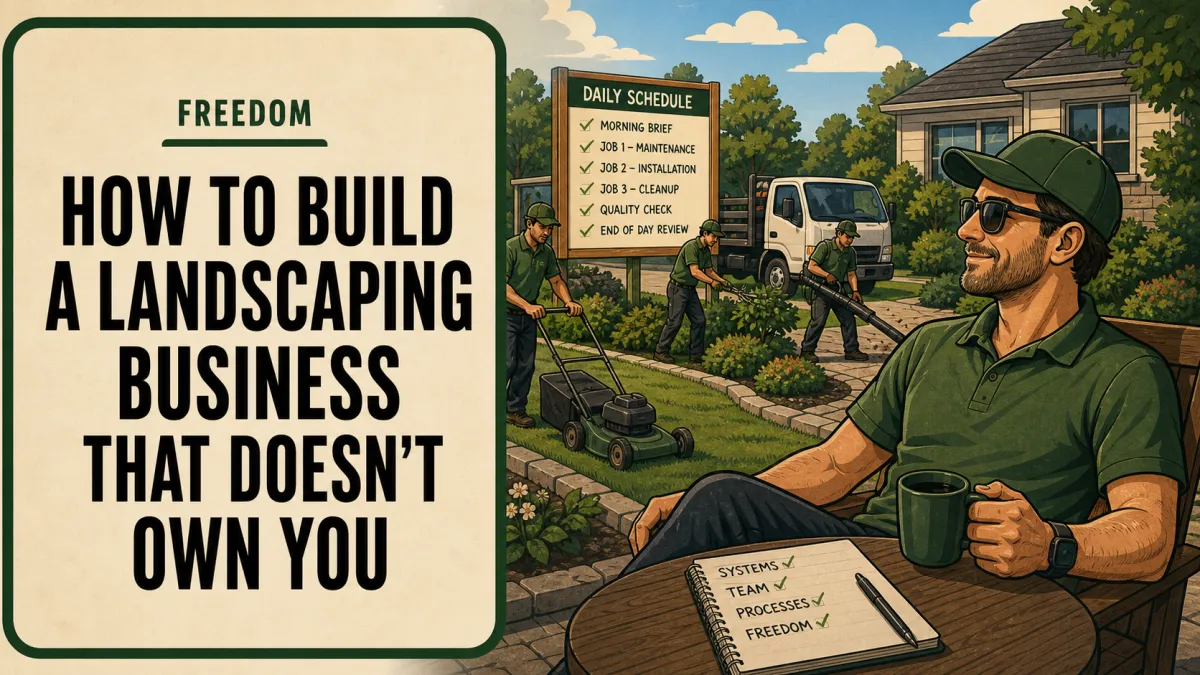
How to Build a Landscaping Business That Runs Without You
A landscaping business can operate with less daily owner involvement when critical knowledge, relationships, and decisions are shared through clear processes. Start with the tasks that stop when you are unavailable, assign trained backups, and test the arrangement in manageable steps.
Updated September 14, 2026
Identify the three kinds of owner dependence
| Dependence | Warning sign | First transfer |
|---|---|---|
| Knowledge | Only you know how to estimate or finish the work | Document the inputs, standard, and worked example |
| Relationships | Customers or suppliers will only deal with you | Introduce a named colleague and shared communication record |
| Decisions | Routine exceptions wait for your approval | Define limits and escalation rules |
For one week, keep a record of interruptions: who called, what they needed, and what would have let them proceed safely. Repeated questions show where documentation or authority is missing. They can also reveal understaffing or missing skills; do not assume paperwork fixes every constraint.
Build one reliable handoff at a time
Pick a recurring process such as site closeout, appointment coordination, or material ordering. Name an owner, demonstrate a successful result, and agree on exceptions. Use the delegation template to make the handoff concrete.
For field work, a closeout checklist gives the crew a visible standard. For office work, measure the workload before deciding whether an administrator is the next useful hire.
Use a staged transition rather than a deadline promise
- Document: record the recurring decisions and job information the team needs.
- Demonstrate: work through normal cases and exceptions with a backup.
- Test: step away for a limited period with an emergency route available.
- Review: check customer issues, production, job costs, and avoidable interruptions.
- Extend: increase independence when the evidence supports it.
A 90-day period can be a useful planning window, but it does not guarantee the company will become independent in three months. Complex work, weak staffing, or unfinished systems may require a longer transition.
Protect continuity as well as your calendar
Document who can access essential records, reach customers, coordinate payroll, and contact key suppliers during an unexpected absence. Use controlled access rather than sharing personal passwords. A backup arrangement should function if the owner cannot provide instructions.
The Ready.gov emergency planning resources offer a broader starting point for preparing for disruption. Adapt the plan to the company's actual roles and obligations.
Measure whether the business is becoming less dependent
Track avoidable owner calls, unresolved decisions, completed handoffs, customer complaints, and job results during test periods. A quiet phone is not success if problems are simply being hidden. The goal is dependable execution with visible exceptions.
Keep reviewing financial performance through the job-costing process. Owner independence is valuable when quality, service, and business economics remain sound.
Frequently asked questions
How can I tell whether my landscaping business is owner-dependent?
Look for work that stops when you are absent: estimating, customer decisions, supplier orders, or routine field approvals. Record the dependency and identify whether the missing piece is knowledge, skill, authority, or access.
Can I step back before hiring an operations manager?
Sometimes. A trained crew leader, clear decision rules, and reliable office support may handle defined responsibilities. Choose staffing based on the workload and required competence rather than assuming one job title solves everything.
What should I check after a test day away?
Review job progress, customer communication, quality, costs, and decisions that waited. Ask the team where information or authority was missing, then correct those gaps before extending the test.
Explore our business systems programs, read about Jim Wertz, or book a strategy call to discuss your transition.
More guides: Owner independence and continuity
Choose the specific issue you want to work on next.
- Three Types of Owner Dependence in a Landscaping Business
- Landscaping Business Continuity: Reduce Single-Person Dependencies
- Measure Owner Freedom in a Landscaping Business
- When Doing Landscaping Tasks Yourself Becomes a Bottleneck
- Test Whether Your Landscaping Business Can Run Without You
- A 90-Day Plan to Reduce Daily Landscaping Owner Involvement
- How to Prepare Your Landscaping Business for an Owner Vacation
- Hands-On Landscaping Owner or Operational Bottleneck? How to Tell
- Owner Involvement vs. Owner Dependence in Landscaping
