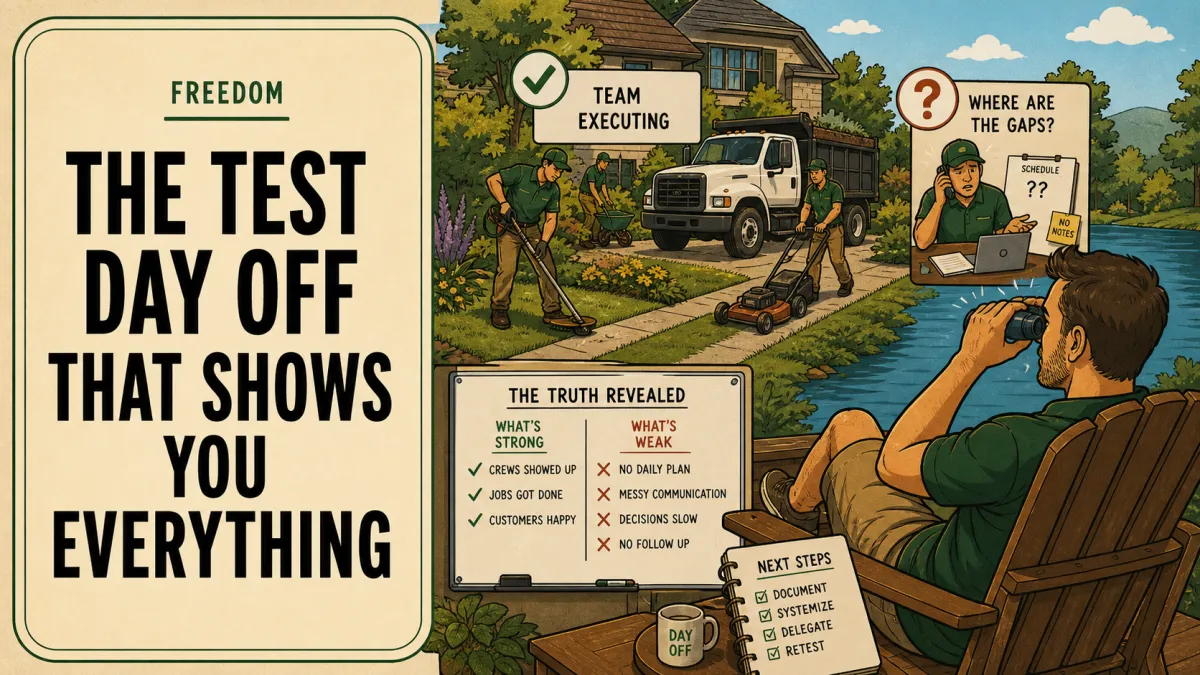
Test Whether Your Landscaping Business Can Run Without You
Can my business run without me? The fastest honest answer comes from one planned test day: pick a normal workday, name a coordinator, keep your phone off except for true emergencies, and have the team log every question that would have gone to you. That log becomes your fix list. One day is long enough to expose the gaps and short enough that customers never feel it.
Updated October 9, 2026
Pick the day and set the rules
Choose an ordinary in-season weekday. Skip Mondays, rain days, and the first day of a big install. You want a typical day, because typical days are where the hidden dependencies live.
The rules are short. You are not at the shop, not on a job site, and not answering texts. Your phone stays off except for true emergencies, and you define those in advance: an injury, serious property damage, police or legal trouble. Everything else goes to the coordinator or waits until tomorrow.
Tell the team the purpose ahead of time. You are looking for gaps under controlled conditions, not trying to catch anyone. Keep normal safeguards in place and do not create problems on purpose to see how people react.
Prep checklist for the week before
- Name the coordinator and tell every crew and the office who it is.
- Have next-day run sheets ready the night before, with addresses, scope, materials, and notes.
- Confirm the coordinator can open the schedule, customer contacts, and job records.
- Add the coordinator as an authorized buyer on supplier accounts, with a spending limit such as $500 per purchase.
- Review the breakdown plan: who to call, where the spare mower is, which rental shop to use.
- Write the emergency definition on one card and give it to the coordinator.
- Hand the coordinator the interruption log below.
- Set your email and voicemail to name the coordinator as the contact for the day.
- Plan to be somewhere other than the shop. Sitting in your truck down the street does not count.
Before you step away, check whether the backup can actually act with the business continuity handoff guide.
The interruption log
The coordinator records every question, decision, or problem that would normally have reached you, plus what they did about it. Here is an example of what a first test day often looks like.
| Time | Who | Question or problem | What was missing | What happened |
|---|---|---|---|---|
| 7:10 | Crew 2 leader | Which property first? | Information | Coordinator checked the run sheet |
| 9:40 | Install crew | Two pallets of pavers short | Authority on supplier account | Crew waited 90 minutes |
| 11:15 | Office | Customer wants $650 of extra bed edging | Authority to price | Told customer someone would call back |
| 1:30 | Crew 3 leader | Mower deck belt broke | Nothing | Used breakdown plan, swapped mowers |
| 3:45 | Office | Where do today's closeout reports go? | Information | Reports held until the next day |
Notice that the day "went fine" on the surface. Every crew worked. But one crew lost 90 minutes, an upsell sat unpriced, and billing slipped a day. A quiet phone can hide that kind of unresolved work, which is why the log matters more than how you felt about the day.
Turn the results into a fix list
Debrief with the coordinator within 24 hours, while the details are fresh. Sort every log entry by what was missing:
Information: the answer existed only in your head. Fix it with a better run sheet, job file, or written procedure.
Authority: the person knew what to do but was not allowed to do it. Write a decision rule with a dollar limit. Setting decision boundaries for crews walks through how.
Skill: they had the information and authority but could not do it yet. That is a training item.
Resources: a login, an account, a spare part, or a vehicle was missing.
Give each fix an owner and a date. If the log is long, start with the three items that cost the most crew time. Closeout problems like the 3:45 entry usually come down to having one reporting destination, which a structured end-of-day crew report solves. For a deeper look at why work stalls when you are gone, read diagnosing slowdowns during owner absence.
Repeat, then go longer
Run the test again two to four weeks later, after the fixes are in. Compare the two logs. You want fewer entries, and fewer entries that would have come to you. Once a test day produces only a handful of items and none of them stopped a crew, try two days in a row.
When two days run clean, you are ready to plan a real week off. That is a bigger exercise with client communication and a countdown, covered in how to prepare for an owner vacation.
Frequently asked questions
What should I tell the team before a test day off?
Explain the purpose, who coordinates the day, which decisions they own, and how to reach you for a true emergency. Confirm they can get to the schedule and job information. Make it clear that you are testing the system and the people are helping you find its gaps.
Should I answer calls during the test?
Only for the emergencies you defined in advance. Routine questions go to the coordinator and get logged. If you answer the routine calls, the test measures nothing.
What should I record after the test?
Compare the work completed against the plan, then list decisions that waited, customer issues, missing information, and anything done below standard. Give each important gap an owner and a review date, and keep the log so you can compare it with the next test.
Explore 7 Figure Landscape Network's business systems programs or book a strategy call to discuss the operating problem you want to work on. Learn about Jim Wertz and the network.
For the broader owner independence and continuity process, use How to Build a Landscaping Business That Runs Without You as your starting guide, then return to the specific issue covered here.
