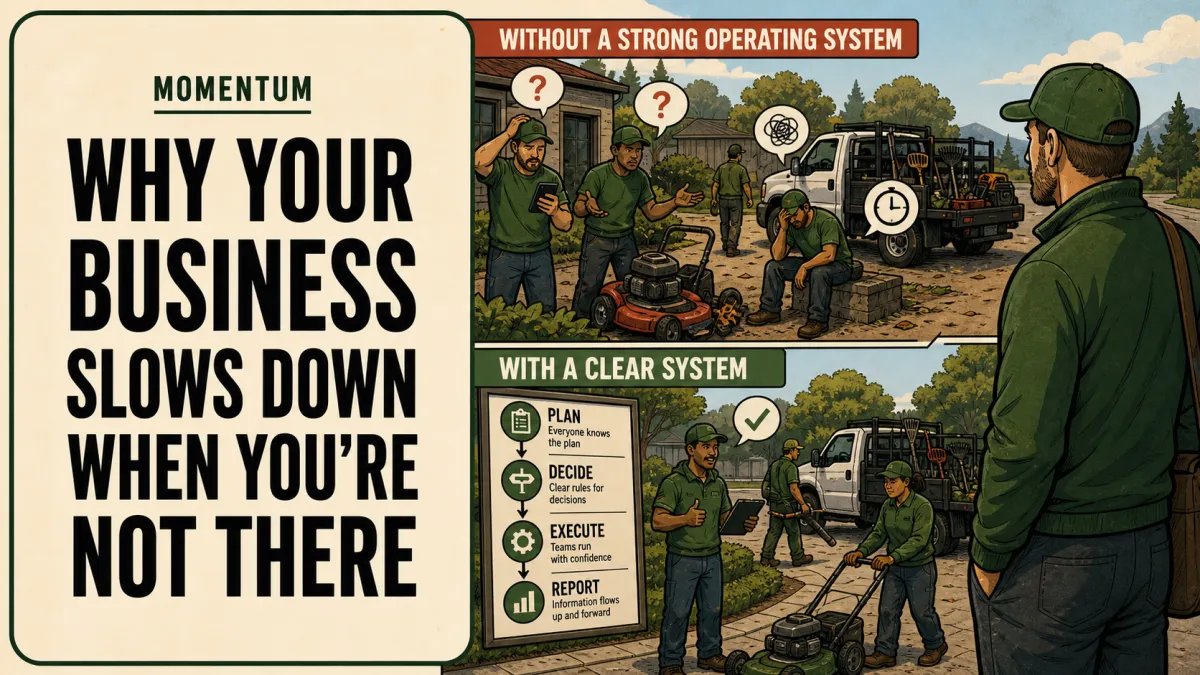
Diagnose Landscaping Business Slowdowns During Owner Absence
When a business falls apart while the owner is away, it rarely breaks everywhere at once. In most landscaping companies the same four things stall: sales follow-up, quotes, approvals, and problem solving. Keep a one-week stall log to find where information or authority stops, then give each stall a named owner with clear limits. The fix depends on where the work gets stuck, not on supervising every department more closely.
Updated October 9, 2026
The four things that stall without you
This is about the whole business slowing down, from the first phone call to the final invoice. If your concern is crews losing pace on the job site, read why crews lose momentum without the owner onsite. Here the problem usually starts before the crew ever leaves the yard.
Sales follow-up. Leads and sent estimates sit because you are the only one who calls people back.
Quotes. Estimate requests pile up until you have time to price them.
Approvals. Purchases, schedule changes, and small extras wait for your yes.
Problem solving. When something goes sideways on a job or with a customer, everyone waits for you to decide.
Each one feels small. Together, a week away can cost you a few lost jobs, a backed-up schedule, and a pile of decisions when you get back.
Run a one-week stall log
For one normal working week, log every time work stopped or slowed because it needed you. Have the office keep it, and ask crew leaders to add anything they waited on in their structured end-of-day crew report.
Each entry needs six things:
Day and time.
What stalled, in plain words.
What it was waiting on: your knowledge, your approval, or your relationship with the customer.
How long it waited.
Which of the four categories it belongs to.
Who could own it next time, if they had the right information and authority.
Do not edit the log while it runs. The point is to see the real pattern, including the stalls that make you look bad.
Example stall log
Here is what one week might look like for a $1.1M company with three crews and one office manager.
| What stalled | Waiting on | Delay | Category | New owner and limit |
|---|---|---|---|---|
| Follow-up on an $8,400 patio estimate | Owner callback | 4 days | Sales follow-up | Office manager, follow-up script at day 2 and day 5 |
| Two maintenance quotes | Owner pricing | 5 days | Quotes | Office manager, using the standard price sheet |
| $1,200 mulch order for a Wednesday install | Owner approval | 1 day | Approvals | Crew leader, purchases up to $1,500 on approved jobs |
| Customer asks to move service day | Owner cell phone | 2 days | Approvals | Office manager, any schedule change within the same week |
| Irrigation leak found during a mow | Owner decision on repair | Return visit | Problem solving | Crew leader, repairs under $250 with photo and customer text |
| Edging complaint | Owner callback | 2 days | Problem solving | Office manager calls same day, owner informed |
In this example, none of the six stalls needed the owner's skill. They needed a name, a price sheet, and a dollar limit. That is typical. Most stalls happen at a handoff, and the person on the other side is ready to act once someone tells them they can.
Assign every stall an owner
Go down the log and give each recurring stall a responsible person. For each one, define:
The outcome. "Every sent estimate gets a follow-up call within two business days."
The information they need. Price sheet, job notes, customer history, supplier accounts.
The limit. A dollar amount, a time window, or a type of decision, plus what still comes to you.
The review point. Check the first few weeks together, then move to a weekly glance.
Then tell everyone who depends on that step. If crews still text you for purchases after you gave the crew leader a $1,500 limit, the new route is not real yet. Send the question back to the person who owns it, every time.
For problem solving in the field, write down the common situations and the response. Broken equipment is a good place to start, and a crew equipment breakdown plan covers it.
Test it with a planned absence
Do not test independence by disappearing without a response plan. Arrange qualified coverage and a separate emergency route before you limit routine contact.
Start with a single day. Validate coverage through a planned test day away, and keep the stall log running while you are gone. Compare completed commitments, unresolved decisions, quality, and customer response with a normal day. When a day works, try three. When three work, you are ready to prepare the business for a real vacation.
Frequently asked questions
Why does my business fall apart when I am away?
Usually because sales follow-up, quotes, approvals, and problem solving all route through you. Trace a week of stalls to find the first decision or information gap that stops the next step, then give that step a named owner.
How is this different from slow crew production?
A business-wide delay can begin long before field work, at an estimate, a purchase, or an approval. Inspect the whole workflow instead of measuring only how fast crews work onsite.
What proves an absence test worked?
Committed work moves forward with acceptable quality and communication, and exceptions are handled or reported through the agreed route. A quiet phone alone is not proof.
Explore 7 Figure Landscape Network's business systems programs or book a strategy call to discuss the operating problem you want to work on. Learn about Jim Wertz and the network.
For the broader team leadership and accountability process, use Landscaping Crew Accountability: Standards, Owners, and Reviews as your starting guide, then return to the specific issue covered here.
