Landscaping Quality Standards Without Owner Micromanagement
Landscaping quality control can work without the owner inspecting every property once four pieces are in place: a written standard for each service, photo closeouts on every job, spot audits run by crew leaders, and a short weekly scorecard. Standards define what the work must achieve. Your personal preferences about how to get there stay out of it, while specifications, safe methods, and customer commitments stay nonnegotiable.
Updated October 9, 2026
Why owner inspection doesn't scale
When the owner is the quality system, crews learn that quality means whatever the boss notices on a drive-by. Standards drift on the days you're not looking, and the evenings go to re-edging beds yourself.
The cost is real. Example: an owner who spends eight hours a week inspecting and redoing work over a 30-week season puts in 240 hours of rework, and none of it shows up on a job cost report. Meanwhile, the crew never learns to inspect their own work, because you always do it for them.
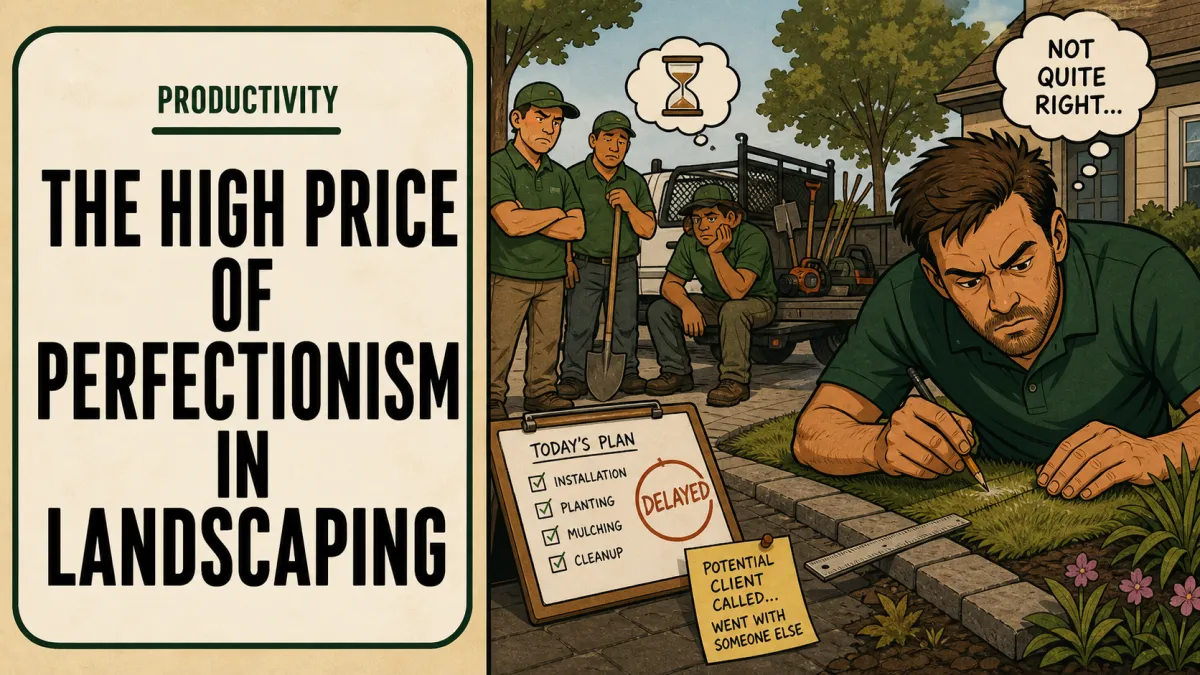
Perfectionism makes it worse. If your preference for a particular tool-loading order triggers rework, even when another safe sequence meets the readiness requirements, you're spending payroll on taste. An installation outside the approved specification is different. That needs correction no matter how close it looks. Telling those two apart is the whole job of a quality system.
Write a standard for each service
Each service you sell needs a short written standard: the required result, the specifics that make it pass, and the photo that proves it. One page per service, not a binder.
| Service | Required result | Closeout photo |
|---|---|---|
| Weekly mowing | Even cut, no missed strips, clippings off hard surfaces, edges trimmed | Front lawn from the street |
| Spring cleanup | Beds clear of debris, crisp bed edge, all debris hauled | Each bed, plus driveway |
| Mulch install | Depth per work order, pulled back from trunks and siding, no mulch on lawn | Wide bed shot and one close-up at a trunk |
| Shrub pruning | Shape per customer notes, clean cuts, clippings removed | Before and after of the main bed |
| Planting | Plants per plan, correct depth, watered in, tags removed | Finished bed matching the plan |
Keep preference out of the standard. If you can't name the customer, safety, or specification reason behind a line, cut it. How to hand a standard to someone and when to correct versus coach is covered in setting delegation standards. This article is about inspecting against them.
Close out every job with photos
Photo closeouts move inspection from your truck to the crew leader's phone. Before leaving a property, the crew leader takes the required shots and uploads them to the job record. That takes about two minutes per stop.
Pair the photos with the jobsite closeout checklist so the crew checks against the standard before anyone else does. The office confirms each job has its photos by end of day. Missing photos get flagged the same day, not at the end of the month.
You or a manager review a sample of photos, not all of them. The point is that the crew checks first, every time.
Have crew leaders run spot audits
Photos catch most issues. Spot audits catch what the camera misses and keep the standard honest across crews.
Each crew leader audits two properties a week serviced by another crew.
They score the property against the written standard, pass or fail on each line.
Failures go back to the responsible crew leader with a photo and the specific line missed.
The responsible crew fixes it and notes the cause: training, time, materials, or a confusing standard.
The owner audits a small sample each month to check the auditors.
Auditing another crew's work builds the eye you want in a leader. Make it part of the role in writing, alongside the other landscaping foreman responsibilities.
Track it on a QC scorecard
A scorecard turns quality from an argument into a number you review weekly.
| Measure | Target | This week | Action |
|---|---|---|---|
| Jobs with complete closeout photos | 95% | 88% | Crew 3 missing photos on maintenance route |
| Spot audit pass rate | 90% | 92% | None |
| Callbacks | 2 or fewer | 4 | Three on mulch depth, retrain on standard |
| Customer complaints | 1 or fewer | 1 | None |
Callbacks are the hardest number to argue with, so count them carefully by tracking landscaping callbacks and rework. When the same failure repeats, use a root-cause review to fix the training or the standard instead of the property.
Avoid percentage promises like accepting 80 percent now and expecting 95 later. Define the acceptance criteria and verify them. For task-specific safety planning, consult the OSHA landscaping resources alongside equipment instructions and confirm what applies to your work.
Frequently asked questions
How do I maintain quality without inspecting everything myself?
Write a standard for each service, require photo closeouts, and train crew leaders to run spot audits on each other's work. Review a weekly scorecard and sample the audits yourself instead of driving every property.
What is the difference between a preference and a standard?
A standard protects an agreed result, a safety requirement, or a specification. A preference is a method choice with acceptable alternatives. If you can't name the reason behind it, it's probably a preference.
Should I redo employee work that is different from mine?
Check it against the written standard first. Correct a specific failure and explain which line it missed, but don't redo acceptable work just because the method differs from yours.
Explore 7 Figure Landscape Network's business systems programs or book a strategy call to discuss the operating problem you want to work on. Learn about Jim Wertz and the network.
For the broader owner time and office support process, use When to Hire an Office Administrator for Your Landscaping Business as your starting guide, then return to the specific issue covered here.
