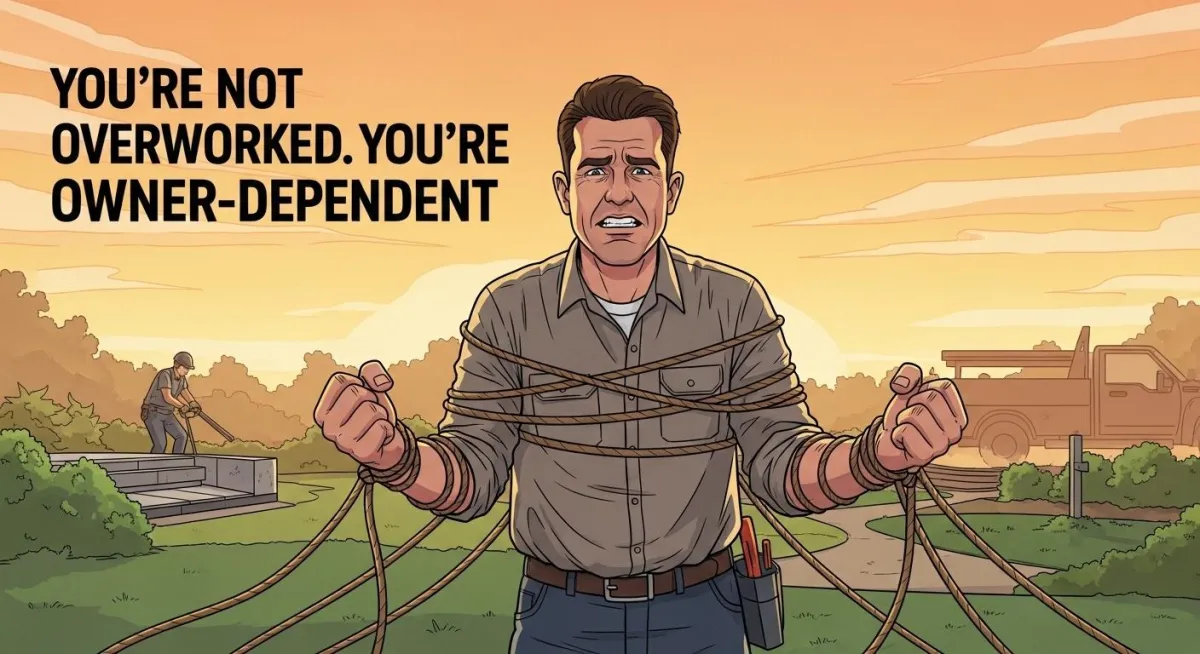
Landscaping Owner Overload: Capacity Problem or Owner Dependence?
An overworked business owner usually has one of two problems, and often both. A capacity problem means there is more committed work than your qualified people can handle. A dependence problem means the team has room, but routine decisions, information, and approvals still have to go through you. Hiring fixes the first. It barely touches the second. Diagnose which one you have before you spend money on the wrong fix.
Updated October 9, 2026
Two kinds of overload
Both kinds feel identical from the driver's seat. You work 65 hours, your phone rings all day, and you still go to bed behind. The difference only shows when you look at what fills the hours.
Capacity overload: every crew is prepared and booked solid, the office is maxed out, and work is turned away or pushed back. You are filling a real gap with your own hands.
Dependence overload: crews have capacity, but they wait for your approval. The office could answer the customer, but only you know the answer. You are doing work other people could do if they had the information or the authority.
Many companies have both at once. That is why this needs evidence, not a gut call. If you have been trying to solve it by working longer, read why longer hours stop helping first.
The 10-question overload diagnostic
Answer yes or no based on a typical week, not your worst one. Questions marked (C) point to capacity. Questions marked (D) point to dependence.
(C) Are crews booked out more than two weeks during the season with no slack for weather?
(C) Are you regularly running a crew yourself because you are short a crew leader?
(C) Is the office behind on scheduling and billing even when you are not interrupting it?
(C) Are you turning down or delaying work you would make money on?
(D) Do crews call you about choices they could make with a clear rule?
(D) Do quotes wait until you personally have time to price them?
(D) Do you answer the same questions from the team every week?
(D) Do customers call your cell instead of the office for routine changes?
(D) Does work slow down noticeably when you are tied up on one job?
(D) Is there a main task of yours that nobody else could cover next week?
Three or more yeses on the C questions: you likely have a real capacity gap. Three or more on the D questions: you have a dependence problem, whatever your headcount. High on both is common, and you fix dependence first so new hires are not stuck waiting on you too.
Sort a real week
The diagnostic gives you a direction. A one-week log gives you numbers. Track your hours for a representative week and sort each block. An owner time audit walks through the tracking.
| Work | Hours | Type | Likely fix |
|---|---|---|---|
| Running a crew short a leader | 20 | Capacity | Hire or promote a crew leader |
| Routine crew calls and approvals | 10 | Dependence | Decision limits by role |
| Customer scheduling calls | 8 | Dependence | Route to the office with a script |
| Repeat questions from the team | 6 | Dependence | Written answers and site notes |
| Payroll and invoicing | 6 | Dependence | Train the office, you approve |
| Callbacks and rework | 6 | Process | Closeout checklist |
| Estimates, sales, planning | 12 | Owner work | Keep, and protect the time |
| Total | 68 |
In this example, only 20 hours come from a true capacity gap. Thirty hours are dependence. A new crew leader would bring the owner to about 48 hours, but the phone would still ring all day. Both fixes are needed, and they are different fixes.
Fixes for a capacity problem
If the evidence says you really are short on people or hours, the answers are about commitments and staffing:
Compare booked work with what your qualified crews can realistically deliver, including weather days.
Adjust commitments: tighten the service area, drop the lowest-margin accounts, or schedule installs further out.
Add capacity where it pays: a crew leader so you leave the field, or office help so you leave the desk.
Plan next season's capacity before spring. Preseason capacity and crew planning covers the numbers to check.
Fixes for a dependence problem
If crews have capacity but wait for routine approvals, another hire may add expense without removing the delay. Fix the routing instead:
Write down which decisions each role can make, with a dollar limit. Setting decision boundaries so crews stop waiting shows how.
Put the answers to repeat questions where the team can find them.
Introduce customers to the office contact and route routine calls there.
Measure what the waiting costs with a crew waiting-time calculation, so you know which handoff to do first.
Choose a response that matches the cause, then review the effect after a few weeks before expanding the change.
One caution. Long hours are not proof of a management failure. Do not dismiss real workload or your own health just because owner dependence is also present.
Frequently asked questions
Can I be both overworked and owner-dependent?
Yes. The company may have too much committed work and also rely on you for routine decisions it does not need you for. Sort your week by cause and address both with evidence, starting with dependence.
Will hiring solve owner overload?
It can close a defined capacity gap. It will not fix missing processes, approval bottlenecks, or unclear responsibilities, and a new hire who has to ask you everything adds to your load at first.
What should I measure before changing staffing?
Committed workload, qualified crew capacity, time spent waiting, rework, and the tasks consuming your hours. Use a representative week of operating data rather than one unusually busy day.
Explore 7 Figure Landscape Network's business systems programs or book a strategy call to discuss the operating problem you want to work on. Learn about Jim Wertz and the network.
For the broader owner time and office support process, use When to Hire an Office Administrator for Your Landscaping Business as your starting guide, then return to the specific issue covered here.
