Landscaping Business Coach vs. Consultant: Which One You Need
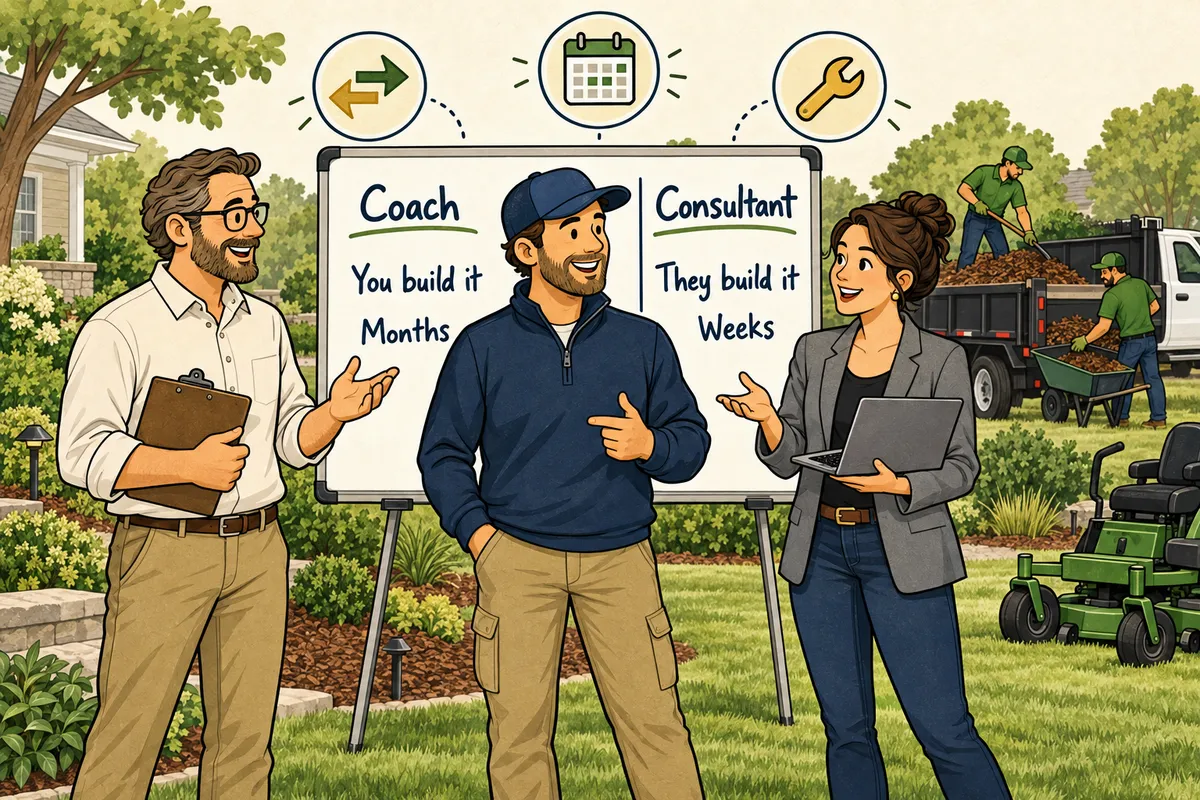
A consultant does a defined piece of work for you and leaves: a pricing rebuild, a software rollout, a hiring process. A coach changes how you and your team run the business, over months, so the improvement stays after they are gone. Hire a consultant for a bounded technical problem. Hire a coach when the problem is the way the business depends on you. Most landscaping owners at $500K to $2M need the second one and keep buying the first.
Updated October 2, 2026
The real difference: who does the work
Strip away the titles and it comes down to one question: at the end, who can do this without help?
A consultant builds the thing. You get a finished estimating spreadsheet, a documented onboarding process, a new CRM configured and running. It is fast and it is done to a professional standard. But the knowledge leaves with the consultant. When the market shifts or your foreman quits, you call them again.
A coach builds you and your team. You build the estimating model with the coach checking the math. Your foreman writes the closeout procedure with the coach setting the standard. It takes longer and the first version is rougher. But at the end, your company knows how to do it, and the next version does not need anyone from outside.
Consultants sell deliverables. Coaches sell capability. That is why a coach is the one who can get you out of the field: the goal is not a document, it is a business that runs without you, and nobody can deliver that for you.
Side-by-side comparison
| Factor | Consultant | Coach |
|---|---|---|
| Who does the work | They do | You and your team do, with structure and accountability |
| Timeline | Days to weeks per project | 6 to 12 months |
| Typical cost | $150 to $400 an hour, or $3,000 to $25,000 per project | $1,000 to $3,000 a month, or $10,000 to $30,000 a year |
| Output | A finished system or document | Owner and team habits, plus the documents they built |
| What happens when they leave | Knowledge leaves; you call again | Capability stays |
| Best for | Bounded, technical, one-time problems | Owner dependence, margin, delegation, culture |
| Fails when | The problem is behavior, not a missing tool | The owner will not do the homework |
Which one for which problem
| The problem | Hire | Why |
|---|---|---|
| Our estimating template is wrong and we lose money on installs | Consultant, then coach | A consultant can rebuild the template in a week; only coaching stops the crew from ignoring it |
| Nobody makes a decision unless I am on site | Coach | This is a roles and boundaries problem, and it lives in how you manage. See why crews wait for approval |
| We need to move to new scheduling software | Consultant | Bounded and technical. Pay for it done right |
| Net profit is 5 percent and I do not know why | Coach | Finding the leak is an audit; fixing it is pricing, labor, and owner behavior over a season |
| I want to sell in three years | Coach, with an accountant and a broker at the end | Buyers pay for transferable systems, which take a year or more to build and prove |
| I need an employee handbook that is legally sound | Consultant or HR attorney | Bounded, and the liability is real |
Why owners buy the wrong one
Owners who are drowning want the problem taken off their plate, so they buy a consultant. The deliverable arrives, it is good, and nothing changes because the crew still calls the owner, the owner still prices from the gut, and the new spreadsheet sits in a folder. Six months later the owner says consulting did not work.
Owners who are proud want to keep control, so they buy a coach and then treat every call as advice to consider rather than a plan to execute. A year later, they say coaching did not work.
In both cases the buyer picked the help that matched their comfort instead of their problem. The tell is simple: if the fix requires you to change what you do on a Tuesday, it is a coaching problem, no matter how technical it looks. If the fix is a finished thing that works whether or not you change, it is a consulting problem. Hands-on or trapped is the honest question to ask first.
When you need both, and in what order
Companies over $1M usually need both at some point. The order matters. Start with a coaching audit, because it tells you which bounded problems are worth a consultant and which are symptoms of owner dependence. Then bring in consultants for the technical pieces the audit exposes: a bookkeeping cleanup, a software migration, a compensation study. Then let the coaching carry the behavior change through a full season.
Doing it backwards is expensive. Owners who hire three consultants before an audit typically end up with three good tools built on a bad pricing model and no one to run them. If the budget only stretches to one, choose the one that fixes the constraint you named in the coaching readiness checklist. A finished document is worth nothing to a business that still cannot run a day without its owner.
Frequently asked questions
Is a business coach or consultant better for a small landscaping company?
Under $300K, neither is a great use of money; fix job costing and pricing yourself. Between $500K and $2M, a coach usually delivers more because the constraint at that size is almost always the owner's role, not a missing tool. Use consultants for bounded technical projects the coaching audit uncovers.
Can a landscaping business coach also act as a consultant?
Some do, and the best programs include a few consultant-style deliverables, like a pricing model built on your numbers. The difference is whether your team can maintain it afterward. If the coach builds everything and your people cannot explain it, you bought consulting at coaching prices.
Which costs more, coaching or consulting?
Per hour, consulting is usually more. Over a year, coaching often costs more in total because it runs for months. Compare on return, not price: a coaching program that adds five points of margin on a $1M company is worth $50,000 a year, every year, which no single consulting project can match. See what coaching costs for the ranges.
Explore 7 Figure Landscape Network's business systems programs or book a strategy call to discuss the operating problem you want to work on. Learn about Jim Wertz and the network.
For the broader strategy process, use Landscaping Business Strategic Plan: A One-Page Framework as your starting guide, then return to the specific issue covered here.
