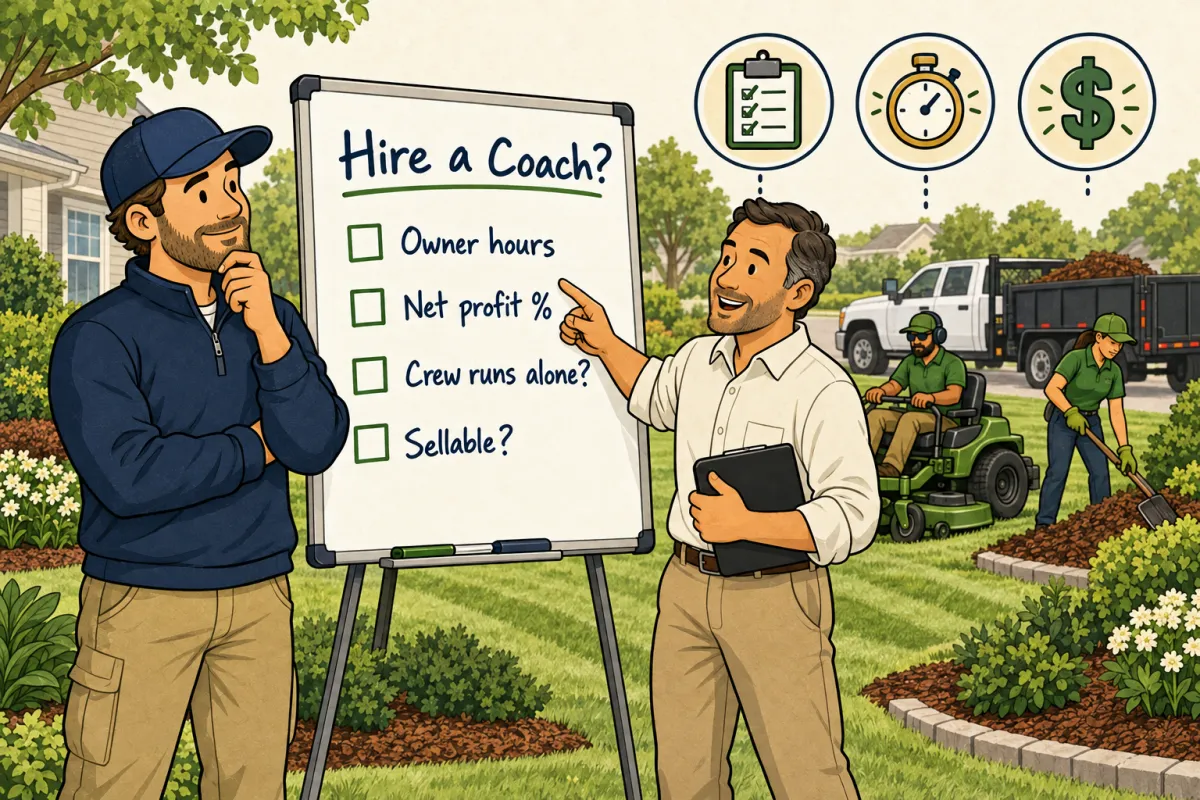
Should You Hire a Landscaping Business Coach? A Decision Checklist
Hire a landscaping business coach when you are doing $500K or more in revenue, working 60-plus hours a week, and the numbers say the business cannot run a day without you. Do not hire one to find leads, to fix a cash crisis, or because a sales page promised to double your revenue. Run the six-point checklist below, then do the return math before you sign anything.
Updated September 17, 2026
The six-point readiness checklist
Coaching works on owners who already have a real business and a real problem they cannot see from inside it. Score yourself honestly. Four or more "yes" answers means coaching is probably worth a conversation. Fewer than three means your money is better spent elsewhere for now.
| Question | Yes means |
|---|---|
| Is revenue above $500K with at least two crews? | There is enough operation to systemize and enough margin to pay for help |
| Are you in the field or on the phone more than 30 hours a week? | Your labor is the constraint, not demand |
| Is net profit below 10 percent, or do you not know the number? | There is a profit leak, and it is usually bigger than the coaching fee |
| Did the last time you took three days off produce a mess? | The business depends on you, which caps growth and kills sale value |
| Have you tried to fix this yourself for more than a year? | Effort is not the problem. The approach is |
| Will you do the homework between calls? | Coaching without implementation is an expensive podcast |
Notice that none of these questions ask whether you want more customers. If lead flow is your problem, you need a marketing fix, not a coach. Most owners at this stage have plenty of work. They have too little profit and too little freedom.
What a coach can and cannot fix
A good landscaping business coach does three things: reads your numbers the way a buyer would, finds the leaks you have stopped noticing, and holds you to a plan for closing them. That covers pricing, job costing, crew structure, delegation, and the owner's calendar.
A coach cannot run your crews, close your sales, or make decisions you refuse to make. If your foreman is weak, the coach can help you define the foreman role and hire or train into it, but the coach will not stand on the job site.
Be suspicious of any program that leads with revenue growth. Revenue feeds the ego. Profit feeds the family. A coach who does not ask for your P&L and last year's tax return in the first two weeks is selling motivation, not operating improvement.
The return math before you sign
Treat coaching like equipment. You would not buy a $60,000 skid steer without knowing what it earns. Run the same math here.
| Line | Before | After 12 months |
|---|---|---|
| Revenue | $1,200,000 | $1,200,000 (unchanged on purpose) |
| Net profit | $72,000 (6%) | $156,000 (13%) |
| Owner field hours per week | 45 | 15 |
| Coaching cost | — | $18,000 |
| Net gain, year one | — | $66,000 plus 30 hours a week |
The profit gain in this example comes from three fixes that show up in almost every audit: pricing jobs off actual costs instead of guesses, cutting labor overruns on the five worst job types, and pulling the owner's unbilled labor out of the field. See how landscaping profit margins improve for the mechanics. If a coach cannot show you where the first $50K is coming from in the initial audit, do not pay for month two.
Then check the payback period. Coaching that costs $1,500 a month needs to find $18,000 a year to break even. On a $1M company, that is 1.8 points of margin. If the coach cannot point at 1.8 points in your numbers, walk away.
Four situations where coaching fails
- You are under $300K. There is not enough business to systemize. Spend the money on a bookkeeper and a job-costing spreadsheet first. Read the job costing system you actually need and do it yourself.
- You are in a cash emergency. Coaching takes 90 days to show results. If payroll is at risk in 30, you need a line of credit conversation and a collections push, not a program.
- You want someone to tell you that you are right. A coach worth paying will tell you that your pricing is wrong, your best guy is overpaid, and your calendar is the problem. If that sounds unbearable, wait.
- You will not delegate. Every fix ends with someone other than you doing the work. Owners who say "nobody does it like me" get the same result with or without a coach. Doing it yourself is a trap, and coaching cannot spring it for you.
What to do if you are not ready yet
If you scored under three, you still have a leak. Start with the pieces a coach would make you do anyway. Cost every job for 30 days. Track your own hours for two weeks and price them at $75 an hour. Take one full test day off and write down every call you get. Those three exercises will tell you whether you have a pricing problem, a people problem, or an owner problem. When you know which, coaching becomes a targeted purchase instead of a hope.
Frequently asked questions
Is a landscaping business coach worth it for a $500K company?
Usually yes, if net profit is under 10 percent or the owner is in the field most of the week. At that size, a two-point margin improvement covers a typical coaching fee, and the freedom gains compound. Below $300K, fix costing and pricing yourself first.
How long before coaching pays for itself?
Expect the first measurable profit gain within 60 to 90 days, usually from repricing and labor controls. Full payback on a $15K to $20K annual program typically lands between month four and month eight, verified on your P&L rather than by the coach's claims.
What is the difference between a landscaping coach and a general business coach?
A landscaping-specific coach knows seasonal cash swings, crew-based labor math, equipment costs, and maintenance-versus-install margins. A general coach can help with mindset and structure but will not catch a 14 percent labor overrun on your install crew. Read the coach versus consultant comparison before choosing.
Explore 7 Figure Landscape Network's business systems programs or book a strategy call to discuss the operating problem you want to work on. Learn about Jim Wertz and the network.
For the broader strategy process, use Landscaping Business Strategic Plan: A One-Page Framework as your starting guide, then return to the specific issue covered here.
