How to Improve Landscaping Profit Margins: Costs, Pricing, and Routes
To improve landscaping profit margins, first measure the cost of delivering each service, then correct underpricing, labor overruns, travel waste, and unpaid extra work. Compare similar jobs and routes. Adding sales helps only when the additional work covers its costs and contributes enough to the business.
Updated September 14, 2026
Define the margin you are measuring
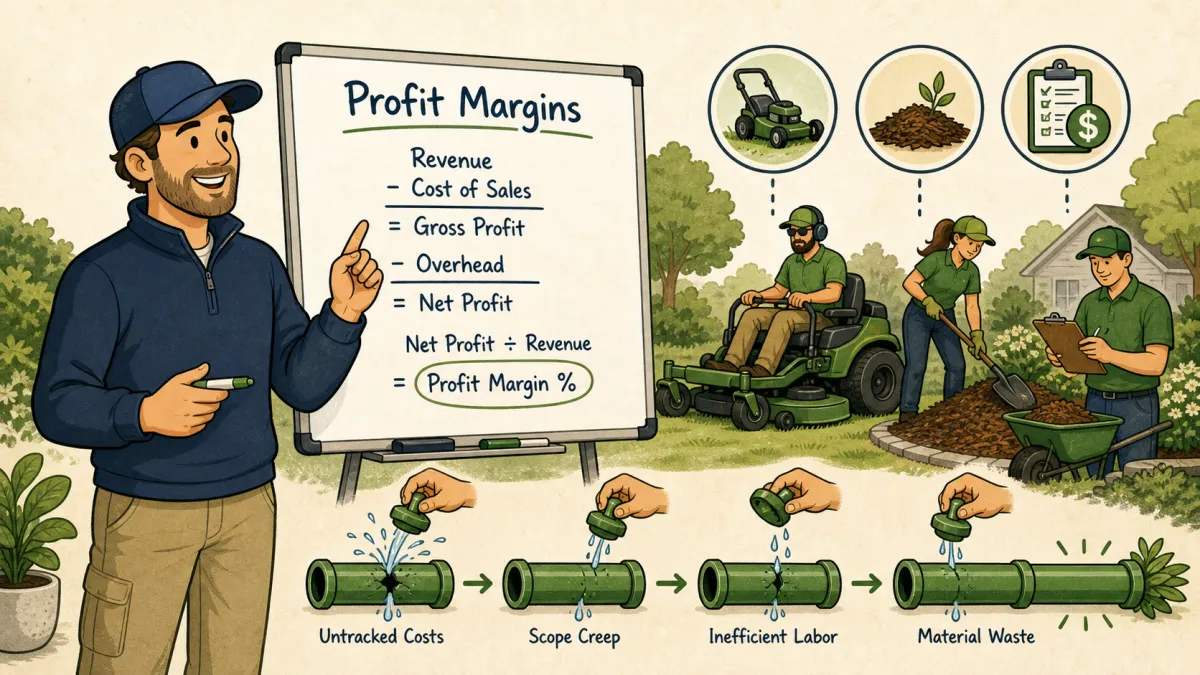
Job margin before overhead is revenue minus direct job costs, divided by revenue. Company net margin includes the broader expenses recognized in the company's accounts. The two numbers answer different questions and should not be used interchangeably.
For illustration, $20,000 of revenue minus $14,000 of direct costs leaves $6,000, or a 30% job margin. After $4,000 of allocated operating overhead, $2,000 remains in this simplified example before any other applicable expenses. The job-costing worksheet helps you build the first calculation consistently.
Check margin versus markup before changing prices
Markup is profit divided by cost. Margin is profit divided by selling price. A 30% markup on $7,000 produces a $9,100 price and a 23.08% margin. To target a 30% margin on the same defined cost base, divide $7,000 by 0.70 to get $10,000.
Price for a target margin = cost / (1 minus target margin). This formula is only as useful as the cost inputs. If overhead is excluded, the result is a margin before overhead, not a guaranteed net profit. These figures illustrate arithmetic; they are not recommended industry rates.
Find the operational leak before adding another crew
| Signal | Review | Possible correction |
|---|---|---|
| Labor exceeds estimate | Scope, access, quantities, and actual person-hours | Revise production assumptions or remove avoidable delays |
| Frequent return visits | Original job and verified cause | Improve inspection or customer handover |
| Paid travel dominates routes | Drive time and service time by route | Group nearby properties or adjust service-area pricing |
| Extras get done without revenue | Requested changes and approvals | Document scope and price before extra work |
Connect return visits to the callback cost register. Include your own field time using a consistent replacement labor calculation.
Evaluate maintenance contracts by route
Recurring revenue can improve predictability, but a maintenance package is not automatically profitable. Include travel, service frequency, seasonal tasks, material use, and likely support work in the estimate. A dense route and a scattered route with identical properties may have different costs.
For an illustrative three-person crew, eliminating 30 minutes of unnecessary daily travel recovers 1.5 person-hours. At a $35 loaded hourly rate, that represents $52.50 of capacity per day. It becomes cash benefit only if overtime, staffing cost, or another expense falls, or the available time produces profitable work.
Review one service line for the next month
Choose one comparable group of jobs, collect the missing costs, and fix the largest repeated variance. Check whether the next jobs improve. Consult your financial adviser before changing accounting allocations; the SBA's finance guidance provides a useful overview of business records.
A good margin review produces a specific decision: change a price, improve a process, clarify a scope, or stop accepting work that cannot meet the company's needs.
Frequently asked questions
What is a good landscaping profit margin?
There is no universal figure for every service mix and accounting method. Distinguish job margin from net profit, calculate your costs consistently, and set a target that supports overhead, risk, reinvestment, and owner compensation.
Will maintenance contracts automatically improve margins?
No. They can add predictable revenue, but route distance, visit frequency, seasonal workload, and pricing still determine the economics. Review the full contract period instead of judging one easy visit.
Should I raise prices or cut costs first?
Use job records to identify the cause. Underpriced work needs a pricing or scope correction; avoidable rework needs an operational fix. Some companies need both, and cutting costs should not undermine safety or agreed quality.
Explore 7 Figure Landscape Network's business systems programs or book a strategy call to discuss the operating problem you want to work on. Learn about Jim Wertz and the network.
For the broader job costs and profitability process, use Landscaping Job Costing: A Worksheet and Worked Example as your starting guide, then return to the specific issue covered here.
