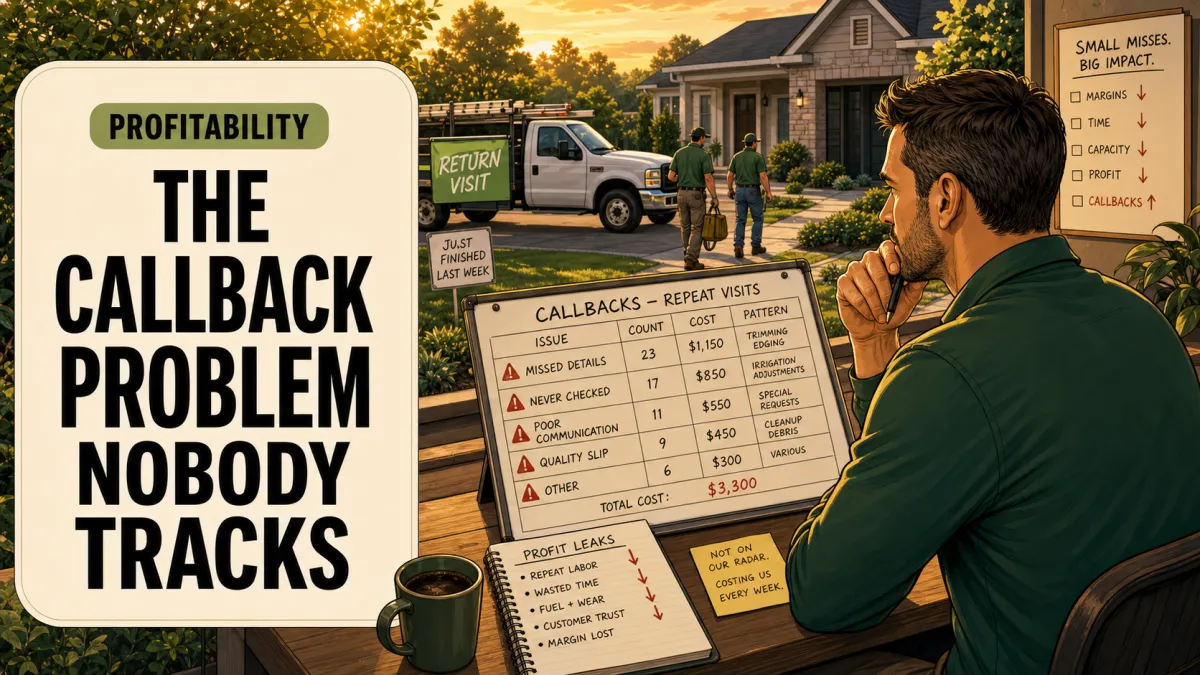
Landscaping Callbacks: Track Rework Costs and Prevent Repeat Visits
A landscaping callback is a return visit to investigate or correct work after the original visit or closeout. Record why the crew returned and charge the attributable cost to the original job. Separate workmanship corrections, warranty issues, customer changes, and unrelated new work so the numbers lead to the right fix.
Updated September 14, 2026
Create a callback register the office can maintain
| Field | What to record |
|---|---|
| Original job and completion date | The work the concern relates to |
| Reported issue | The customer's description and photos |
| Verified cause | Workmanship, materials, scope misunderstanding, warranty, or new work |
| Cost | Person-hours, travel, materials, and equipment |
| Resolution | Work completed, confirmation, and unresolved items |
| Prevention owner | Who changes the relevant process and by when |
Do not force the office to guess the cause during the first call. Mark it unconfirmed until someone investigates. A fair register helps the crew solve problems instead of hiding them.
Calculate a return visit without exaggerating it
Illustrative example: two people spend two hours each on a correction, including travel. At $35 per person-hour, labor is $140. Add $45 in materials and $25 in attributable vehicle cost for a total of $210. Avoid adding travel wages again if they are already inside the four person-hours.
If the original $4,000 job had $1,000 remaining after direct costs, the callback reduces that result to $790, or 19.75% of revenue. This is a job-level example before overhead. Put the cost into the original job-cost record rather than losing it in a general service expense.
Measure both frequency and cost
For a defined group of completed jobs, divide jobs with at least one verified correction by the total completed jobs in that group. Five affected jobs out of fifty is a 10% callback incidence, even if one job required three trips. Track total return visits separately.
Compare like-for-like work and allow a consistent reporting window. Recently completed jobs have had less time to generate complaints. Maintenance visits, irrigation repairs, and major installations should not be mixed without explanation.
Turn one recurring cause into a closeout change
If repeated visits come from debris left behind, add a specific perimeter check to the jobsite closeout checklist. If plant problems relate to unclear care instructions, document the handover and investigate installation, product, and maintenance causes rather than assuming one party is at fault.
Assign inspection responsibility before the truck leaves. For concerns involving irrigation, structures, equipment, or other hazards, use qualified personnel and the appropriate procedure. OSHA's landscaping hazard guidance is a starting resource for planning safe field work.
Review the largest recurring cost weekly. Choose a change, a responsible person, and a date to check whether the problem returned. A spreadsheet alone does not prevent the next trip.
Frequently asked questions
Is every return visit a callback?
A planned follow-up or newly requested service is different from correcting completed work. Define your categories clearly so warranty work, new scope, and preventable rework are not all treated as the same problem.
What is a good landscaping callback rate?
There is no single target that fits every service mix and reporting window. Establish your own baseline for comparable jobs, track the causes and costs, and work to reduce preventable recurrence without discouraging honest reporting.
Should callbacks be charged to the customer?
That depends on the cause, agreed scope, warranty, and applicable obligations. Investigate first. Handle genuine new work through approval of additional scope; do not automatically bill customers for correcting work you were responsible for delivering.
Explore 7 Figure Landscape Network's business systems programs or book a strategy call to discuss the operating problem you want to work on. Learn about Jim Wertz and the network.
For the broader job costs and profitability process, use Landscaping Job Costing: A Worksheet and Worked Example as your starting guide, then return to the specific issue covered here.
