Build a Transferable Landscaping Business, Not Just an Owner Job
If you want to know how to sell a landscaping business, start with what a buyer is actually paying for: profit that keeps coming in after you leave. That means transferable systems, a solid share of recurring maintenance revenue, clean books, and operations that run without the owner. A company that depends on your memory, your phone, and your relationships is a job, and jobs are hard to sell. Begin fixing those things two to three years before you plan to exit.
Updated October 9, 2026
What a buyer is actually buying
A buyer is not buying your trucks or your client list on its own. They are buying future cash flow, and they are asking one question the whole way through: will this keep working when the seller is gone?
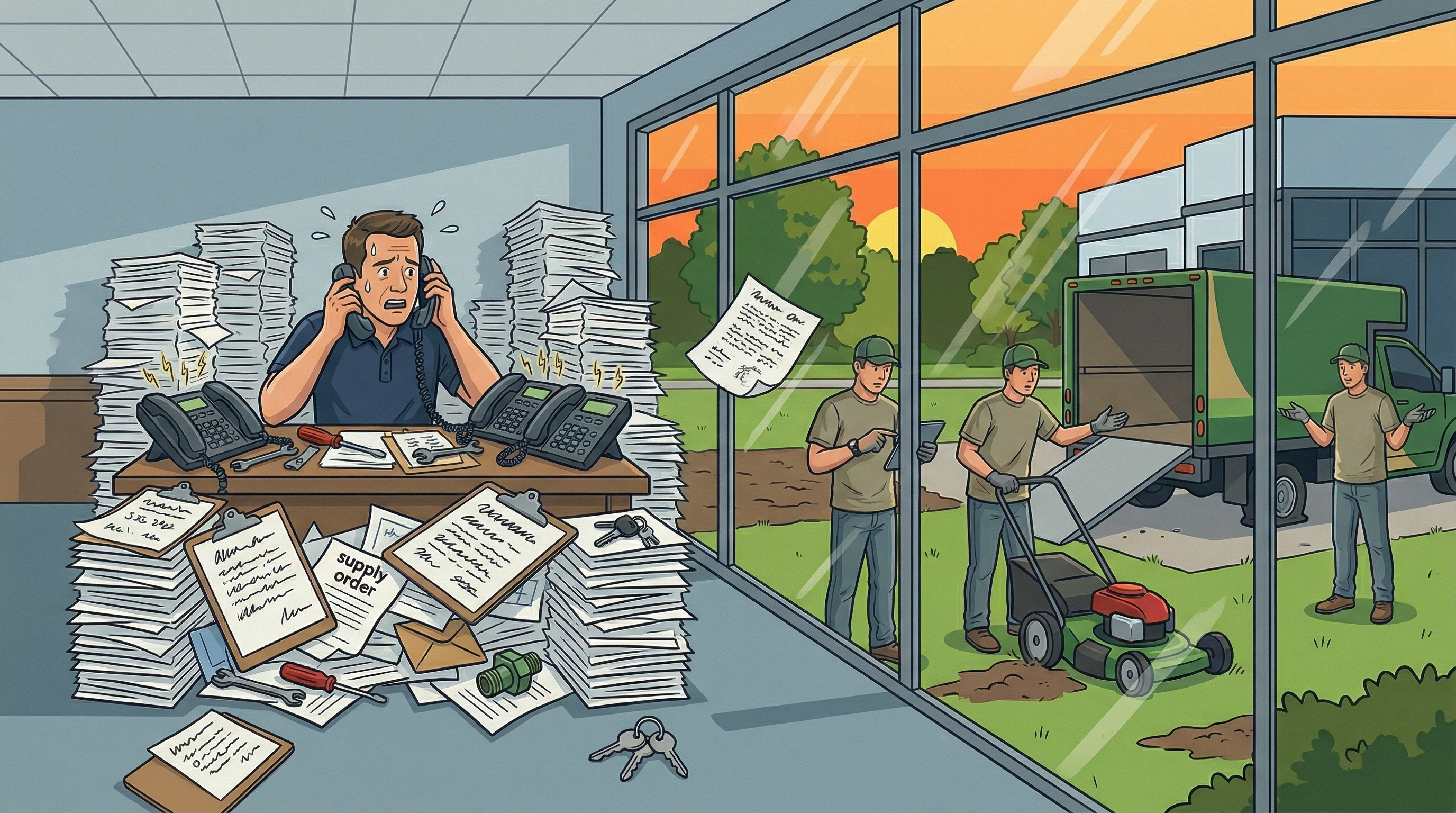
If the honest answer is "only if the seller stays," you have built a job instead of a business. You can still collect a paycheck from it, but a buyer either walks away, pays very little, or asks you to stay on for years under an earnout. Reducing that dependence is its own project, covered in the guide to building a landscaping business that runs without you.
Four things that make a landscaping company sellable
Transferable systems. Estimating, scheduling, job delivery, quality checks, and billing are written down and used by the team. A new owner can follow them without you.
Recurring revenue share. Maintenance contracts that renew every year are more predictable than one-off installs. As a rule of thumb, the higher the share of revenue that repeats, the more a buyer will trust next year's numbers.
Clean books. Business and personal spending are separate, the P&L closes every month, and job costing shows which services make money. Reconciling job margin and cash is a good place to start. The SBA's guide to managing your business finances covers the basics.
Owner-independent operations. A general manager or operations lead runs the day, crew leaders make field decisions, and customers know who to call besides you. Reducing key-person risk explains why buyers look hard at this.
A customer relationship held entirely in the owner's text messages is hard to transfer. Keep approved scope and communication history in the company record, and introduce a responsible account contact. The relationship stays personal, but it now belongs to the business.
How buyers value a landscaping business
Most small company sales start from adjusted EBITDA: earnings before interest, taxes, depreciation, and amortization, adjusted for one-time costs and for what it would cost to replace the owner with a hired manager. That number is multiplied by a figure that reflects risk. As a rough rule of thumb, well-run landscaping companies are often discussed in the 3 to 5 times EBITDA range, while owner-dependent ones land lower or struggle to find a buyer. Size, region, service mix, and deal terms all move that number, so get a real valuation from a qualified business broker or M&A adviser and your accountant.
| Item | Company A: owner is the job | Company B: transferable |
|---|---|---|
| Revenue | $1.5M | $1.5M |
| Adjusted EBITDA | $150K after paying someone to do the owner's job | $225K |
| Recurring maintenance share | 25% | 60% |
| Books | Personal and business mixed, cleaned up once a year | Monthly P&L with job costing |
| Owner role | Sells, prices, holds key clients | Strategy only; a manager runs operations |
| Illustrative multiple | 2x | 4x |
| Illustrative value | $300K | $900K |
Same revenue, three times the value. The difference is almost entirely in the four factors above. For a picture of what Company B looks like day to day, see what a well-run $1 million landscaping business looks like.
What to fix two to three years out
Buyers usually ask for several years of financial statements and tax returns, so improvements need time to show up in the numbers. Work backward from your target date:
Three years out: decide what you actually want from an exit using three questions about your business direction. Separate personal spending from the business, start monthly P&Ls, and track your recurring revenue share.
Two years out: document how work is estimated, approved, delivered, checked, and billed. Hire or promote an operations lead. Introduce key clients and suppliers to the people who will serve them. Move one-off customers onto maintenance agreements where it makes sense.
One year out: step out of daily operations and let the numbers prove it. Review financial records and owner-specific dependencies with your accountant, an attorney, and a broker. Identify exactly what a successor would need to operate competently.
Connect each of these steps to your wider goals with a one-page landscaping strategic plan.
Mistakes that hurt a sale
Starting the cleanup six months before listing, when the past three years of books still tell the old story.
Assuming documentation alone creates value. Performance, obligations, team capability, and transition terms also matter.
Believing a company becomes transferable once it passes some revenue threshold.
Running heavy personal expenses through the business right up to the sale, then asking a buyer to take the add-backs on faith.
Frequently asked questions
How is a landscaping business valued when you sell it?
Most buyers start from adjusted EBITDA and apply a multiple based on risk. Recurring revenue, clean books, documented systems, and a team that runs without the owner push the multiple up. Get a formal valuation from a qualified adviser before you set expectations.
Can an owner-operated business still be sold?
Possibly. Owner dependence is one consideration, not an automatic bar to a sale, but it usually lowers the price or adds an earnout that keeps you working for the buyer. Seek qualified advice about your actual business and transition.
Where should I start if everything is in my head?
Document one recurring process and its current job information, then train a responsible backup and test the handoff. Start with an important, manageable dependency, and start the books cleanup at the same time.
Explore 7 Figure Landscape Network's business systems programs or book a strategy call to discuss the operating problem you want to work on. Learn about Jim Wertz and the network.
For the broader business planning and growth process, use Landscaping Business Strategic Plan: A One-Page Framework as your starting guide, then return to the specific issue covered here.
