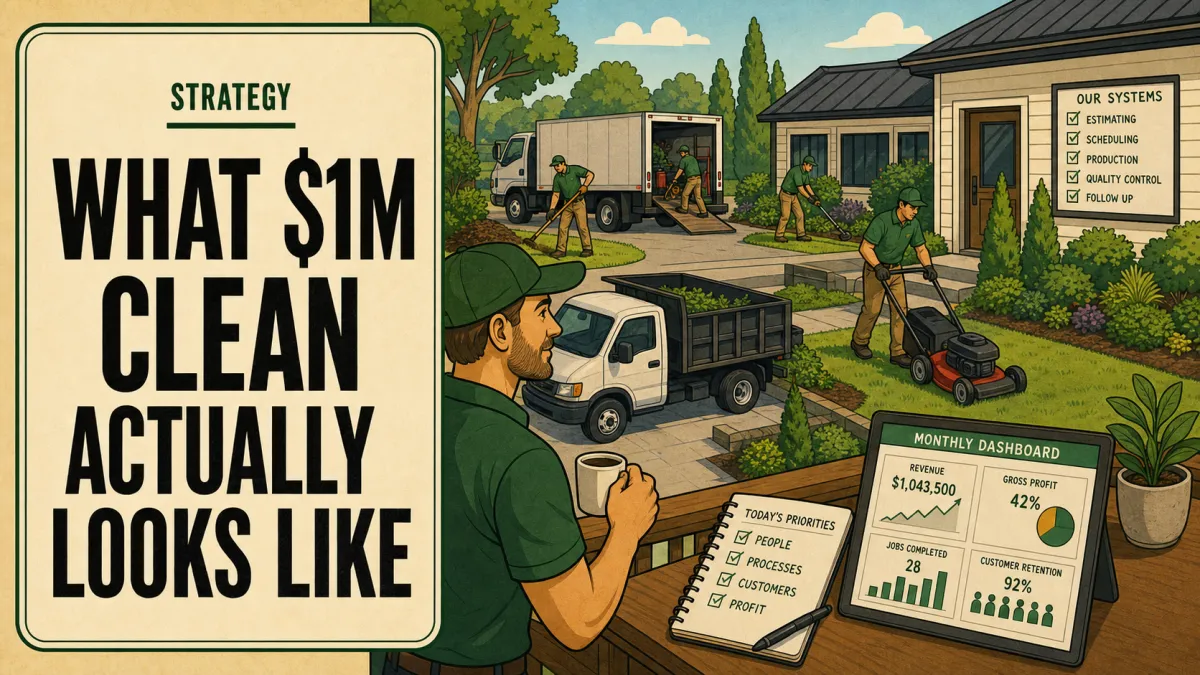
What a Well-Run $1 Million Landscaping Business Looks Like
A well-run 1 million dollar landscaping business keeps double-digit net profit after paying the owner a fair salary, runs three or so crews with trained leaders, and does not stop when the owner takes a week off. Plenty of companies hit $1M in sales and have none of that. Revenue tells you the size of the company. Job economics, cash timing, roles, and owner hours tell you whether it is any good.
Updated October 9, 2026
Same revenue, two very different companies
Two companies can each bill $1 million in a year and live completely different lives. One carries heavy rework, slow collections, and an owner who works 70 hours a week. The other has steady recurring revenue, priced jobs that actually make money, and an owner who spends most of the week on sales and planning.
From the outside they look the same. The sign on the truck does not show net profit. To tell them apart, look at reconciled records and how the operation behaves on an ordinary Tuesday.
Treat the $1M figure as an illustrative milestone. It is not a promise of profit, owner income, valuation, or freedom. The right targets depend on your service mix and cost structure.
Benchmark: well-run vs. struggling $1M company
These are example profiles, built to show the contrast. Use them as a checklist against your own numbers.
| Measure | Struggling $1M company | Well-run $1M company |
|---|---|---|
| Net profit | 4%, about $40,000 | 15%, about $150,000 |
| Owner pay | Whatever is left after payroll | Set salary plus profit distributions |
| Owner hours per week | 70 | 40 to 45 |
| Field crews | 3 crews, with the owner running a fourth | 3 crews, each with a trained crew leader |
| Field management | Owner on site every day | Lead foreman or operations manager with decision limits |
| Revenue mix | Mostly one-off installs, little recurring work | About half recurring maintenance, half enhancements and installs |
| Estimating | Owner, at night, from memory | Pricing sheet built from actual job costs |
| Collections | 45+ days, deposits rare | Deposits on installs, maintenance on autopay |
| Weekly numbers | Owner checks the bank balance | Job costs reviewed every week |
If most of your answers sit in the left column, you are not alone. The left column describes a company that grew faster than its systems, and that is fixable.
Crews and roles behind a clean $1M
At this size, a well-run company usually has three field crews, each led by someone who can read a work order, run the day, and handle routine customer questions without calling the owner. Above the crews sits one person responsible for the schedule and field problems. That might be a lead foreman early on, and an operations manager later.
In the office, one capable administrator handles scheduling support, invoicing, and payroll prep. The owner's job shifts to sales, pricing, hiring key people, and reviewing the numbers.
Test the depth. List who can make routine decisions, keep records, and keep work moving when you are unavailable for a week. If the answer is nobody, the company is still built around you. How to scale from there is a separate topic, but if growth has stalled at this level, look at what is really causing your landscaping growth plateau.
Margins, revenue mix, and where the money goes
Here is one way the money can flow in a well-run $1M company. Your categories and percentages will differ.
Revenue: $1,000,000
Direct field labor: $300,000 (30%)
Materials and subcontractors: $200,000 (20%)
Equipment, fuel, and repairs: $70,000 (7%)
Gross profit: $430,000 (43%)
Overhead, including the owner's salary, office staff, insurance, and rent: $280,000 (28%)
Net profit: $150,000 (15%)
The owner's salary sits in overhead, so the 15% is real profit on top of a paycheck. Profit feeds the family. Revenue feeds the ego. A struggling company often shows a similar gross margin on paper and then loses it to rework, unbilled extras, and an owner salary that is never actually paid.
Recurring maintenance matters because it smooths cash and fills the schedule before spring. If revenue is climbing but the bank account is not, check what to check when revenue is up but cash is tight.
For financial recordkeeping context, see the SBA business management resources. Apply consistent definitions with your accounting professional.
The systems that hold it together
A clean $1M company runs on a short list of systems that work whether or not the owner is on site:
A daily run sheet for every crew, prepared the afternoon before.
Written SOPs for the jobs you do most often.
Job costing that compares estimated and actual hours every week, using a landscaping job-cost worksheet.
An org chart with one name per responsibility.
A weekly meeting where numbers, problems, and next week's schedule get decided.
These systems are what make a business transferable. Without them, a buyer sees an owner with a job. Build them in order with an owner-independence plan, and compare your company with this profile of how owners accidentally build jobs instead of businesses.
Frequently asked questions
How much profit should a $1 million landscaping company make?
As a rule of thumb, aim for double-digit net profit after paying yourself a fair salary. Where you land depends on service mix, pricing, and cost structure. Use your own reconciled records and confirm definitions with your accountant.
Does reaching $1 million mean I can leave daily operations?
No. Stepping back depends on capable people, written processes, delegated authority, and coverage you have actually tested. Plenty of $1M owners still work every crew day.
What operating signs matter besides revenue?
Look at job-cost accuracy, rework, collection speed, recurring revenue share, owner hours, and how many decisions stop when you are unavailable. Those show whether the business is healthy or just busy.
Explore 7 Figure Landscape Network's business systems programs or book a strategy call to discuss the operating problem you want to work on. Learn about Jim Wertz and the network.
For the broader business planning and growth process, use Landscaping Business Strategic Plan: A One-Page Framework as your starting guide, then return to the specific issue covered here.
