Landscaping Client Retention: Recurring Revenue and Renewal Systems
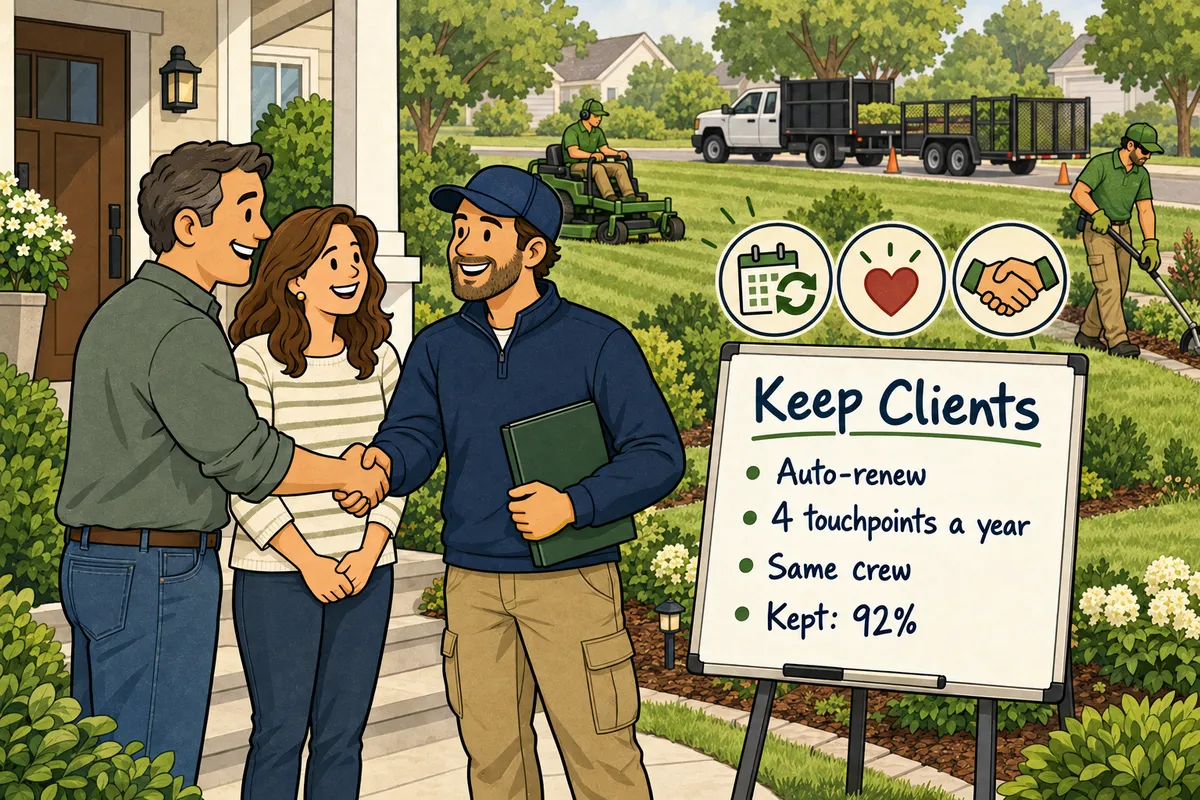
Landscaping client retention comes from three systems, not from charm: agreements that renew automatically with an annual price adjustment, a fixed calendar of four client touchpoints a year, and crews that show up as the same people doing the same standard. A maintenance company keeping 92 percent of clients spends almost nothing on sales; one keeping 75 percent replaces a quarter of its book every spring at $300 to $600 per new account. The difference is usually worth more than any marketing budget.
Updated October 30, 2026
The retention math
| Line | Amount |
|---|---|
| Annual revenue | $4,800 |
| Gross margin at 48 percent | $2,304 per year |
| Average tenure at 92 percent retention | About 12 years |
| Average tenure at 75 percent retention | 4 years |
| Lifetime gross margin, 92 percent | Roughly $27,600 |
| Lifetime gross margin, 75 percent | Roughly $9,200 |
| Cost to replace one client (sales time, quote, onboarding, route disruption) | $300 to $600 |
On a 200-client maintenance book, the gap between 75 and 92 percent retention is 34 clients a year, about $160,000 of revenue to re-sell and $15,000 of replacement cost, before counting the route inefficiency of onboarding new properties scattered across town. Retention is the cheapest revenue you will ever keep. Track it monthly alongside the other numbers on the scorecard.
Agreements that renew by default
A client who has to re-sign every spring is a client you re-sell every spring. Switch maintenance to an evergreen agreement that continues until either side cancels, with an annual rate adjustment clause and a 30-day notice period.
- Term: 12 months, auto-renewing, cancellable with 30 days' written notice after the first season.
- Rate adjustment: stated in the agreement, applied each January with 45 to 60 days' notice, using the method in how to raise landscaping prices.
- Payment: monthly on a card or ACH on file, twelve equal payments, which smooths your cash and removes the invoice-chasing that sours relationships.
- Scope: the visit count, services, and standard on one page, attached and signed once.
Move existing clients over at renewal with a short note: same service, easier billing, no annual paperwork. Most accept; the ones who refuse are telling you something about their intent to stay.
The four-touchpoint calendar
Clients leave quietly, usually because the only contact they had all year was an invoice and a truck. Four scheduled contacts change that, and none of them require the owner.
| When | Touchpoint | Who | Purpose |
|---|---|---|---|
| January or February | Renewal notice with rate and a spring enhancement menu | Office | Lock the season; sell one enhancement |
| May | Property walk with photos and a short report | Crew leader or account manager | Catch issues before the client does |
| August | Mid-season check-in call or text | Office | "Anything we should adjust?" Most say no; the ones who say yes were about to leave |
| October or November | Fall closeout note with next year's dates and a thank-you | Office | Signal you are planning on them |
Put all four in the office admin's calendar as recurring tasks. If you do not have that person yet, that hire pays for itself in retention alone.
Retention is an operations problem
Ask clients who left and they rarely say price. They say the crew changed every week, the gate was left open, nobody called back, the beds looked worse in August than in May. Every one of those is a field process. Same crew on the same route protects the relationship; a closeout checklist protects the gate; a callback logged and fixed within 48 hours protects the trust. Crews that run a complaint script keep clients that an owner answering the phone at 9 p.m. would have lost. If retention is under 90 percent, look at the callback log before you look at the price list.
Build the recurring revenue base
The companies that sell for the highest multiples have 60 percent or more of revenue on recurring agreements, because a buyer can see next year's revenue before the season starts. If your mix is install-heavy, use every install as an entry to a maintenance agreement: quote the first year of maintenance with the install, at a modest discount for signing both. Then sell enhancements (seasonal color, mulch, pruning, lighting) into the maintenance base through the renewal menu and the May walk, rather than through cold leads. Retained clients buy more each year, refer their neighbors on the same route, and cost nothing to find. That is the momentum a landscaping company runs on, and it starts with keeping the clients you already have.
Frequently asked questions
What is a good client retention rate for a landscaping company?
Ninety percent or higher annually for recurring maintenance clients. Between 80 and 90 percent usually means a service consistency problem; under 80 percent means expectations are not being set at onboarding or crews are changing too often. Measure it as clients still active at year end divided by clients at the start, excluding the ones you chose to drop.
How do I get landscaping clients to sign annual contracts?
Offer an evergreen agreement with monthly billing and a clear one-page scope, position it as less paperwork and predictable pricing, and make it the default on every new quote. Most residential clients prefer twelve equal payments to seasonal lump sums once it is offered plainly.
Should I offer discounts to keep clients from leaving?
No. Fix the service problem that made them consider leaving, offer to adjust scope to fit their budget, and hold the rate. Discounts to unhappy clients keep the unhappiness and cut the margin; they also teach the client that threatening to leave works.
Explore 7 Figure Landscape Network's business systems programs or book a strategy call to discuss the operating problem you want to work on. Learn about Jim Wertz and the network.
For the broader strategy process, use Landscaping Business Strategic Plan: A One-Page Framework as your starting guide, then return to the specific issue covered here.
