Should Your Landscaping Business Specialize or Offer Everything?
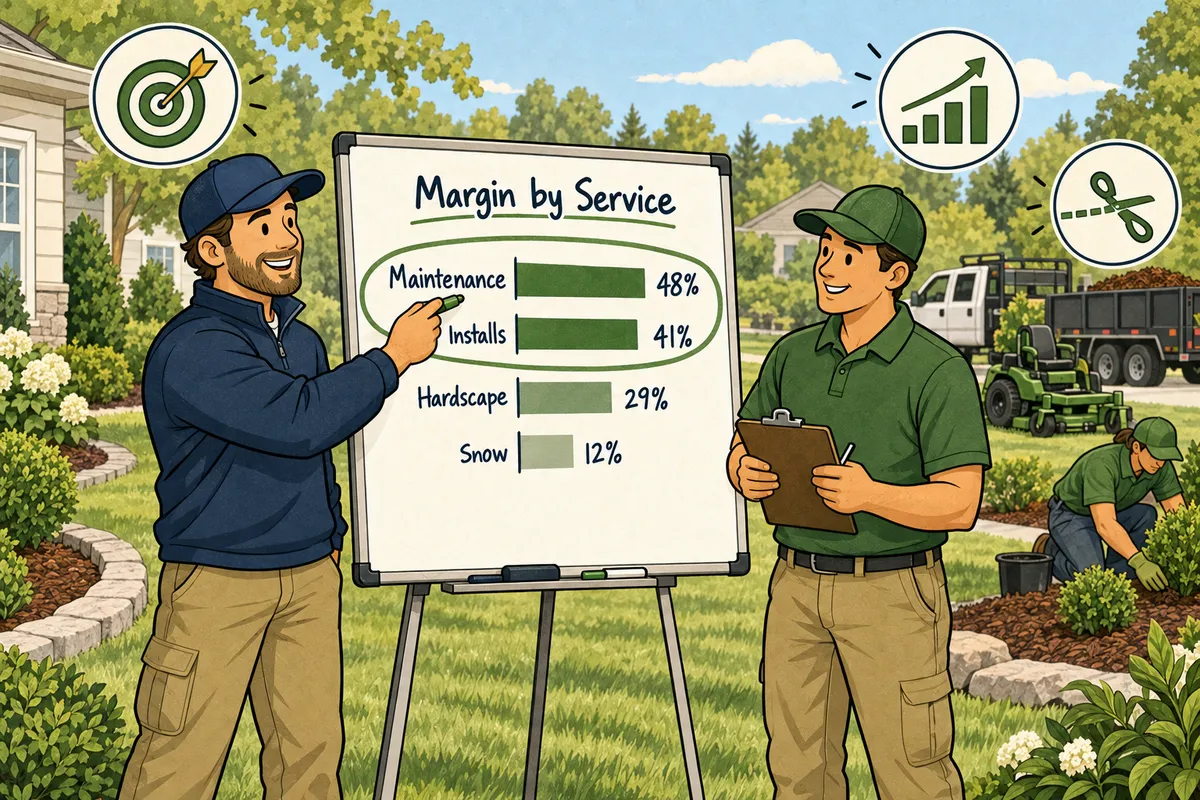
A landscaping business should offer the two or three service lines that clear its margin floor and feed each other, and stop offering the rest. "We do it all" is how most companies reach $1M and how most get stuck there: six service lines, each with its own equipment, training, and estimating errors, none of them run well enough to be profitable. The decision is not about passion or market size. It is a table of gross margin and owner hours by line, and the table usually makes the call for you.
Updated November 2, 2026
The generalist trap
Every added service looked like free revenue at the time. A maintenance client asked for a patio, so you bought a plate compactor. A patio client asked about lighting, so you learned low voltage. Somebody asked about snow. Five years later the company sells eight things, owns equipment for all of them, and the owner is the only person who can estimate six of the eight. Revenue grew. Net margin did not, because each new line arrived at a lower margin than the core and pulled owner hours away from it. That pattern is the growth plateau in most landscaping companies, and it is a strategy problem, not an effort problem.
Build the service line table
Pull twelve months of job data and fill in one row per service line. If you cannot fill the margin column, that is the first finding: you have been running lines without knowing whether they make money. Start with job costing and come back in a quarter.
| Service line | Revenue | Gross margin | Owner hours per week in season | Feeds another line? |
|---|---|---|---|---|
| Recurring maintenance | $620,000 | 48 percent | 4 | Yes: enhancements, installs |
| Enhancements (mulch, color, pruning) | $210,000 | 52 percent | 2 | Yes: sold into maintenance |
| Planting installs | $310,000 | 41 percent | 8 | Yes: maintenance agreements |
| Hardscape | $190,000 | 29 percent | 12 | Rarely |
| Snow | $70,000 | 12 percent | 10 (winter) | No |
Two lines fail the margin floor and consume more than half of the owner's field hours. Hardscape at 29 percent is not a hardscape problem; it is an estimating and crew-skill problem that the company has never had the focus to fix. Snow at 12 percent is a favor to clients that costs money. This company is a maintenance-and-enhancement business with an install arm, and it has been running as a general contractor.
Three models that work at $1M to $3M
| Model | Core lines | Why it works | Where it fails |
|---|---|---|---|
| Maintenance-first | Recurring maintenance, enhancements, small installs | Route density, 60 percent or more recurring revenue, highest sale multiples | Owners who find maintenance boring and chase big installs |
| Design-build specialist | Installs and hardscape, with a maintenance partner | Higher ticket, strong referrals, crews that get very good at one thing | Lumpy cash, estimating errors, winter |
| Niche operator | One client type (HOAs, commercial, estates) across a few services | Fewer, larger accounts; repeatable scope; premium pricing for expertise | Concentration risk; losing two accounts hurts |
Each model can support 15 to 20 percent net. What none of them can support is running two models at once with one owner. Pick by looking at where your margin and your best crews already are, not at what you wish the company was.
How to cut a service line without losing clients
Owners avoid cutting lines because they picture clients leaving. Most do not, if the exit is managed.
- Find a referral partner who does that line well and does not compete on your core. Refer both ways. A hardscape specialist who sends you their maintenance leads is worth more than your hardscape crew ever was.
- Sunset at renewal, not mid-season. Announce it with the renewal notice, name the partner, and finish any committed work.
- Sell the equipment within 90 days using the utilization test. Idle equipment is how cut lines creep back.
- Redeploy the hours. The owner's 12 hardscape hours a week go to estimating installs properly and selling enhancements into the maintenance base, where the margin is.
Track retention on the affected clients for two seasons. In most companies the number does not move, and net margin rises three to five points within a year from the lines that remain.
When adding a line is the right call
Add a service only when it passes four tests: it sells to clients you already have, it clears your gross margin floor in a costed pilot of at least ten jobs, it can be estimated and led by someone other than the owner within one season, and it does not need equipment that fails the utilization test. Enhancements pass all four for a maintenance company; that is why they belong in every maintenance-first model. Snow passes almost none for most residential companies. Run the pilot, review it in your quarterly priorities, and be willing to kill it. A line added with a pilot and a margin floor is strategy. A line added because a client asked is how the generalist trap starts again.
Frequently asked questions
Is it better for a landscaping company to specialize?
For most companies between $500K and $3M, yes: two or three lines that clear a 40 percent gross margin floor and feed each other beat six lines at mixed margins. Specialization raises crew skill, cuts equipment cost, and reduces owner hours. The exception is a genuinely small market where a broader offer is the only way to fill a route.
What is the most profitable landscaping service?
Recurring maintenance with enhancements sold into it typically produces the highest sustained net margin and the highest sale value, because of route density and predictable revenue. Hardscape and design-build can carry higher gross margins per job but require stronger estimating and carry more variance.
Should I stop offering snow removal?
Cost it honestly: labor at overtime rates, equipment wear, insurance, and the owner's winter hours. Many residential companies find snow runs under 15 percent gross margin and exists to "keep the crew busy." If it fails the margin floor, sunset it at renewal and refer clients to a snow specialist.
Explore 7 Figure Landscape Network's business systems programs or book a strategy call to discuss the operating problem you want to work on. Learn about Jim Wertz and the network.
For the broader strategy process, use Landscaping Business Strategic Plan: A One-Page Framework as your starting guide, then return to the specific issue covered here.
