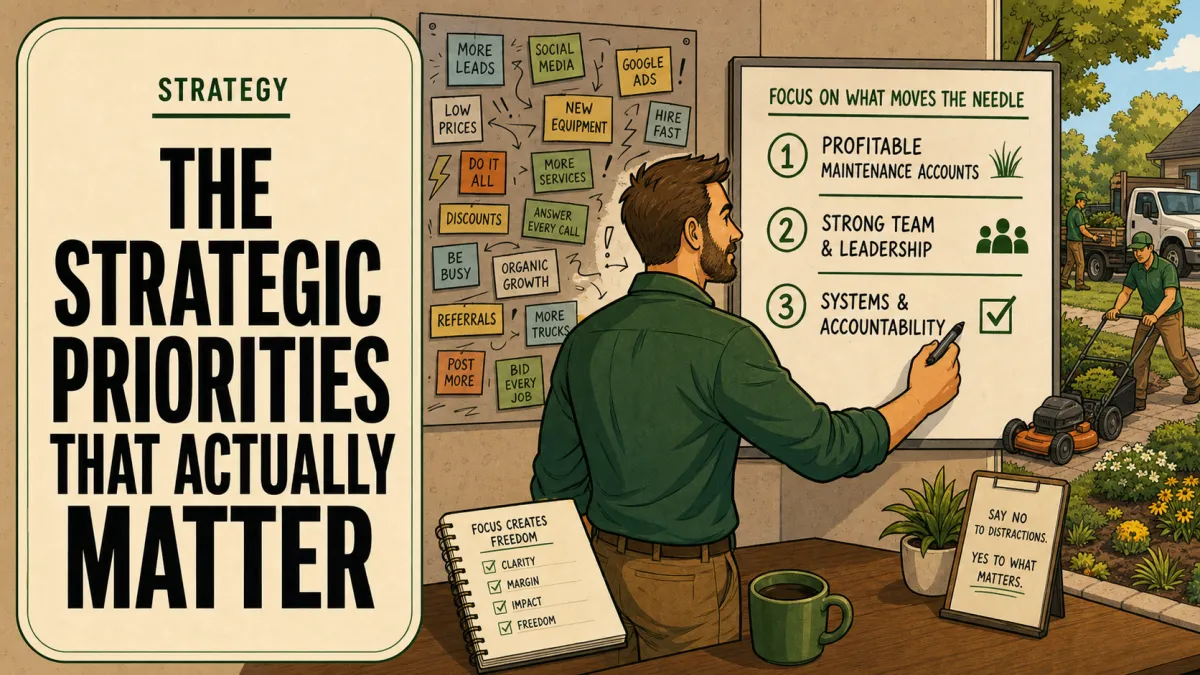
How to Choose Quarterly Priorities for a Landscaping Company
Quarterly priorities for a small business are the two or three changes you commit to finishing in the next 90 days, on top of normal work. For a landscaping company, pick them from a written candidate list, score each one on profit, owner freedom, and risk, and give the winners a named owner and milestones. A long list of good ideas is not a plan until you decide what comes first and what waits.
Updated October 9, 2026
Build a candidate list from evidence
Start with what the business is actually telling you. Pull the last quarter's job variances, customer complaints, missed estimates, crew availability, and the interruptions that hit your phone most often. Look for patterns with real money or real hours behind them.
Write every candidate as a short line. Ten to fifteen is normal. Do not filter yet. The point of the list is to get every idea out of your head and onto one page so you can compare them honestly.
If everything on the list feels urgent, separate true emergencies from important work first using this guide on what to work on when everything feels urgent.
Score candidates on profit, freedom, and risk
Score each candidate from 1 to 5 on three questions. Profit: how much will this improve net profit within a year? Freedom: how many owner hours will it take off your plate? Risk: how much does it reduce the chance of a serious loss, such as an injury, a lost contract, or a key person walking out?
| Candidate | Profit (1–5) | Freedom (1–5) | Risk (1–5) | Total (of 15) |
|---|---|---|---|---|
| Promote a lead foreman with written decision limits | 3 | 5 | 4 | 12 |
| Closeout record on every install before billing | 4 | 3 | 2 | 9 |
| Raise maintenance prices at renewal | 5 | 1 | 3 | 9 |
| Equipment maintenance schedule | 3 | 2 | 3 | 8 |
| Written safety training for new hires | 1 | 1 | 5 | 7 |
| New company website | 2 | 1 | 1 | 4 |
In this example the top three are the lead foreman, the closeout record, and the price increase. Pick three. That is a rule of thumb, but it holds up: a small company running full crews rarely has the people to finish more than three meaningful changes in a quarter.
Do not let the spreadsheet hide judgment. Safety training scores 7 here, but it is an obligation. It gets done as normal work regardless of its score. Use the scores to rank discretionary improvements, never to skip a legal, safety, or contractual requirement.
Turn each priority into an outcome with milestones
"Improve operations" is too broad to finish. "Every installation crew submits a complete closeout record before billing" is an outcome you can check. Write each priority that way, then add one owner and three or four milestones across the quarter.
Weeks 1–2: office manager drafts the closeout form with crew leader input.
Weeks 3–6: two crews use it on every install, and the office logs missing fields.
Weeks 7–10: form revised and rolled out to all crews.
Weeks 11–13: billing confirms 95% of installs arrive with a complete record.
Include the handoff. If the office cannot use the closeout information to bill faster, the project is not finished just because a form exists. Set a baseline too, such as current days from job completion to invoice, so you can see whether anything moved.
Protect the time to finish
Quarterly priorities die quietly. Nobody cancels them. Daily work just eats the hours. Each owner needs reserved time on the calendar, and so do you. Block it before the week fills, using a protected planning block for landscaping owners.
Check progress in the weekly team meeting so it stays in front of everyone. Add one line per priority to the weekly landscaping team meeting agenda: on track, behind, or blocked, and what is needed. Cost exceptions that surface along the way go to the weekly landscaping profit review.
Run the quarterly review
Give the review 90 minutes in the last week of the quarter. Use this checklist:
For each priority, compare the result with the baseline. Done, partly done, or not done.
Decide what happens to unfinished work: carry it forward, cut it, or shrink it.
Rebuild the candidate list with the new quarter's evidence.
Score, pick three, name owners, and set milestones.
Check that the new three still point toward your longer-term direction.
Quarterly priorities are the short-term layer. The longer view comes from three questions that set your landscaping business direction and a one-page landscaping strategic plan. If a priority cannot be tied to either, ask why it is on the list.
Frequently asked questions
How many quarterly priorities should a small landscape business choose?
Three is a good default. Choose only as many as your people can finish alongside normal delivery work. A short list of clear outcomes beats a long list that is half done at the end of the quarter.
What makes a priority measurable?
State what will exist or behave differently, who owns it, and how you will check it. Include a baseline when the goal is a change in performance, such as days to invoice or owner field hours.
Should priorities change during the quarter?
Change them when new evidence or an obligation justifies it, and decide out loud what stops or moves to make room. Adding priorities without dropping any usually leaves everything partly finished.
Explore 7 Figure Landscape Network's business systems programs or book a strategy call to discuss the operating problem you want to work on. Learn about Jim Wertz and the network.
For the broader business planning and growth process, use Landscaping Business Strategic Plan: A One-Page Framework as your starting guide, then return to the specific issue covered here.
