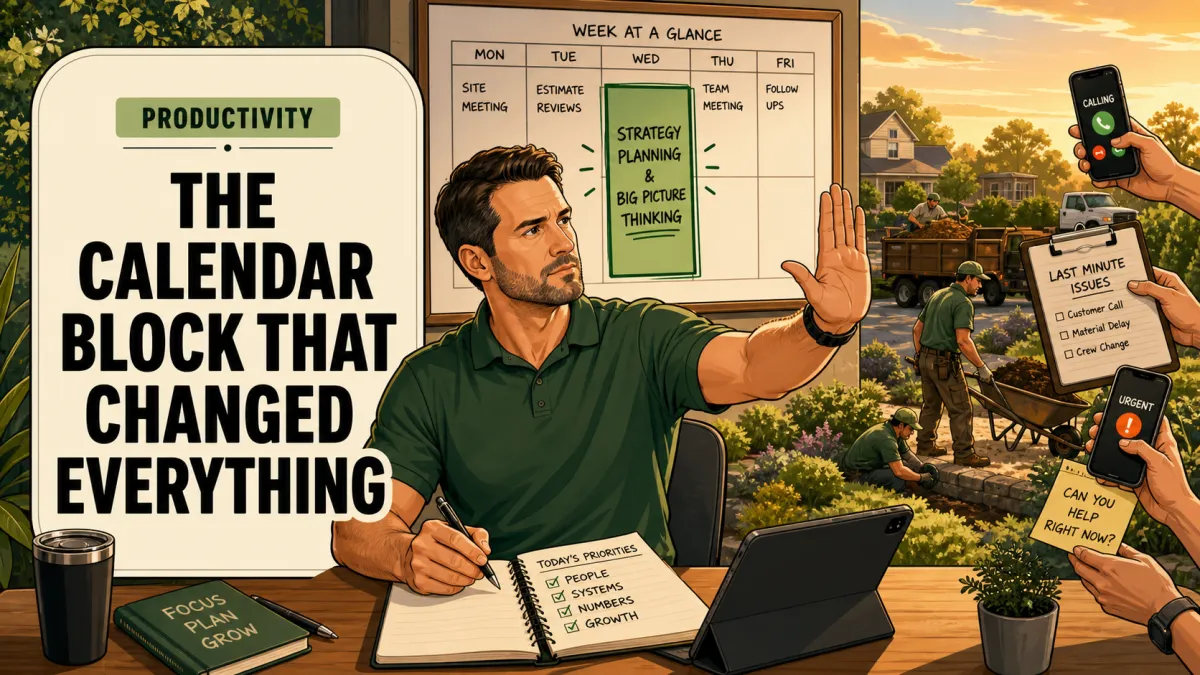
How to Protect Planning Time as a Landscaping Business Owner
Time blocking for business owners works when each block has a job, a defined output, and someone covering operations while you're in it. For a landscaping owner that usually means four recurring blocks a week: planning, sales, review, and field time with a cap on it. An empty block on the calendar is easy to give away. A block tied to next month's crew capacity or a finished pricing review is much harder to surrender.
Updated October 9, 2026
Why owner calendar blocks get given away
Most owners have tried blocking time. It lasts about a week. The block says "planning," nobody knows what that means, and the first crew call wins.
Blocks fail for three reasons. They have no defined output, so skipping one costs nothing visible. Nobody is covering the phone, so the field keeps pulling you back. And field time has no limit, so it expands to fill whatever the week leaves open. Fix those three and the calendar starts to hold.
If you aren't sure where your hours go today, run an owner time audit first. It shows how much room you actually have to block.
A weekly owner calendar template
Here's a starting template for an owner with two to four crews. Adjust the days to your route schedule, but keep the four block types and the output column.
| Day | Block | Time | Output |
|---|---|---|---|
| Monday | Planning | 7:30 to 9:30 | Week's priorities set, crew capacity checked, one decision made |
| Tuesday | Sales | 1:00 to 4:00 | Estimates priced and sent, follow-ups done |
| Wednesday | Field (capped) | 7:00 to 12:00 | Crew leader coached, quality walk on two jobs |
| Thursday | Sales | 1:00 to 4:00 | Site visits and remaining estimates |
| Friday | Review | 1:00 to 2:30 | Job costs checked, cash reviewed, next week's open questions listed |
That's about 15 blocked hours. The rest of the week stays open for calls, meetings, and the unexpected, which is why the blocks can hold. If you also run a weekly team meeting, put it on a fixed slot using the weekly landscaping meeting agenda so it doesn't eat a block.
What to do inside each block
Decide the deliverable before the block starts. A block without an output turns into inbox time.
Planning: one decision you've been putting off, such as next month's crew capacity, a staffing change, or a crew leader's development plan. Tie it to the quarterly priorities you already set, so the week moves the quarter forward. Before the season, this block covers preseason capacity and equipment planning.
Sales: pricing, site visits, follow-up calls. Have the office queue up the leads and paperwork beforehand.
Review: compare finished jobs against their estimates, check cash, and turn exceptions into assigned actions through the weekly landscaping profit review.
Field: coaching and quality walks with a purpose. You are there to build the crew leader, not to fill in on the mower.
Example: an owner uses a Friday review block to compare three completed installs against their estimates. The office pulls the cost records Thursday, and the crew leader handles dispatch. The output is one revised production assumption to test on the next comparable estimate.
Cap your field time
Field time is where blocks go to die. There's always a crew short a person or a job running behind, and the owner is the easiest fill-in.
Pick a number of field hours per week, write it down, and schedule them like any other block. Start where you are. If you're in the field 30 hours today, cap it at 24 for a month, then 18. When a crew is short, the first question is who else can cover. You come last on that list.
Track every time you blow the cap and why. If it's always the same crew or the same task, that is a staffing or training problem the review block should take on.
Defend the blocks
A block nobody else knows about is just a wish. Defending it takes a few rules.
Put every block on the shared calendar so the office and crew leaders can see it.
Name who handles routine questions during each block, and write down the short list of exceptions that can interrupt you.
If a block gets interrupted, note why. Repeated interruptions point to missing coverage or a missing rule.
Move a lost block to another slot in the same week. Never delete it.
Every few weeks, check whether the blocks produced results rather than just counting hours blocked.
Cutting the interruptions themselves is its own job, covered in how to reduce morning interruptions.
Frequently asked questions
How much planning time should a landscaping owner block?
Start with enough time to finish one important decision using prepared information, often 90 minutes to two hours a week. Add more only when coverage holds and the blocks are producing useful outputs.
What should I work on during a protected planning block?
Work that improves future operations, such as reviewing job costs, setting capacity limits, or developing a leader. Define the deliverable before the block starts and leave with a decision or an assigned action.
How do I prevent interruptions without ignoring crews?
Name a backup decision-maker, give crews written limits, and set a place for nonurgent questions. Keep a clear route for genuine safety or customer emergencies.
Explore 7 Figure Landscape Network's business systems programs or book a strategy call to discuss the operating problem you want to work on. Learn about Jim Wertz and the network.
For the broader owner time and office support process, use When to Hire an Office Administrator for Your Landscaping Business as your starting guide, then return to the specific issue covered here.
