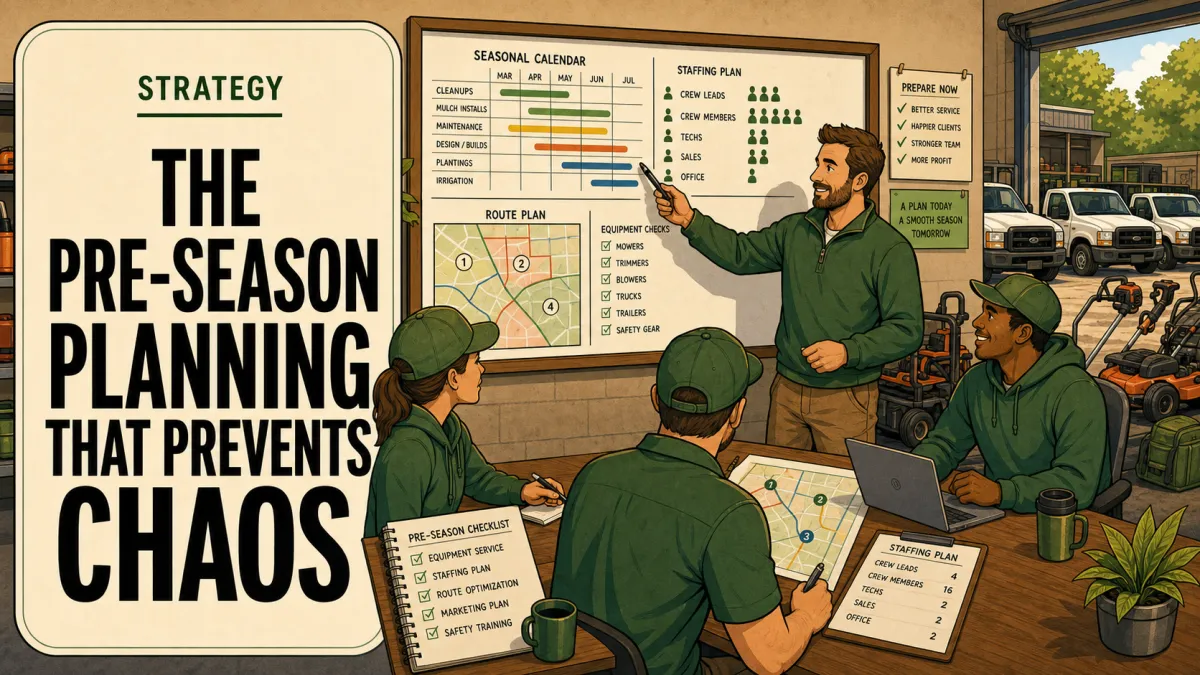
Landscaping Preseason Planning: Capacity, Equipment, and Crew Readiness
A landscaping preseason planning checklist lines up sold work, crew capacity, hiring, equipment service, supplier orders, cash, and client renewals before the schedule fills. Work backward from your first committed job and give every task a date and a name. A sales target alone does not tell you whether the first busy month will run smoothly or fall apart in week two.
Updated October 9, 2026
Work backward from the first committed job
Pick the date your first crew rolls on paid work. That is week zero. Every preseason task gets a deadline counted back from it, based on your longest lead times: how long it takes to hire and train a crew member, how long your mechanic is booked out, and how far ahead your suppliers need orders.
The common failure is planning in the order things come to mind, then starting to hire the week the phones explode. Working backward puts the slow items first.
This checklist is about readiness. Deciding what the company should focus on this year is a separate exercise, so set those goals with quarterly priorities for your landscaping company and let this list handle getting the operation ready.
The preseason timeline
Adjust the weeks to your own lead times. The order matters more than the exact dates.
| Weeks before start | Task | Who owns it | Done when |
|---|---|---|---|
| 16 | Send renewal agreements and price changes to maintenance clients | Owner or office | Every renewal signed, declined, or followed up |
| 14 | Build the capacity calendar from renewed and sold work | Owner or operations lead | Sold crew-days compared with sellable crew-days |
| 12 | Post open roles and start interviews | Owner or office | Offers accepted with start dates |
| 10 | Book equipment service and order wear parts | Shop lead | Every machine inspected and tagged ready |
| 8 | Confirm supplier pricing, lead times, and early orders | Purchasing or owner | Orders placed for the first four weeks of work |
| 6 | Write the cash plan for the first eight weeks | Owner and bookkeeper | Payroll and materials covered before collections arrive |
| 4 | Onboard new hires and run safety training | Crew leaders | Each hire trained on the equipment they will run |
| 2 | Run a practice dispatch day with load lists | Operations lead | Trucks loaded and out on time without the owner |
| 1 | Confirm start dates with the first customers | Office | Every first-month customer contacted |
Build a realistic capacity calendar
Most spring chaos comes from selling days you do not have. Start from people and working days, then subtract everything that is not production.
Example: two crews have twenty working days each in the first month, which is 40 crew-days. Subtract 2 days of training, 1 day of scheduled equipment maintenance, and 1 day of known leave, and you have 36. Hold back about 10% for weather and disruption, roughly 4 crew-days, and you can sell 32.
Now estimate the sold work using production rates from last season's actual job costs. Bid-sheet rates tend to run optimistic. If that work needs 34 crew-days, you are already 2 crew-days over before the season starts. The answer is revised start dates or carefully chosen outside help, not another promise that everyone will work faster.
Hiring and equipment readiness
Hiring has the longest lead time of anything on the list, so it starts early. Write down what each open role must do on day one before you post it, and use a landscaping hiring process that defines the job before interviewing. A hire who starts the week of the rush goes out untrained, and your crew leader pays for it all spring.
Equipment gets a full pass before it is needed. Finding a bad belt on the first big job can cost a whole crew-day. Use this checklist for every machine:
Service completed and logged: oil, filters, belts, blades, tires.
Wear parts on the shelf for the first month.
Trailers inspected: lights, brakes, straps, ramps.
Each operator trained and signed off on the machine they will run.
A written plan for who decides what when something breaks in the field. Build it with this landscaping equipment breakdown plan for crews.
Supplier orders, cash, and client renewals
Supplier orders. Confirm pricing and lead times for your high-volume materials, then place orders for the first four weeks of sold work. Readiness gaps that slip through show up at 6:30 a.m., so close them before crews leave with the morning dispatch checklist.
Cash plan. Spring is when cash goes out fastest and comes in slowest. Example: nine field employees at 45 hours a week and $22 an hour cost $8,910 a week, or $35,640 for the first four weeks. Add $18,000 of early materials and you need $53,640 out the door before net-30 invoices start paying. If that number makes you nervous, read what to check when revenue is up but cash is tight while there is still time to act on it.
Client renewals. Send renewals early, with any price change stated plainly. Every signed renewal goes on the capacity calendar. Every unanswered one is a gap you need to know about by week fourteen.
Review the open items every week until the timeline is complete, and connect the season to your wider goals with a one-page landscaping strategic plan.
Frequently asked questions
When should preseason planning start?
Start early enough to cover your longest lead time, which is usually hiring and training. For many companies that means about four months before the first production day. Work backward from your first committed jobs rather than relying on a calendar habit.
What belongs on a landscaping preseason checklist?
Client renewals, a capacity calendar, hiring, equipment service, supplier orders, a cash plan, safety training, and a practice dispatch day. Each item needs an owner and a deadline, reviewed weekly until done.
Should I sell all available crew capacity?
No. Subtract training, maintenance, and leave first, then hold back a margin for weather and disruption. A schedule with no slack turns one rainy week into a month of missed promises.
Explore 7 Figure Landscape Network's business systems programs or book a strategy call to discuss the operating problem you want to work on. Learn about Jim Wertz and the network.
For the broader business planning and growth process, use Landscaping Business Strategic Plan: A One-Page Framework as your starting guide, then return to the specific issue covered here.
