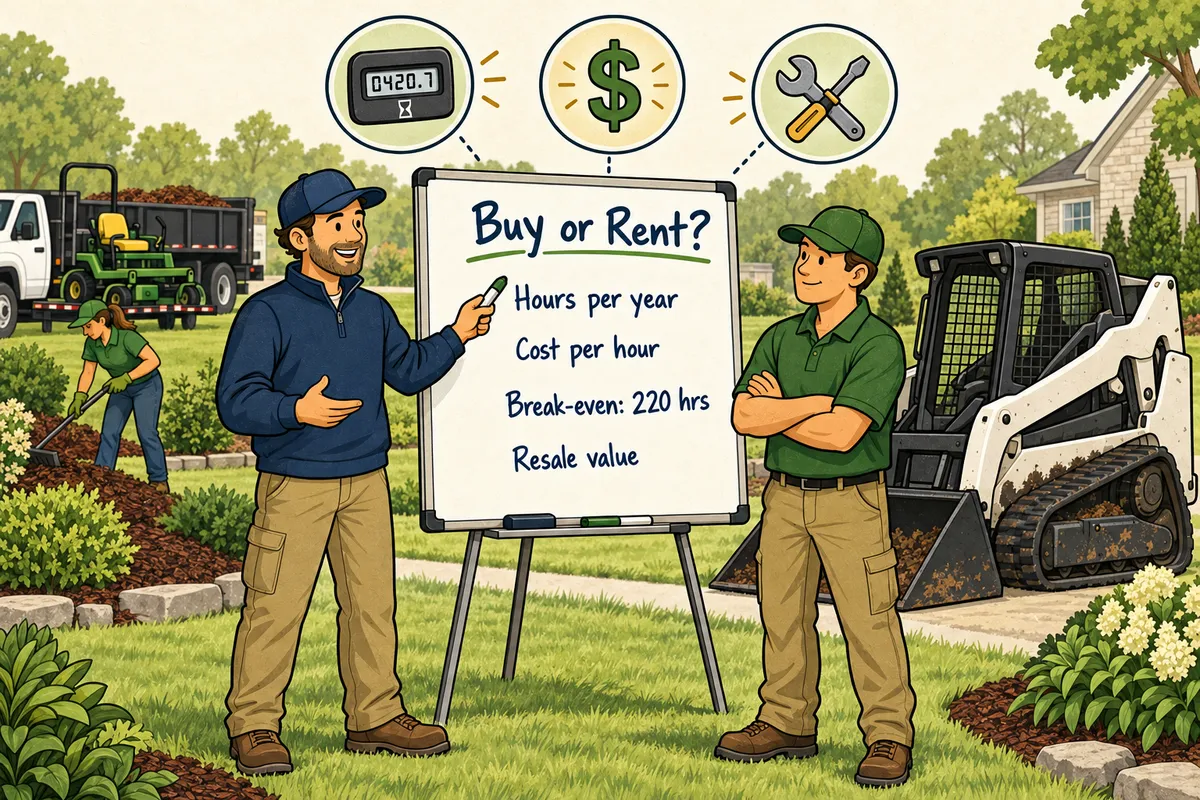
Landscaping Equipment: Buy, Lease, or Rent? A Utilization Test
Buy landscaping equipment when you will run it more hours a year than the break-even between owning cost per hour and rental cost per hour, usually 200 to 300 hours for a skid steer or mini excavator. Rent below that. Lease when you need the machine more than the break-even but cash or obsolescence makes ownership risky. The test takes ten minutes with last season's hour meter readings, and it usually shows that the second skid steer was a want, not a need.
Updated October 28, 2026
Cost of owning per hour
Owners compare the monthly payment with the rental rate and stop there. The payment is about half the real cost. Owning cost per hour has six parts:
- Depreciation: purchase price minus expected resale, spread over the years you will keep it.
- Interest: on the financed amount, or the return the cash could have earned.
- Insurance and registration: inland marine coverage on a skid steer runs $600 to $1,500 a year.
- Maintenance and repairs: budget 8 to 12 percent of purchase price per year for machines with engines and hydraulics; more after warranty.
- Storage and transport: yard space, plus the trailer and truck hours to move it, which are not free.
- Downtime: every breakdown costs crew hours; see the downtime math.
Add those up for a year and divide by the hours you will actually run it. That is your owning cost per hour, and it falls as hours rise, which is the whole point of the test.
The break-even utilization test
Pull the hour meter reading from last season for the machine you have, or estimate from the job list for the one you want: jobs per year × machine hours per job. Then:
- Fixed annual owning cost = depreciation + interest + insurance + storage (these do not change with hours).
- Variable cost per hour = maintenance and fuel per hour.
- Rental cost per hour = daily or weekly rate ÷ productive hours per rental period, plus delivery.
- Break-even hours = fixed annual owning cost ÷ (rental cost per hour − variable cost per hour).
Above break-even, buy. Below it, rent. Within 20 percent of it, rent for one more season and re-run the numbers, because estimates of future hours run optimistic in exactly the way growth plans do.
Worked example: a $55,000 skid steer
| Line | Amount |
|---|---|
| Purchase price | $55,000 |
| Expected resale after 5 years | $25,000 |
| Depreciation per year | $6,000 |
| Interest (7 percent on average balance) | $2,100 |
| Insurance | $1,100 |
| Storage and trailer share | $1,200 |
| Fixed annual owning cost | $10,400 |
| Maintenance, repairs, and fuel per hour | $14 |
| Rental: $425 per day, 6 productive hours, plus delivery | $82 per hour |
| Break-even hours | $10,400 ÷ ($82 − $14) = 153 hours per year |
At 153 hours, owning and renting cost the same. At 300 hours a year, owning costs about $49 an hour against $82 renting, saving roughly $10,000 a year. At 80 hours, owning costs $144 an hour and the machine is a $5,000-a-year lawn ornament. Most $1M companies run their first skid steer 250 to 400 hours and their second under 120. That is the machine to sell, and the equipment hourly rate in your pricing model should reflect the real hours, not the hoped-for ones.
When leasing makes sense
Leasing is not a middle option between buy and rent; it is a financing choice for a machine you already know clears break-even. It fits three situations. Cash is tight and a lease preserves the line of credit for payroll. The machine's technology moves fast (electric handhelds, GPS-guided anything) and you do not want to own it in year six. Or you want a fixed maintenance cost, which some full-service leases include. It does not fit a machine under break-even; the lease payment just makes an underused machine cheaper to keep ignoring. Compare lease cost per hour the same way, and confirm the tax treatment with your accountant, because how a lease is written changes what you can deduct and when.
The "need versus nice" checklist
Before any purchase over $10,000, answer all five in writing. If any answer is no, rent.
- Do we have hour-meter or job-count evidence that this machine will clear break-even in year one, not year three?
- Does it shorten a job type we already sell profitably, or does it require us to sell a new service to justify it?
- Is there a trained operator on staff today, and a second one within 90 days, so the machine is not idle when one person is out?
- Is there a breakdown plan and a maintenance schedule with an owner, or will it be run until it stops?
- Would we still buy it if the crew never saw it? Machines bought because a competitor has one, or because the crew asked in July, rarely pass the first question.
Run the same test every winter on what you already own. A yard with three trucks running 700 hours each and one running 150 has a truck to sell, and the cash from it is usually worth more in the profit account than in the yard.
Frequently asked questions
Is it better to rent or buy a skid steer for landscaping?
Buy if you will run it more than roughly 150 to 250 hours a year, depending on price, resale, and local rental rates; rent below that. Pull the exact number from the break-even formula above using your own figures, and rent one more season if you are within 20 percent of it.
Should I buy used landscaping equipment?
Used lowers depreciation and interest, which drops the break-even, but raises repair risk and downtime. It works well for simple machines (trailers, walk-behind mowers) and for a second unit of something you already know how to maintain. For your primary production machine, warranty coverage is usually worth the premium.
How do I calculate an equipment hourly rate for estimating?
Divide total annual owning cost (fixed plus variable) by the hours you actually ran the machine last year. Charge that rate in every estimate the machine touches. If the rate is higher than a rental, you have found a machine to sell.
Explore 7 Figure Landscape Network's business systems programs or book a strategy call to discuss the operating problem you want to work on. Learn about Jim Wertz and the network.
For the broader daily operations process, use Landscaping Daily Operations: Dispatch, Checkpoints, and Closeout as your starting guide, then return to the specific issue covered here.
