How to Price Landscaping Services: Markup, Margin, Worked Example
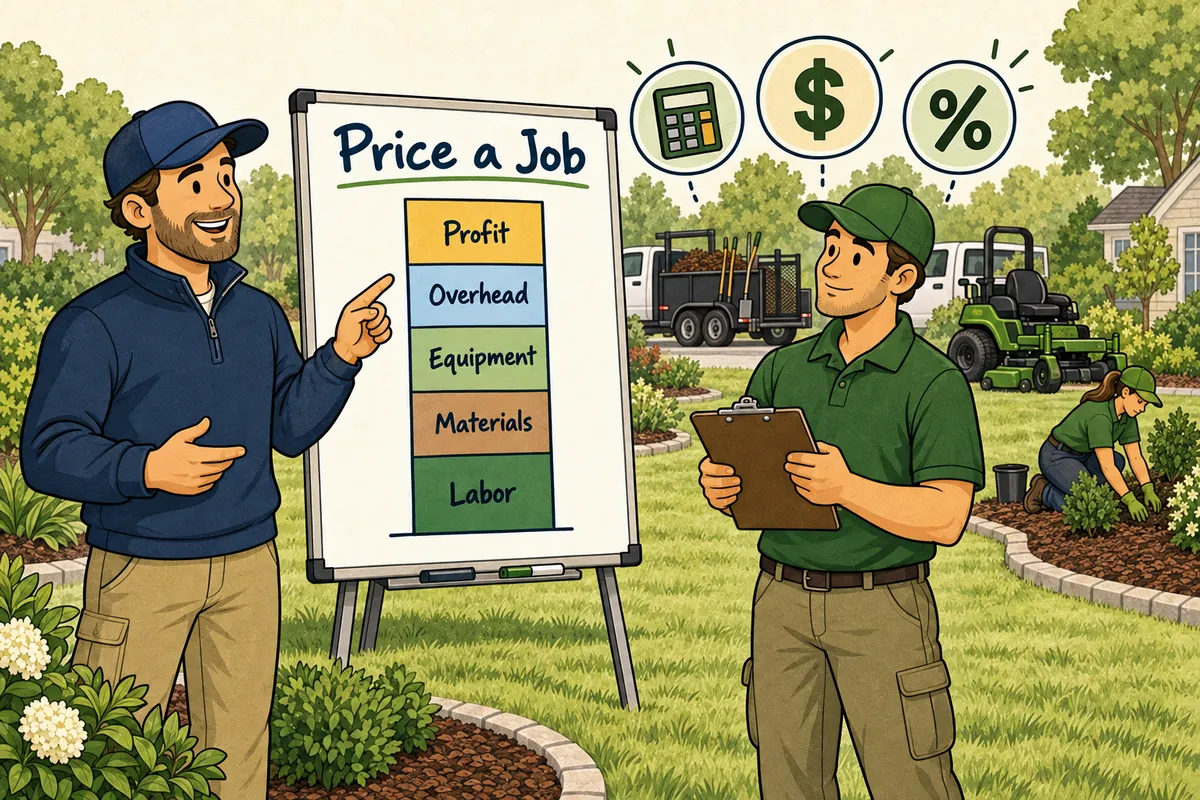
Price landscaping services from the bottom up: burdened labor cost plus materials plus equipment plus a share of overhead, then add the profit you want as a margin on price, not a markup on cost. Most owners who "add 30 percent" end up at 8 percent net because they mark up bare wages, forget overhead, and confuse markup with margin. The worked example below shows the difference on one $5,000 install.
Updated October 12, 2026
Markup versus margin: the mistake that costs 7 points
Markup is a percentage added to cost. Margin is the percentage of the final price that is profit. They are not the same number, and the gap grows as the percentage grows.
| Markup on cost | Resulting margin on price |
|---|---|
| 20 percent | 16.7 percent |
| 30 percent | 23.1 percent |
| 40 percent | 28.6 percent |
| 50 percent | 33.3 percent |
| 100 percent | 50 percent |
If your target is 30 percent gross margin and you apply a 30 percent markup, you are 7 points short on every job before anything goes wrong. The formula to get from a margin target to a price is price = cost ÷ (1 − margin). For a 30 percent margin, divide cost by 0.70, not multiply by 1.30.
Build the price from real costs
Every price starts with four cost buckets. If you do not know these numbers for your company, start with the job costing worksheet and cost 20 recent jobs before you reprice anything.
- Burdened labor. Wage plus payroll taxes, workers' comp, benefits, paid time off, and unbilled time (drive, load, breaks). A $22 wage is typically $30 to $34 burdened. Use the burdened number in every estimate.
- Materials. Delivered cost including tax, waste (5 to 10 percent on plants and mulch), and the time someone spends sourcing them.
- Equipment. An hourly rate per machine that recovers purchase, fuel, maintenance, and repairs over its life. A $14,000 zero-turn used 800 hours a year for five years is roughly $9 to $12 an hour all-in.
- Overhead. Everything that is not a job: rent, insurance, office staff, software, trucks not on a job, and your own salary. Total it for the year and divide by billable field hours to get an overhead rate per labor hour. On a $1.2M company with 9,000 billable hours and $260,000 of overhead, that is about $29 per hour.
Direct costs plus overhead recovery is your break-even. Profit goes on top. If your own field time is not in either labor or overhead, you are pricing as if you work for free. See the real math of owner labor.
Worked example: a $5,000 planting install
| Line | Calculation | Amount |
|---|---|---|
| Labor | 3 crew × 8 hours × $32 burdened | $768 |
| Materials | $1,650 delivered + 8 percent waste | $1,782 |
| Equipment | Skid steer 4 hours × $45; truck and trailer 8 hours × $18 | $324 |
| Direct cost | — | $2,874 |
| Overhead recovery | 24 labor hours × $29 | $696 |
| Break-even | — | $3,570 |
| Price at 15 percent net | $3,570 ÷ 0.85 | $4,200 |
| Price at 20 percent net | $3,570 ÷ 0.80 | $4,463 |
The owner who quotes this job at "$2,874 plus 30 percent" charges $3,736 and books a $166 profit, about 4 percent, before the first callback. The owner who quotes $4,200 is not overcharging. They are covering the office, the trucks, and the fact that somebody has to answer the phone. The client sees the same crew, the same plants, and the same result.
Set a price floor for each service line
Maintenance, installs, hardscape, and enhancements carry different labor intensity, material share, and risk. One blended markup underprices the risky work and overprices the easy work. Set a minimum margin per line and refuse jobs that fall under it.
| Service line | Gross margin floor | Why |
|---|---|---|
| Recurring maintenance | 45 to 55 percent | Predictable, route-dense, low material; overhead is the main cost |
| Planting and softscape installs | 40 to 50 percent | Material heavy; plant losses and callbacks are real |
| Hardscape | 40 to 45 percent | Highest labor variance and equipment cost |
| Enhancements and one-offs | 50 percent or more | Small jobs carry disproportionate drive and setup time |
Gross margin here is after direct costs and before overhead, which is why the floors look higher than the net targets above. Check your actual results with a weekly profit review, and if a line consistently misses its floor, fix the estimate before you fix the crew.
Three pricing habits that leak profit
- Pricing from last year's quote. Labor is up, mulch is up, insurance is up. A quote copied from 2024 is a discount you did not intend to give. Rebuild the rate sheet every January and every time a burdened labor rate changes by more than 5 percent.
- Estimating hours from memory. Owners remember the good days. Compare estimated hours with actual hours on the last 20 jobs; most companies find a 10 to 20 percent gap. Labor overruns are usually estimating errors in disguise.
- Discounting to win. A 10 percent discount on a job at 15 percent net removes two-thirds of the profit. If you need the work, negotiate scope, not price. And once your model is right, learn how to raise prices on existing clients without losing the good ones.
Frequently asked questions
Should I use markup or margin to price landscaping jobs?
Use margin. Decide the share of the final price you want to keep, then divide total cost by one minus that share. A markup on cost always understates profit, which is why a 30 percent markup yields only a 23 percent margin. For margin targets and how to raise them, see how to improve landscaping profit margins.
How much should I charge per hour for landscaping labor?
Take burdened labor cost per hour, add your overhead rate per labor hour, then divide by one minus your net margin target. A $32 burdened rate plus $29 overhead at a 15 percent target gives $72 an hour. Your market will not care about the math, but your P&L will.
Should I show hourly rates or a flat price to clients?
Quote flat prices built from the hourly model. Clients buy outcomes, and an hourly figure invites comparison with the guy with one truck and no insurance. Keep the hours internal and use them to check estimates against actuals.
Explore 7 Figure Landscape Network's business systems programs or book a strategy call to discuss the operating problem you want to work on. Learn about Jim Wertz and the network.
For the broader job costing process, use Landscaping Job Costing: A Worksheet and Worked Example as your starting guide, then return to the specific issue covered here.
