Plan Landscaping Growth Before Adding Crews and Equipment
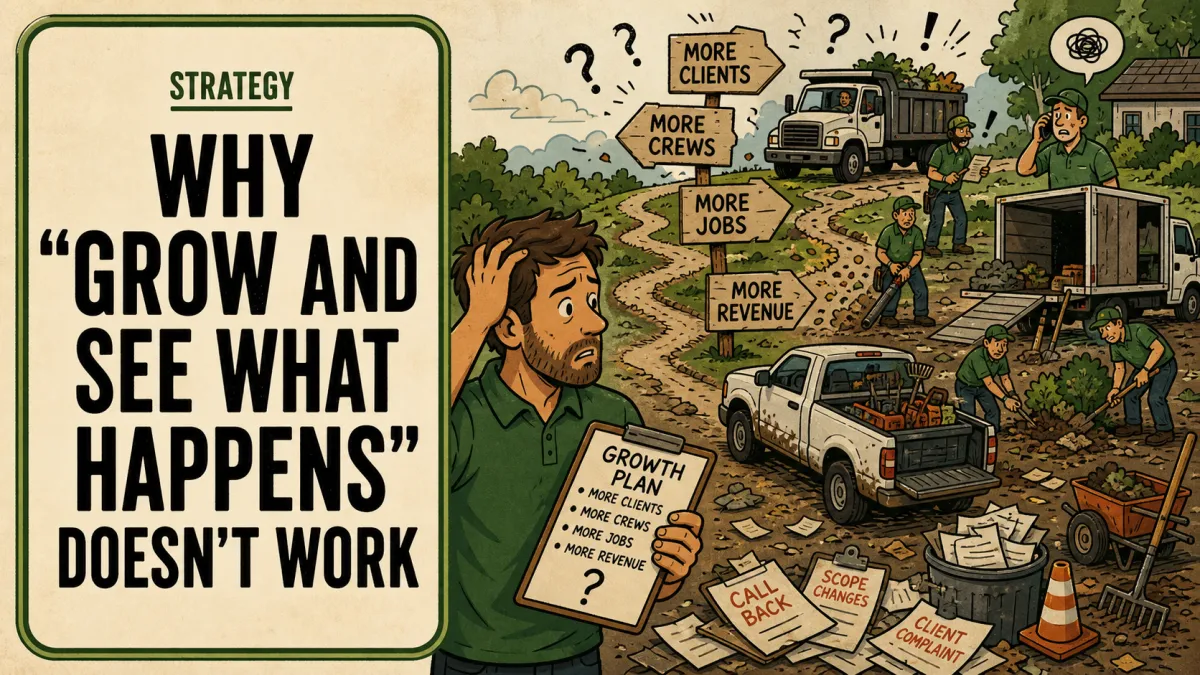
A landscaping business growth plan fits on one page: a revenue target, where that revenue will come from, the crews, people, and equipment needed to deliver it, the cash needed before it gets paid, and a trigger that decides when each addition happens. "Grow and see what happens" skips all of that. It usually ends with payroll that arrives before the work does and an owner covering the gap with longer days.
Updated October 9, 2026
What goes on a one-page growth plan
Keep it to five blocks. If a block is blank, you are guessing.
Revenue target: the number, the date, and which services or customer segments will produce it.
Capacity needed: crews, people, supervision, and equipment, plus how long a new crew takes to reach reliable output.
Cash needed: what goes out before the new work pays, including recruiting, training, payroll, and equipment.
Milestones: what should be true by each month, so you can tell early if the plan is off track.
Triggers: the condition that has to be met before each new hire or purchase.
Before you write a target, check that the work is worth growing. Actual job costs have to support the pricing, or growth just multiplies a margin problem. Compare estimates with real delivery costs using the landscaping job-cost worksheet. And if revenue has been flat for a while, first find out what is really causing your growth plateau, because a growth plan cannot fix the wrong constraint.
Worked example: from $850K to $1.1M
Example: a company at $850K wants to reach $1.1M next season, mostly through maintenance contracts. Here is its one-page plan.
| Plan block | Detail | Number |
|---|---|---|
| Revenue target | From $850,000 to $1,100,000 by end of next season | +$250,000 |
| Source 1 | 50 new maintenance contracts at $3,000 per year | $150,000 |
| Source 2 | Enhancement work sold to existing clients | $100,000 |
| People | One new crew: a crew leader and two technicians | 3 hires |
| Equipment | Truck $55,000, trailer $10,000, zero-turn $18,000, handheld tools $12,000 | $95,000 |
| Cash: payroll before collections | 3 people x 45 hours x $24 average x 6 weeks | $19,440 |
| Cash: equipment down payment | 20% of $95,000 | $19,000 |
| Cash: recruiting and training | Job ads, onboarding time, safety training | $4,000 |
| Total cash needed up front | Payroll + down payment + recruiting | $42,440 |
That $42,440 has to exist before the first new contract pays. A full season of forecast revenue is not cash in the bank today. Add the time a new crew needs before it runs at the same pace as your experienced ones, and the true number is often higher.
Supervision belongs in the plan too. If the person who would train the new crew is already stretched, the plan needs a leadership answer, not just a truck.
Set a trigger for every addition
Triggers stop you from buying capacity on hope. Each addition waits until its condition is met:
Hire the crew leader when 30 of the 50 target contracts are signed.
Hire the two technicians when the crew leader is in place and signed work fills at least eight weeks of the new crew's schedule.
Buy the truck and trailer only once the full crew is hired.
Add office help when the owner's admin work goes past 15 hours a week for a month.
Write the trigger next to every line of the plan. When someone pushes to buy early, the trigger answers the question so you do not have to argue it.
Going from two crews to four brings its own routing and supervision problems. That is a separate topic. This plan decides whether and when.
Test a slower scenario before you commit
Now run the same plan with worse assumptions. Suppose only 60% of the target contracts sign, which is 30 contracts and $90,000 instead of $150,000, and the new crew starts four weeks late.
Ask what you can still sustain. In this example, the trigger for the crew leader is still met at 30 contracts, but the trigger for the full crew may not be. The sensible move might be to hire the leader, have that leader take over existing work, and push the equipment purchase to the next milestone. You find that out on paper, before payroll is committed.
Use scenarios as decision tools. They are not predictions, and they work best when updated from actual results.
Review the plan every month
Put a monthly review on the calendar and check these items:
Contracts signed against the milestone.
Cash on hand against the cash plan.
Which triggers have been met, and which purchases are now approved.
New crew output against your experienced crews, by job type.
Assumptions that turned out wrong, updated in the plan.
Line up the new crew's first month with the landscaping preseason planning checklist, and resolve readiness gaps before crews leave using the morning dispatch checklist.
If you are budgeting for outside help with your growth plan, here is what a landscaping business coach costs.
Frequently asked questions
What should I check before adding a landscaping crew?
Check that demand is repeatable, that job costs support your pricing, and that you have qualified people, supervision, equipment, and cash. Then set a trigger, such as a number of signed contracts, that must be met before you hire.
Why can rapid growth reduce landscaping profit?
Training time, new overhead, inefficient routes, underpricing, and cash gaps can grow faster than the profit from new work. Check job and company records each month to see which one is eating the margin.
What is a useful growth forecast?
One that shows expected work, realistic capacity, direct costs, new overhead, and payment timing, then tests a slower scenario. Give it a review date so you compare the forecast with actual results instead of filing it away.
Explore 7 Figure Landscape Network's business systems programs or book a strategy call to discuss the operating problem you want to work on. Learn about Jim Wertz and the network.
For the broader business planning and growth process, use Landscaping Business Strategic Plan: A One-Page Framework as your starting guide, then return to the specific issue covered here.
