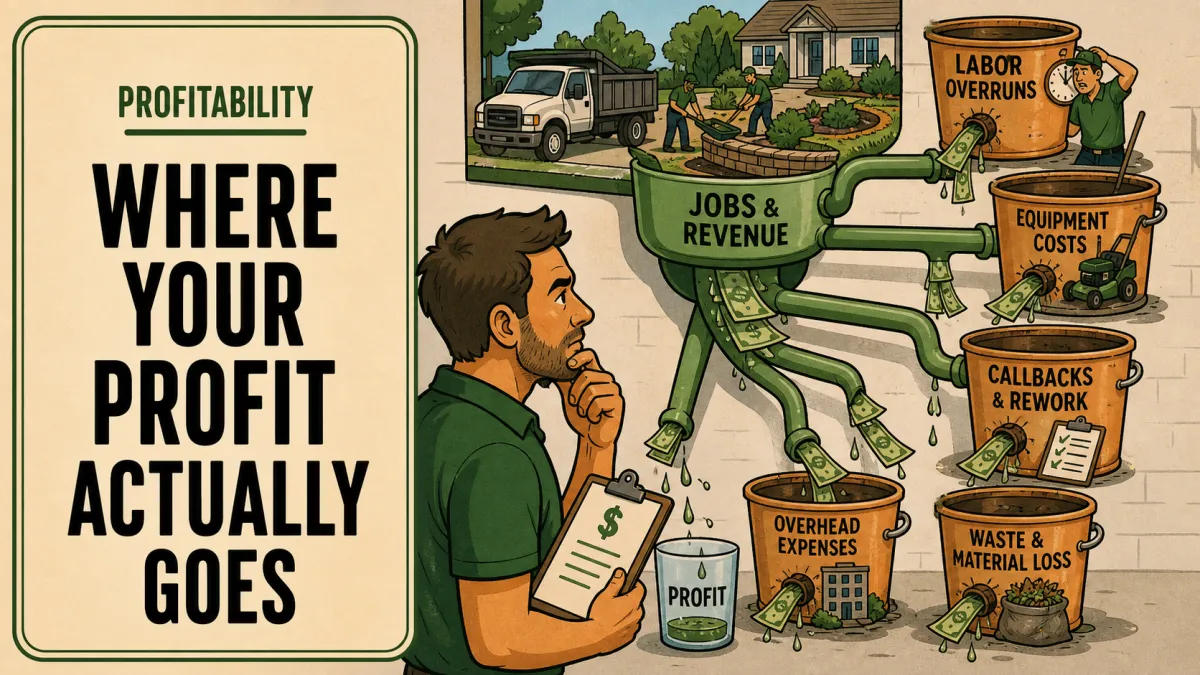
Where Landscaping Profit Goes: Reconcile Job Margin and Cash
Your landscaping profit and loss statement and your bank balance answer different questions. The P&L shows whether the work earned money after job costs and overhead; the bank shows what is left after customers pay late, loan principal goes out, equipment gets bought, and you take draws. Reconcile the two once a month and you will know exactly where the profit went instead of guessing from the bank app.
Updated October 9, 2026
Job margin, net profit, and cash are three numbers
Most owners carry one number in their head: "Are we making money?" The trouble is that three different numbers answer that question, and they rarely agree.
Job margin is revenue minus the direct cost to deliver the work: crew labor, materials, disposal, subcontractors. It tells you whether you priced and ran the jobs well.
Net operating profit is job margin minus overhead: office staff, insurance, shop rent, software, fuel for owner vehicles, depreciation, interest. It tells you whether the company as a whole earned money.
Cash change is what actually happened in the bank. It depends on when customers paid, what you borrowed or repaid, what you bought, and what you took out.
A good month on jobs can still be a bad month in the bank. Usually the money went somewhere the P&L does not show.
Read the P&L from the job up
Start with job-level revenue and direct costs. Check for missing time, materials, disposal, and unbilled changes before you trust the margin; the landscaping job-cost worksheet shows how. Then add overhead in one block below the jobs.
Example: a $1.2M company in a strong June.
| Line | Amount | % of revenue |
|---|---|---|
| Revenue billed | $140,000 | 100% |
| Direct job costs | $91,000 | 65% |
| Job margin (gross profit) | $49,000 | 35% |
| Overhead, including $2,500 depreciation and loan interest | $28,000 | 20% |
| Net operating profit | $21,000 | 15% |
On paper, a healthy month. The owner opens the bank app expecting roughly $21,000 more than last month. Instead, the balance is down.
The monthly profit-to-cash reconciliation
This table walks from net profit to the actual change in the bank. Every line is a real movement of cash that the P&L either does not show or shows on a different schedule.
| Step | Amount | Running total |
|---|---|---|
| Net operating profit | $21,000 | $21,000 |
| Add back depreciation (an expense, but no cash left) | +$2,500 | $23,500 |
| Increase in receivables (billed, not yet collected) | −$12,000 | $11,500 |
| Equipment loan principal (only interest is on the P&L) | −$4,500 | $7,000 |
| Cash down payment on a new mower | −$6,000 | $1,000 |
| Owner draws | −$10,000 | −$9,000 |
| Transfer to tax savings account | −$4,000 | −$13,000 |
| Change in bank balance | −$13,000 |
Nothing here is a mystery once it is written down. The company earned $21,000. Twelve thousand of it is sitting in customers' pockets, $10,500 went into equipment, $10,000 went to the owner, and $4,000 went to taxes. The bank dropped $13,000 in a profitable month.
How draws, owner wages, depreciation, and taxes are recorded depends on your entity type and your accountant's setup, so build this table with your bookkeeper rather than on your own. For tax set-asides, the IRS explains estimated tax payments; confirm the amounts with your accountant.
Where the gap usually comes from
When profit and cash disagree, it is almost always one of these:
Receivables growing. You are doing more work than customers have paid for. Common in spring and during growth. If that is your situation, the companion guide on landscaping cash flow when revenue is up covers the fixes.
Loan principal. Only the interest hits the P&L. The principal comes straight out of the bank every month.
Equipment bought with cash. The purchase is spread over years as depreciation, but the money leaves now.
Owner draws. Depending on your setup, these may not appear as an expense at all.
Tax payments and set-asides. Real cash, often outside the operating P&L.
Unrecorded job costs. If job margin is overstated, profit is overstated too. Cash planning will not fix that; better job records will.
If your job margin itself is weak, reconciling cash will not fix it. Start with how to improve landscaping profit margins instead.
Set up the monthly routine
Close the month within ten days: all invoices sent, all bills and receipts entered.
Pull the P&L and check job margin against your job-cost records.
Build the reconciliation table: start at net profit, add back non-cash items, then list receivables, loan principal, equipment, draws, and taxes.
Confirm the bottom line matches the actual change in your bank accounts. If it does not, find the missing line before moving on.
Write one sentence on what moved cash most this month and whether it was a choice or a surprise.
Weekly job exceptions belong in your weekly landscaping profit review; this monthly reconciliation sits on top of that. If you want a picture of what healthy numbers look like at scale, see what a well-run $1 million landscaping business looks like.
For financial recordkeeping context, see the SBA business management resources. Apply consistent definitions with your accounting professional.
Frequently asked questions
Why does my job margin look good but company profit look weak?
Job margin excludes overhead such as office staff, insurance, rent, and software. If overhead has grown faster than revenue, a strong job margin can still produce thin net profit. Also check that all delivery costs and rework were recorded on the jobs.
Is the bank balance the same as profit?
No. Collections, loan principal, equipment purchases, owner draws, and tax payments move cash on schedules that differ from the profit and loss statement. A monthly reconciliation shows exactly which of those explains the difference.
What should I review before cutting costs?
Verify the records, separate direct job costs from overhead, and reconcile profit to cash. Many owners cut a needed person or tool when the real issue was receivables or a large equipment payment. Cutting the wrong cost can create rework and lost capacity.
Explore 7 Figure Landscape Network's business systems programs or book a strategy call to discuss the operating problem you want to work on. Learn about Jim Wertz and the network.
For the broader job costs and profitability process, use Landscaping Job Costing: A Worksheet and Worked Example as your starting guide, then return to the specific issue covered here.
