How to Scale Landscaping Crews from Two to Four Without Losing Margin
Scaling a landscaping business from two crews to four works when the third crew arrives after the systems that let someone other than the owner run it: a real foreman on each truck, an office admin, job costing that flags a bad week within seven days, and a route dense enough to feed the trucks. Owners who add crews first and systems later hit the same wall at three: revenue up 40 percent, net margin down 5 points, owner hours up, and no idea which crew is losing the money.
Updated November 4, 2026
Why the third crew is where margin dies
With two crews, the owner can be on both sites in a morning, estimate every job, and catch every problem by lunch. The company runs on the owner's attention, and it works. The third crew breaks the math. There are now more job sites than the owner can see, a foreman who has never been trusted with decisions is making them, and the estimate-to-actual gap that used to be caught in person shows up on the P&L six weeks later. Overhead steps up for a truck, a trailer, and insurance, but revenue per crew falls because the route is thinner. Owners then work more hours to cover the gap, which is exactly how crews slow down without the owner onsite. Nothing about the third crew is different from the first two except that it cannot be supervised by one person. Plan for that before the truck is bought, not after.
The capacity math: does a new crew pay?
Before adding a crew, prove that the existing ones are full and that the new one will be. Pull three numbers from your scorecard.
| Measure | Add a crew when | Fix first when |
|---|---|---|
| Revenue per crew per year | Existing crews are at $280,000 or more, and booked work would push them past $320,000 | Under $240,000: the schedule has gaps; density is the problem, not capacity |
| Overtime hours per crew per week | Consistently above 8 for six weeks in season | Under 4: you are not full; a new crew dilutes the route |
| Backlog or waitlist | Priced, signed work you cannot start for 4 or more weeks | A "list of interested people" is not backlog |
A third crew costs roughly $180,000 to $220,000 a year to run before it earns anything (burdened wages for three, truck, trailer, equipment, fuel, insurance). It needs $260,000 or more of revenue at your normal margin to be worth the disruption. If the signed backlog is $120,000, you do not need a crew. You need better routing, and possibly a price increase that trims the bottom 5 percent of clients and frees the hours.
The step costs from two to four crews
Overhead does not grow in a straight line. It steps, and the steps are what surprise owners.
| Crews | Revenue range | Overhead added at this step | Who runs the field |
|---|---|---|---|
| 2 | $500K to $750K | Owner does sales, dispatch, admin | Owner |
| 3 | $750K to $1.1M | Office admin (part-time to full), second yard bay, job costing system | Owner plus one strong foreman |
| 4 | $1.1M to $1.5M | Operations lead or field manager, fleet maintenance schedule, formal SOPs | Ops lead; owner in sales and planning |
| 5 to 6 | $1.5M to $2.2M | Estimator or sales role, HR basics, larger yard | Ops lead with crew leaders |
The step from three to four is the expensive one, because it includes a salaried person who does not swing a shovel. Owners who skip the ops lead run four crews themselves for a season and then either burn out or shrink back to three. Budget the role into the price of the fourth crew from the start.
The hire sequence: people before trucks
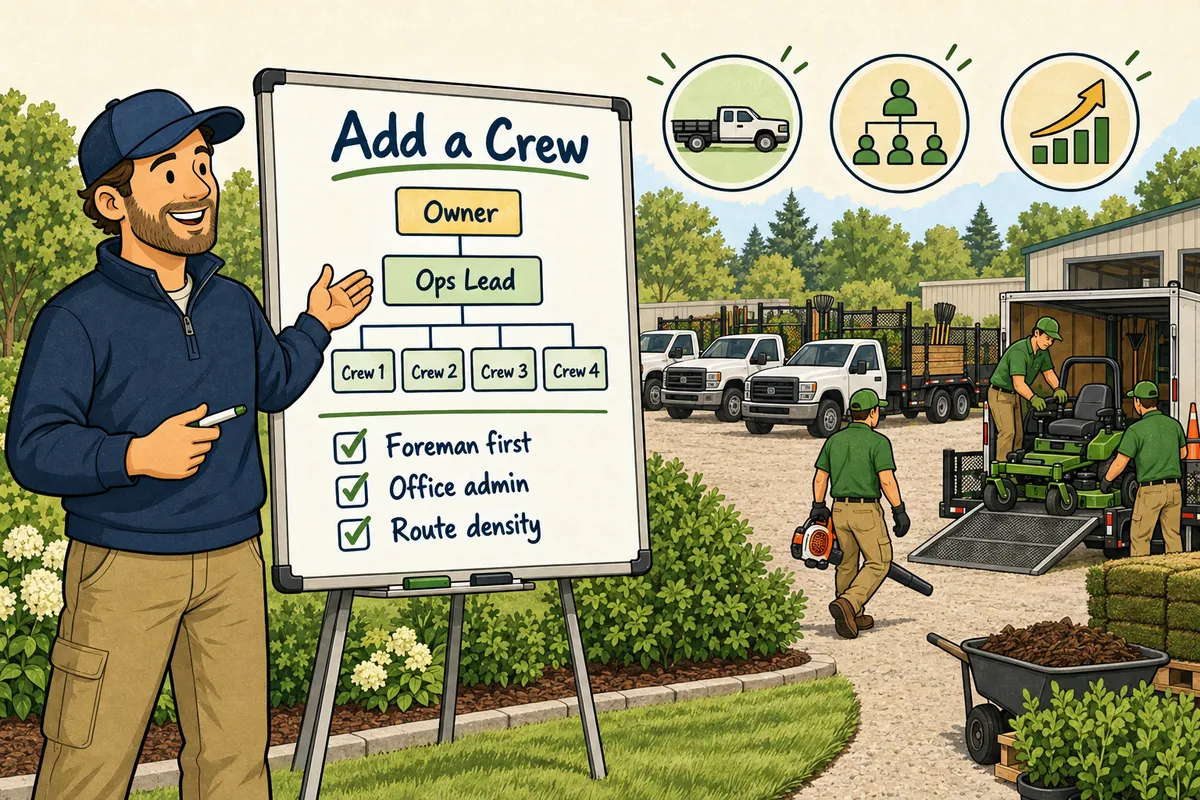
- First: a foreman on every existing crew with written responsibilities and decision authority. If your two crews cannot run a day without you, a third will not either. Use the foreman scorecard and give it a full season.
- Second: an office admin before the third crew starts. Scheduling, invoicing, client touchpoints, and payroll prep leave the owner's plate. This is usually the hire that changes everything, and it costs less than one crew member.
- Third: the third crew, led by the best current crew member, with a defined route and its own numbers on the scorecard from day one.
- Fourth: an operations lead before the fourth crew. Promote the strongest foreman or hire from outside; either way, the role exists on paper with its own metrics before the fourth truck is ordered.
- Then the fourth crew.
Written down, the sequence looks slow. In practice it takes 18 to 30 months from two crews to four, which is faster than the owners who add trucks first and spend two years fixing what broke.
The 90-day add-a-crew checklist
- Capacity check passed: revenue per crew, overtime, and signed backlog all say yes.
- Crew leader named 60 days out, shadowing the best current foreman for at least 20 working days.
- Route built on paper: which clients move to the new crew, drive time per day under 20 percent of hours.
- Truck, trailer, and equipment costed through the utilization test, with a used option priced.
- Twelve one-page SOPs in the truck, starting with dispatch and closeout.
- Scorecard line for the new crew: labor share, estimated versus actual, callbacks, reviewed weekly from the first Monday.
- Owner's calendar: the hours freed by the admin hire are blocked for planning and sales, not absorbed by the new crew.
- Kill criteria written down: if the crew is under $5,000 a week of revenue by week 10, it merges back and the route is rebuilt.
Review the checklist at day 30, 60, and 90 in the weekly meeting. Companies that run it typically add the crew at the same net margin they had before, which is the whole point. Growth that costs margin is not growth. It is a bigger job for the owner.
Frequently asked questions
How much revenue does a landscaping crew need to generate?
A three-person maintenance crew should produce $260,000 to $350,000 a year to carry its costs and contribute to overhead and profit; install crews run higher per crew but with more variance. Below $240,000 the crew is underutilized, and the fix is route density or pricing rather than more sales staff.
When should a landscaping business hire an operations manager?
Before the fourth crew, or at roughly $1.1M in revenue, whichever comes first. The role should be defined with its own metrics (labor share, estimated versus actual hours, callbacks, downtime) before the hire, and the owner should be prepared to hand over daily dispatch entirely.
Is it better to add a crew or raise prices?
Raise prices first. A 7 percent increase on a full book usually frees 5 percent of capacity by shedding the least profitable accounts and adds more net profit than a new crew would in year one. Add the crew when the repriced book is still overflowing with signed work.
Explore 7 Figure Landscape Network's business systems programs or book a strategy call to discuss the operating problem you want to work on. Learn about Jim Wertz and the network.
For the broader strategy process, use Landscaping Business Strategic Plan: A One-Page Framework as your starting guide, then return to the specific issue covered here.
