Landscaping SOPs: Which Processes to Document First and Why
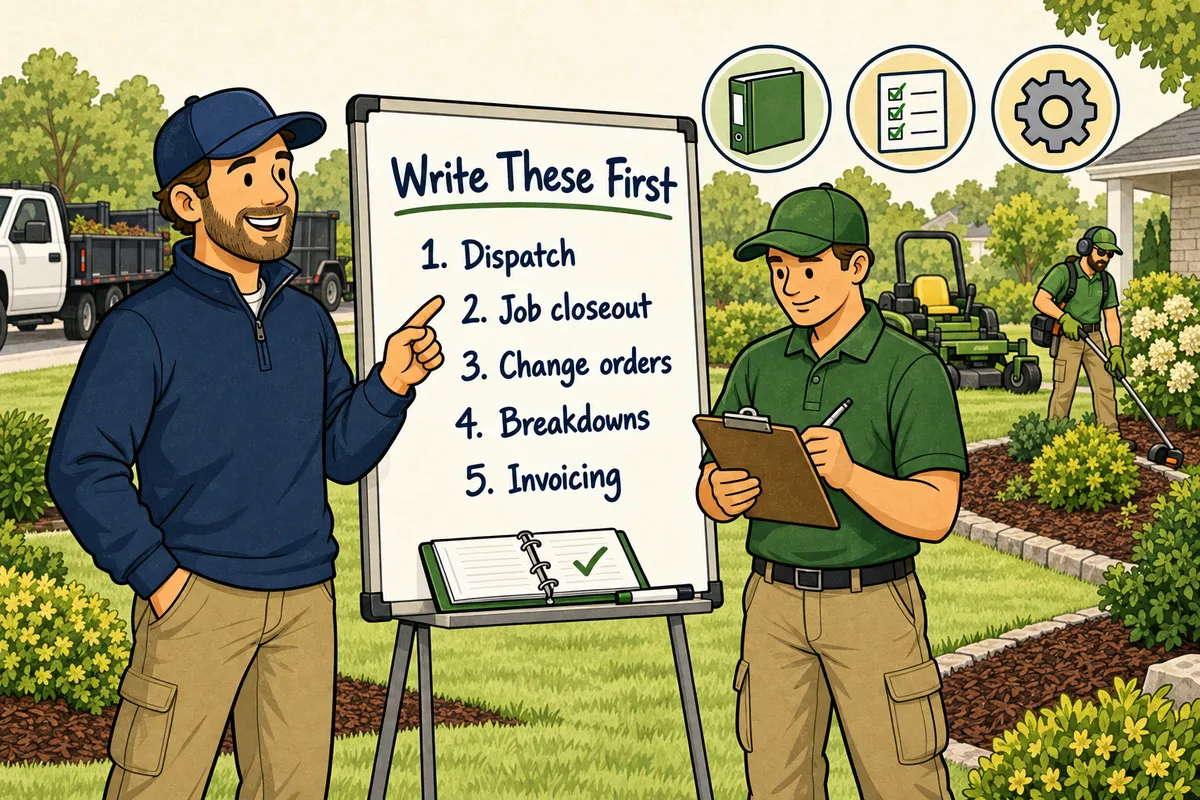
Document landscaping processes in the order of how often they run multiplied by what a mistake costs and how often the crew calls you about them. That puts morning dispatch, job closeout, change orders, equipment breakdowns, and invoicing at the top, and the 40-page employee handbook at the bottom. Twelve one-page SOPs, written by your crew leaders and approved by you, cover roughly 80 percent of the calls that interrupt an owner's day.
Updated October 23, 2026
The ranking rule: frequency, cost, and calls
Owners who try to "systemize everything" write 60 documents nobody reads. Owners who systemize nothing answer the same question 40 times a day. The fix is a short list, chosen by three questions for each process:
- How often does it run? Daily beats weekly beats seasonal.
- What does a mistake cost? A missed closeout photo costs a callback. A missed change order costs $800 of free work. A missed pre-trip inspection costs a truck.
- How often does the crew call you about it? Log interruptions for one week. Anything that shows up three or more times is a missing SOP, not a training problem.
Score each candidate 1 to 3 on each question, multiply, and write them in descending order. Most companies land on the same first dozen.
The first 12 landscaping SOPs
| # | SOP | Runs | Why it is near the top |
|---|---|---|---|
| 1 | Morning dispatch and load-out | Daily | Every late start traces here; see the dispatch checklist |
| 2 | Jobsite closeout and photos | Daily | Prevents callbacks and "did you finish?" calls; see the jobsite checklist |
| 3 | Change order approval | Weekly | The most expensive missing process in install work |
| 4 | Equipment breakdown response | Weekly | Turns a 3-hour loss into a 40-minute one |
| 5 | End-of-day report | Daily | Feeds estimating, payroll, and job costing |
| 6 | Invoicing and deposits | Daily | Every day of delay is cash you are lending the client |
| 7 | Client complaint handling | Weekly | Crews need a script so the owner is not the only answer |
| 8 | Pre-trip vehicle and equipment inspection | Daily | Cheapest insurance you have |
| 9 | New client onboarding | Weekly | Sets expectations that prevent the complaints in number 7 |
| 10 | Estimate site walk | Weekly | Accurate quantities start here |
| 11 | New hire first week | Monthly | Retention is decided in the first five days |
| 12 | Weekly crew meeting agenda | Weekly | Where all the other SOPs get reviewed |
Notice what is missing: the mission statement, the dress code, and the 30-page safety manual. Those matter, but they are not what is making the phone ring. Safety procedures are a separate, non-negotiable track; use OSHA's landscaping guidance as the baseline and keep them out of the operational SOP queue so neither delays the other.
The one-page SOP template
An SOP a crew will actually use fits on one page and answers six things. If it needs a second page, it is two SOPs.
- Purpose: one sentence on what this protects. "Every job leaves with photos and a signed checklist so we do not get a callback."
- Trigger: when it starts. "Last 20 minutes on any job site."
- Steps: numbered, five to twelve of them, in the order they happen, with the tool or form named.
- Standard: what done looks like, in measurable terms. "Four photos: front, back, beds, debris area. Client signature or a note that nobody was home."
- Exceptions: the two or three things that legitimately break the process and who to call for each. This is where the owner's phone number appears, and only here.
- Owner and date: the person accountable for the SOP and the last time it was reviewed.
Write in the crew's language. "Blow off hardscape, bag debris, load, photo, sign" beats a paragraph. Photos of a correct closeout beat both.
Who writes them, and why it is not you
The owner should not write the SOPs. You will write how you did it in 2019, and the crews will ignore it because they do it differently now. Have the crew leader who runs the process best draft it on the template, in 30 minutes, then review it with them and sign off. Three things happen: the document matches reality, the crew leader owns it, and you learn where your picture of the job is out of date. This is the same move that a team knowledge base relies on. Your job is the standard and the exceptions, not the steps.
A 90-day rollout that sticks
One SOP per week, in ranked order. Draft on Monday, review Wednesday, run it Thursday and Friday, and check it at the next weekly crew meeting with one question: what did we skip, and why? Fix the document, not the person. After 12 weeks you have a dozen living pages in a binder in every truck and a folder on every phone, and your interruption log will have dropped by half or more. Then measure: count owner calls per day for a week before you start and again at day 90. That number is the return on the project, and it usually beats any single hire you could make with the same time.
Frequently asked questions
How many SOPs does a landscaping business need?
Fifteen to twenty-five one-page documents cover the operating core of a $500K to $3M company. Start with the twelve above, add the seasonal ones (spring startup, fall cleanup, snow if you do it), and stop. More than 30 means some are not being used.
What software should I use for landscaping SOPs?
Whatever your crews will open on a phone. A shared folder of PDFs works. A knowledge base app works. A binder in each truck works. The document format matters far less than the review habit; an SOP nobody checks in the weekly meeting dies in any tool.
How do I get crews to actually follow SOPs?
Have crew leaders write them, keep them to one page, put the standard in measurable terms, and review one skipped step every week without blame. Crews follow processes that describe what they actually do and that someone visibly checks. They ignore processes handed down from an office.
Explore 7 Figure Landscape Network's business systems programs or book a strategy call to discuss the operating problem you want to work on. Learn about Jim Wertz and the network.
For the broader daily operations process, use Landscaping Daily Operations: Dispatch, Checkpoints, and Closeout as your starting guide, then return to the specific issue covered here.
