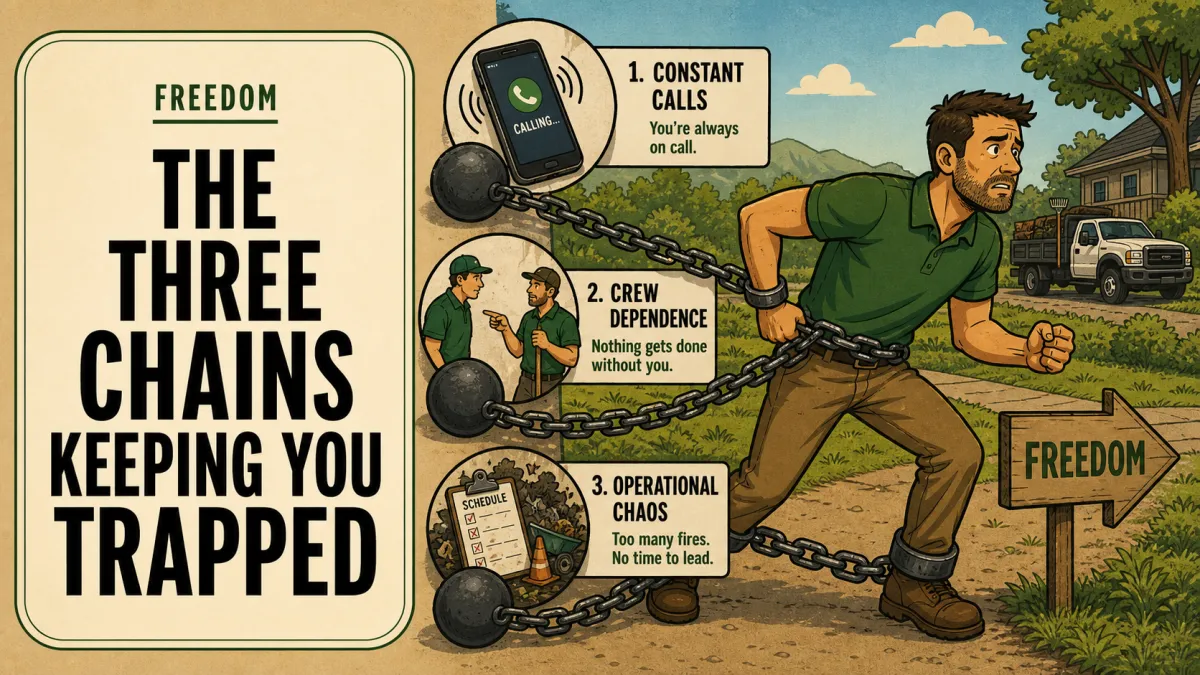
Three Types of Owner Dependence in a Landscaping Business
There are three types of owner dependence in a landscaping business: decision dependence, knowledge dependence, and relationship dependence. Each one keeps work routed through you for a different reason, so each one needs a different fix. Writing an SOP helps with missing knowledge, but it will not make a customer trust your office manager or give a crew leader permission to approve a $300 change. Figure out which type is stopping your team before you pick a solution.
Updated October 9, 2026
The three types at a glance
If you want the basic definition first, read the difference between owner involvement and owner dependence. This guide assumes you already know you are required too often and want to know why.
Most owners have a mix. One owner can be the only person allowed to approve anything over $500, the only person who knows how the irrigation clocks at the big HOA are set, and the only person the top ten clients will call. Those are three separate problems. Treat them as one problem and you end up writing manuals nobody uses while the phone keeps ringing.
Decision dependence
Your team knows what to do and has the information, but they are not allowed to act, or they believe they are not.
Symptoms: crews call you before swapping a plant variety, the office holds a quote until you look at it, and small refunds or schedule changes wait for your text back.
What it costs: idle crew time, slow quotes, and a team that stops thinking because thinking never gets rewarded.
First fix: write down which decisions each role can make, with a dollar or time limit, and which exceptions still come to you. Then back the first few decisions people make inside that limit, even if you would have done it a little differently. Setting decision boundaries for your crews walks through how to draw the lines.
Knowledge dependence
The information lives in your head. Nobody else can do the work because nobody else knows how, where, or to what standard.
Symptoms: the same questions every morning, jobs that wait until you can explain them, and new hires who take months to get useful.
What it costs: your time answering repeat questions, plus rework when people guess.
First fix: pick recurring work that only you can explain. Record the inputs, a good example, and the finish standard, then check whether someone else can actually use it without calling you. Start with the questions you hear most and put the answers where people look, using a simple team knowledge base.
Relationship dependence
Clients and suppliers will only deal with you. This is the hardest type to see, because it feels like good service.
Symptoms: customers text your personal cell about schedule changes, your best supplier rep only gives the good pricing when you call, and accounts get nervous when someone else shows up.
What it costs: you cannot take a week off without the phone following you, and a buyer would see the client list as yours rather than the company's.
First fix: introduce a responsible colleague to the customer or supplier in person or on a call. Explain what that person handles, then consistently route routine updates through them. Keep commitments in shared records, not your text messages. A relationship moves when the new person actually does the work with the client, over and over.
If a customer calls you about every schedule change, writing an internal procedure may not change the behavior. If the office still needs you to approve every update after the introduction, you also have a decision problem to fix.
Score your company and pick the first fix
Track one representative week and tag every interruption with its type. Here is what that looks like for an example company.
| Type | Interruptions | Owner hours | Typical example | First fix |
|---|---|---|---|---|
| Decision | 34 | 7 | "Can we add two shrubs for the customer?" | Approval limits by role |
| Knowledge | 22 | 5 | "How do you set the timer at the big HOA site?" | Site notes and a knowledge base |
| Relationship | 15 | 6 | Client calls you directly to move service day | Introduce the office contact |
| Total | 71 | 18 |
In this example, decision dependence produces the most interruptions, so it goes first. Relationship dependence costs nearly as much time per call and takes longest to move, so start the introductions now even while you fix approvals.
Before you hand anything off, run this check:
Does the person have the skill, or a plan to build it?
Do they have access to the records, accounts, and tools?
Do they have time in their week to take it on?
Do they know exactly what they can decide without you?
Have you checked whether the backup can actually act, using the business continuity handoff guide?
Do not transfer responsibility without competence, access, and time. Important technical, safety, and financial decisions may still need qualified people and specific controls. Document the outcome, authority, and review point using the delegation handoff template.
Frequently asked questions
What are the main types of owner dependence?
Decision dependence, knowledge dependence, and relationship dependence. Your team may be waiting for permission, missing information, or dealing with clients and suppliers who only trust you. Most landscaping companies have some of all three and need a different transfer for each.
Why is documentation not enough to reduce owner dependence?
A written process only fixes knowledge dependence. It does not give someone the authority to act or the trust of a customer who has dealt with you for eight years. Test whether the handoff works in practice.
Which owner dependency should I address first?
Start with the type that causes the most frequent interruptions and can be transferred safely to a capable person. For most owners that is decision authority. Define the expected result and review the first attempts before expanding the handoff.
Explore 7 Figure Landscape Network's business systems programs or book a strategy call to discuss the operating problem you want to work on. Learn about Jim Wertz and the network.
For the broader owner independence and continuity process, use How to Build a Landscaping Business That Runs Without You as your starting guide, then return to the specific issue covered here.
