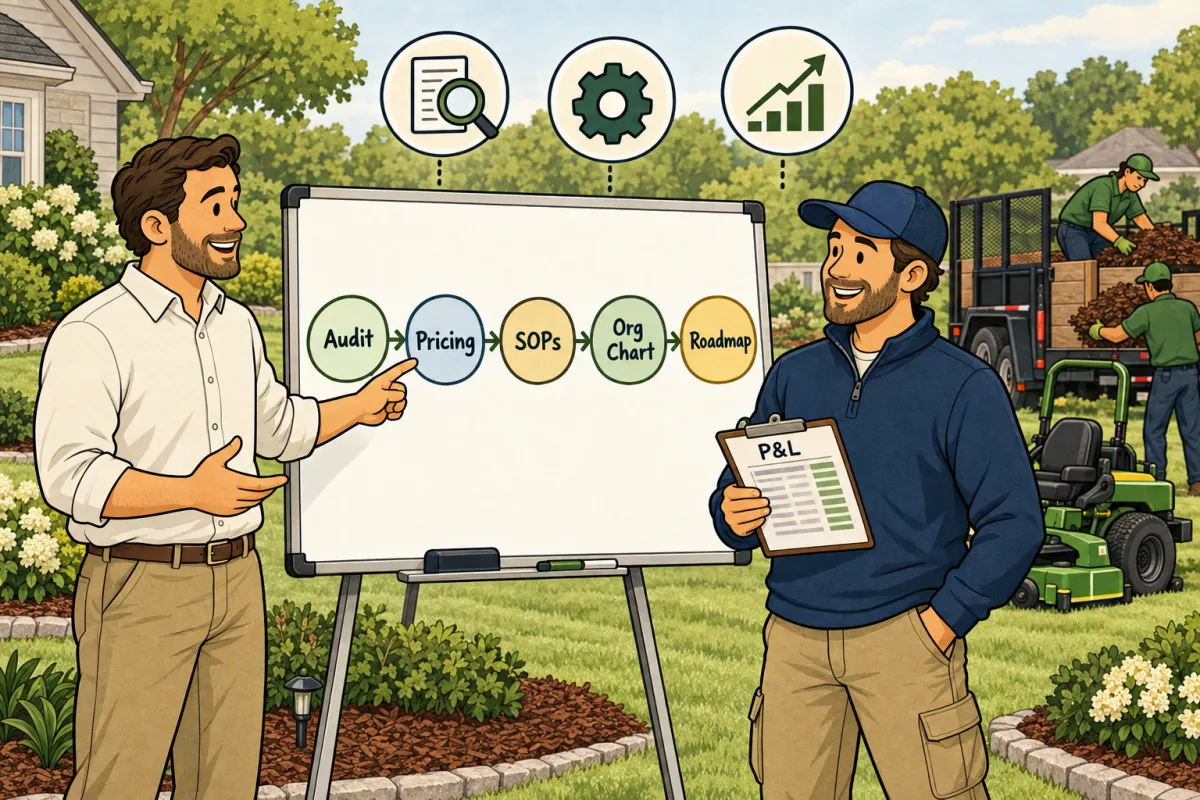
What a Landscaping Business Coach Does: Problems and Deliverables
A landscaping business coach audits your numbers, finds where profit and owner time are leaking, builds the pricing, systems, and org structure that stop the leaks, and holds you to a plan until the business runs without you in the field. The output is a set of documents and habits, not a pep talk. If you cannot name the deliverables, you are not being coached.
Updated September 17, 2026
The five problems a coach is hired to solve
Owners rarely call a coach because they want "growth." They call because one of five things has become unbearable. A competent coach names which one you have in the first conversation.
| Problem the owner feels | What is usually underneath it | What the coach fixes |
|---|---|---|
| "We did $1.4M and I have nothing to show for it" | Pricing off guesses, unbilled owner labor, labor overruns on installs | Job costing, price model, margin targets by service line |
| "Nothing happens unless I am on site" | No defined roles, no standards, crews trained to wait | Accountability chart, foreman scorecard, decision boundaries |
| "I am working 70 hours and falling behind" | Owner doing $20-an-hour tasks, no admin, no calendar control | Time audit, office hire plan, protected planning blocks |
| "Good people keep leaving" | Vague expectations, no growth path, owner as bottleneck | Role definitions, review rhythm, pay tied to standards |
| "I could not sell this if I wanted to" | Business equals owner; no systems a buyer could operate | Operations manual, transferable processes, clean financials |
Notice that lead generation is not on the list. Owners at $500K and up almost always have enough demand. What they lack is margin and a business that functions without them. See why owner overload is usually owner dependence.
The deliverables you should receive
Advice evaporates. Documents stay. A real coaching engagement leaves you with things you can hand to a manager, a buyer, or your future self.
- A profit audit against your P&L and tax returns, listing every leak with a dollar estimate. If the audit cannot find at least $50,000 on a $1M company, either the company is already tight or the coach is not looking hard enough.
- A pricing and estimating model built on your actual labor rates, equipment costs, and overhead. Not an industry average. Yours. Start with the job costing worksheet and build up.
- An operations manual: the 15 to 25 procedures your crews run daily, written so a new foreman can follow them without calling you. Dispatch, jobsite closeout, change orders, equipment breakdowns, end-of-day reporting.
- An accountability chart showing every function in the business, who owns it, and what result they are measured on. Most owners discover their name is in 11 of 14 boxes.
- A profit roadmap with quarterly targets for net margin, owner field hours, and the next hire, reviewed on a fixed schedule.
Ask for samples of each before you sign. A coach who has done this 50 times has 50 versions to show you, with client names removed.
What the first 90 days look like
| Weeks | Focus | Owner homework |
|---|---|---|
| 1 to 2 | Audit: P&L, job history, owner time log, org review | Pull 12 months of numbers; track your hours for 10 days |
| 3 to 4 | Repricing: cost every service line, set margin floors | Cost the last 20 jobs; reprice the next 20 quotes |
| 5 to 8 | Roles: accountability chart, foreman responsibilities, first SOPs | Write dispatch and closeout procedures; run the first weekly meeting |
| 9 to 12 | Owner exit from the field: delegation handoffs, planning blocks | Take a test day off; hand off two recurring tasks |
Profit usually moves first, in weeks three to six, because repricing is fast. Owner hours move last, because they depend on people and systems that take a season to settle. If a coach promises both in 30 days, they have not done this with a real crew.
What a coach does not do
A coach does not run your crews, sell your jobs, do your bookkeeping, or fire your brother-in-law for you. Those are decisions and actions that belong to the owner. The coach makes the decision clear and the timeline firm; you still have to make it.
A coach also does not replace a good accountant or a lawyer. Coaching reads the numbers to run the business better. Your accountant keeps them accurate and legal. If a coach starts giving tax advice, that is a signal to slow down.
And a landscaping coach should not be selling you leads, software, or a franchise. If the program's economics depend on you buying something else, the coaching is a funnel. Compare with what a consultant does instead.
How to tell if it is working
Track three numbers monthly and ignore the rest. Net profit percentage from your P&L, not from a dashboard the coach built. Your own field hours per week, from a log, not from memory. And the count of decisions your crew made without calling you, which your foreman can report at the weekly meeting. If two of the three have not moved by day 90, stop and ask why. Either the plan is wrong or the homework is not getting done, and both are fixable, but only if you name it.
Frequently asked questions
What does a landscaping business coach do on a typical call?
Reviews the numbers since the last call, checks the homework, works one problem in depth (a bad estimate, a foreman issue, a hiring decision), and sets the next two weeks of actions. A good call ends with three specific tasks and a date, not a list of ideas.
Can a business coach help with landscaping crew management?
Yes, and it is one of the most common reasons owners hire one. The work is defining the foreman role, setting decision boundaries so crews stop waiting on you, and building the daily rhythm of dispatch, checkpoints, and closeout. The coach designs the system; your foreman runs it.
Do I need a coach if I already have a good accountant?
They do different jobs. An accountant tells you what happened and keeps it compliant. A coach changes what happens next: pricing, roles, and how you spend your week. Most owners with strong accountants still have 5 to 10 points of margin sitting in operations.
Explore 7 Figure Landscape Network's business systems programs or book a strategy call to discuss the operating problem you want to work on. Learn about Jim Wertz and the network.
For the broader strategy process, use Landscaping Business Strategic Plan: A One-Page Framework as your starting guide, then return to the specific issue covered here.
