Reduce Key-Person Risk in Your Landscaping Company
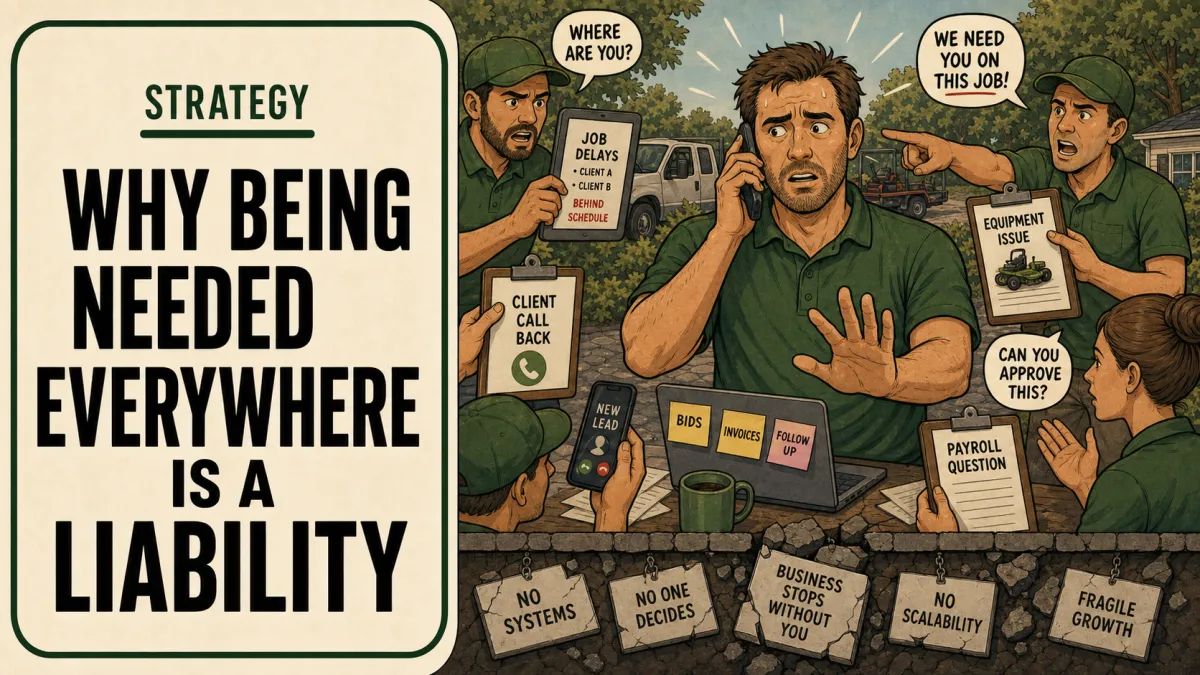
Key person risk is the chance that your company loses revenue, customers, or the ability to operate when one specific person is gone. In most landscaping companies that person is the owner, but it can also be a sole estimator, the only licensed applicator, or the admin who runs all the billing. Buyers, lenders, and insurers all price it in. Score yours, shrink the biggest items, and ask your agent whether key-person insurance makes sense while you do.
Updated October 9, 2026
What key person risk means in business terms
Every company depends on people. The risk becomes a liability when important work depends on one individual's knowledge, authority, relationships, or access, and nobody else can step in. If only one person can retrieve current estimates, even a fully staffed crew cannot answer a customer's scope question. Hiring another employee without access does not fix that. A maintained job record and an authorized backup do.
This article covers how outsiders measure that risk. Building the written backup-per-function plan is covered in the business continuity handoff guide, and the binder for what happens if you are injured tomorrow is in the landscaping owner emergency plan.
How buyers discount it
A buyer is paying for future earnings. If those earnings walk out the door with the owner, the buyer protects themselves in one of three ways: a lower multiple, more of the price paid as an earnout, or a requirement that you stay on for a year or two to hand over relationships.
Example: a company with $300K in owner-adjusted earnings. With a general manager, documented estimating, and customers who know their crew leaders, a buyer might offer 3 times earnings, or $900K. If every relationship runs through the owner's phone, the same buyer might offer 2.5 times, or $750K, with a third of it tied to customer retention after you leave. These multiples are for illustration only; the size of the gap is what to notice. Building a transferable landscaping business covers what a buyer looks for, and what a well-run $1 million company looks like shows the target.
How lenders and insurers look at it
A lender's question is simple: if this person disappears, does the loan still get paid? When the answer is unclear, expect a personal guarantee, a request for life insurance on the owner assigned to the bank, or tighter terms. Requirements differ by lender and loan type, so ask your banker directly what they need and why.
Insurers look at the same exposure from the other side. When you apply for key-person coverage, they will ask what the person does, what they earn, and what the company would lose without them. The questions are worth answering even if you never buy a policy.
Score your key person risk
Score each factor 0, 1, or 2 for the person you are most worried about. Do it again for your second-most-critical person.
| Factor | 0: low risk | 1: some risk | 2: high risk |
|---|---|---|---|
| Customer relationships | Customers know crew leaders or an account manager | Mixed | Top accounts only call this person |
| Estimating and pricing | Written pricing and a second estimator | Others price small jobs | Every job is priced from memory |
| Supplier accounts | Two authorized buyers | Backup on some accounts | Accounts only in this person's name |
| Banking and signing | Second signer with limits | Online access only | Sole signer |
| Licenses and certifications | Two people hold them | Backup in progress | Only this person |
| Crew leadership | Crew leaders run full days alone | Daily check-ins needed | This person runs every site |
| Systems and records | Shared, role-based access | Partly documented | Lives in one head or phone |
A total of 0 to 4 is low. Five to 9 means specific functions need backups. Ten or more means the company is built around one person. To lower the score, work the 2s first:
- Move your top ten accounts to an account manager or crew leader they already see every week.
- Write the pricing sheet down and train a second estimator on jobs under a set size.
- Add an authorized buyer on every supplier account and a second signer at the bank.
- Get a second person licensed for chemical applications, and confirm requirements with your state agency.
- Develop crew leaders so routine site decisions do not need you. Owner involvement versus owner dependence shows how to sort what you keep.
Key-person insurance basics
Key-person coverage is a life or disability policy the company buys on a critical person. The company pays the premium and the company receives the payout. That money can cover lost profit, recruiting a replacement, or paying down debt while the business stabilizes.
Agents size coverage in different ways, such as a multiple of the person's pay, the cost to replace them, or their contribution to profit. The tax treatment of premiums and benefits has specific rules, so confirm it with your accountant, and confirm coverage details with a licensed agent. Insurance buys time. It does not lower the score, so treat it as a bridge while you work the list above.
Owner dependence can affect transition risk, but it does not establish a company's value on its own. Valuation needs a broader professional assessment. Use the Ready.gov business emergency planning resources when developing the wider disruption response.
Frequently asked questions
Can key-person risk involve someone other than the owner?
Yes. A sole estimator, office administrator, licensed applicator, or mechanic can hold critical knowledge or access with no backup. Score each of them the same way you score yourself.
What should a backup person be able to do?
Handle the specific function assigned to them, with the skill, access, and written authority it requires. They do not need unrestricted control of every business system, only enough to keep that function running.
Does owner dependence mean my business has no value?
No. It is one risk factor among many. Earnings, assets, contracts, team capability, and transition arrangements all matter, and a high score can be reduced over a season or two before a sale or a loan application.
Explore 7 Figure Landscape Network's business systems programs or book a strategy call to discuss the operating problem you want to work on. Learn about Jim Wertz and the network.
For the broader business planning and growth process, use Landscaping Business Strategic Plan: A One-Page Framework as your starting guide, then return to the specific issue covered here.
