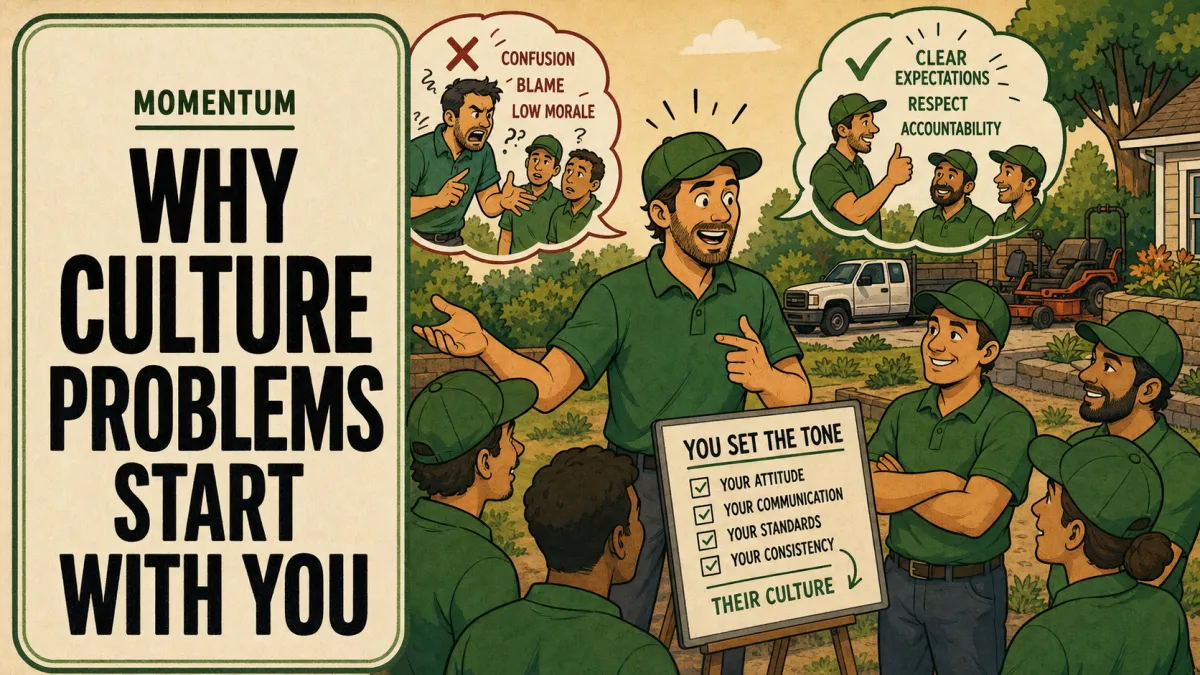
Landscaping Company Culture: Turn Stated Values Into Daily Standards
Landscaping company culture is whatever your crews see you model, reward, and allow, especially during a busy week. Values on a wall do nothing until each one is turned into a behavior a crew leader can see on a job site. Pick three to five values, define what they look like in the field, hold yourself to them first, and run simple recognition and correction routines every week.
Updated October 9, 2026
Turn values into observable crew behaviors
"Respect," "quality," and "teamwork" mean something different to every person on your payroll. A value only shapes behavior when someone can watch a crew for an hour and say whether it is happening.
Keep the list short. Three to five values is plenty. More than that and nobody remembers them by Tuesday. For each one, write two or three behaviors you want and one you will not accept.
| Value | What it looks like on the crew | What it does not look like |
|---|---|---|
| Own the result | Walks the property before leaving; fixes misses without being asked | "That's not my job" when edging was missed |
| Tell it early | Reports delays, damage, and mistakes the same day | Customer is the first to mention the broken sprinkler head |
| Respect people | Listens to a safety concern; gives feedback in private | Yelling at a crew member in front of a client |
| Leave it better | Clean truck, clean site, tools returned and logged | Debris left on the driveway "because we were running late" |
Quality is a common value that gets distorted. If you want quality without turning into the person who inspects every bed edge, set the standard upfront with landscaping quality standards that don't depend on owner micromanagement.
Your habits set the real standard
Crews learn your culture from what you do at 7 a.m. on a Monday in May, not from the handbook. If you say "tell it early" and then explode when someone reports a mistake, they learn to hide mistakes. If you say "respect people" and then answer your phone mid-conversation with a crew leader, they learn where they rank.
Run an honest check on your own week:
When a crew reported a problem, did you thank them for raising it before you solved it?
Did you show up when you said you would, to the meeting, the job walk, the review?
Did you correct anyone in front of their crew or a customer?
Did you skip a rule you expect everyone else to follow, such as PPE on site or a pre-trip check?
Did you praise only speed, or also quality and good reporting?
If you see two or more problems, start there. Changing the owner's habits shifts culture faster than any new policy.
Close the exceptions
Culture breaks fastest through exceptions. The strong producer who ignores the same rules everyone else follows teaches the whole company that results buy a pass. So does the supervisor who quietly contradicts the written process because "that's how we've always done it."
Look for exceptions in three places: who gets away with late starts, whose quality misses never get mentioned, and which crew leader runs their own system. Address the behavior with the same standard you apply to everyone. Losing one strong but corrosive producer usually costs less than the people who leave because of them.
A weekly recognition routine
Recognition only shapes behavior when it is specific and tied to a value. "Good job, guys" teaches nothing. "Thanks for calling the office about the cracked downspout before you left, so we quoted the repair instead of getting a complaint" teaches everyone what "tell it early" means.
Ask crew leaders to bring one example each week of someone living a value.
Share two or three of them in the weekly team meeting, naming the behavior and the value.
Recognize good reporting and early warnings, not only finishing fast.
Once a month, pick one example for a small, consistent reward like lunch or a gift card.
When a crew flags an issue before leaving a site, acknowledge the early report and solve the underlying problem rather than treating the report as the mistake.
A correction routine that keeps respect intact
Correction is part of culture too. Handled badly, it teaches people to hide things. Handled well, it shows the standard is real.
Keep it simple: correct privately, describe the specific behavior, connect it to the value, and agree on what happens next time. Then follow up within a week. For repeat issues that need formal tracking, owners, and consequences, use your crew accountability system, since culture sets the expectation and accountability enforces it.
Culture also shows up in who you bring in. Screen for the same behaviors during hiring using a hiring process that defines the job first, and remember that culture never replaces fair pay, workable schedules, or safe conditions. If those are the problem, fix them through a practical retention plan.
Frequently asked questions
How can a landscape owner identify a culture problem?
Compare your written expectations with what happens under pressure. Hidden mistakes, uneven treatment between crews, and people who stop raising concerns are the usual signals. Investigate with specific examples instead of general complaints about attitude.
Can one high-performing employee damage team culture?
Yes, when their results are used to excuse behavior that undermines others or ignores shared standards. Everyone else notices the exception. Address the behavior with the same standard you apply to the rest of the team.
What is one useful first culture change?
Pick one value, define two observable behaviors for it, model it yourself, and recognize real examples every week for a month. One small, consistent change is easier to see and measure than a broad campaign about attitude.
Explore 7 Figure Landscape Network's business systems programs or book a strategy call to discuss the operating problem you want to work on. Learn about Jim Wertz and the network.
For the broader team leadership and accountability process, use Landscaping Crew Accountability: Standards, Owners, and Reviews as your starting guide, then return to the specific issue covered here.
