When Longer Hours Stop Helping Your Landscaping Business
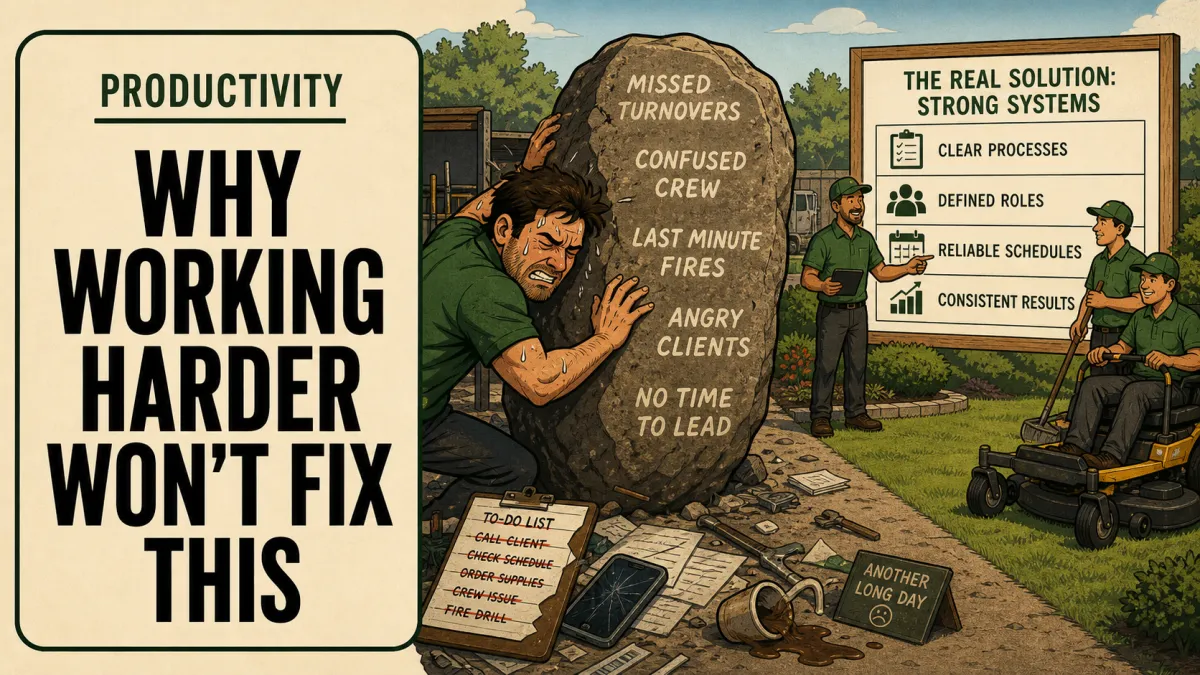
A landscaping owner working too many hours usually reaches a point where each extra hour buys less. The added time goes into the same evening material runs, the same callbacks, and the same approvals, and next week they all come back. Longer hours absorb a broken process without fixing it. Find the constraint that keeps eating your time and spend a few of those hours removing it instead.
Updated October 9, 2026
Why more hours stop paying off
Early on, more hours meant more revenue. That math works until the business has crews, and then your hours stop being the thing that limits output.
At three or four crews, what limits the company is usually a process: materials that are not staged, approvals that wait, estimates with the wrong production rates. Working until 9 p.m. does not change any of those. It just means you personally cover the gap every day. If you are not sure whether you are short on people or stuck with the wrong work on your plate, start with the owner overload diagnosis. This post is about why the extra hours themselves stop helping.
Decision fatigue at the end of a long day
The 11th hour of your day is not as good as the 2nd. By evening you have answered dozens of calls and made dozens of small decisions. That is when most owners sit down to price the big install, review payroll, or decide whether to fire someone.
Tired decisions tend to look the same: you round the bid down to win it, you say yes to the customer who wants extra work for free, you put off the hard conversation again. None of those show up as a mistake that night. They show up on the P&L months later. A rule of thumb: if a decision affects more than a few thousand dollars or someone's job, make it in the morning.
The business learns to depend on your hours
Here is the part most owners miss. When you are always available, the team learns that the fastest path is to call you. When you fix the missing material yourself every evening, nobody fixes the ordering process. Your effort hides the problem.
So the business adapts to your 70-hour week. It needs those hours now. Cut back to 50 and things break, which proves to you that you cannot cut back. That loop is how a high-stress job gets built inside what should be a company.
The math of an extra 10 hours
Look at where an added 10 hours a week actually goes. Here is an example for an owner who went from 60 to 70 hours during a busy stretch.
| Activity | Hours per week | What it produces | Is it back next week? |
|---|---|---|---|
| Evening material pickups | 3 | Tomorrow's jobs have material | Yes |
| Answering routine crew calls | 3 | Crews keep moving today | Yes |
| Redoing late estimates | 2 | Quotes go out a few days late | Yes |
| Callback visits | 1 | One unhappy customer settled | Yes |
| Fixing the load list process | 1 | Fewer missing items on every job | No, it keeps paying |
Nine of the ten hours repeat next week. Over a 30-week season that is 270 hours spent covering the same gaps, which is almost seven 40-hour weeks. Only one hour a week builds anything that lasts.
Now flip it. If those 3 hours of material pickups came from an ordering gap, spending 4 or 5 hours once on a complete pre-job material check could remove most of them for good. That is roughly 80 hours back across the season. Put a dollar figure on the delays your crews absorb in the meantime with a crew waiting-time calculation.
What to do instead
You do not need to cut your hours in half next week. Point some of them at the cause.
Record where work waits or repeats for one representative week. Note the cause, who was affected, and whether your stepping in changed the underlying process.
Pick the one recurring constraint with the biggest consequence. Separate a temporary demand spike from a lasting issue in capacity, information, skill, authority, or pricing.
Test one correction and compare the result. Keep service, quality, and safe work practices in view while you check whether waiting or rework actually dropped.
Block a fixed time each week for this work. Two hours on Tuesday morning, phone off. Protecting planning time on your calendar shows how to make it stick.
Tie it to where the company is going. Connect each fix to your wider goals with a one-page landscaping strategic plan.
Example: an owner makes evening material pickups three nights a week. Hiring more installers will not fix an ordering process that misses items. If the records instead show real demand beyond what the crews can handle, then a staffing decision makes sense.
Some busy stretches, like spring startup or a storm cleanup, need extra effort. Just do not treat exhaustion as your operating method.
Frequently asked questions
How do I know whether effort or a system is the problem?
Look for the same obstacle across multiple jobs or days. Repeated waiting, missing information, and rework point to a process gap that more effort will not resolve. If the same problem shows up three weeks in a row, it is a system problem.
Should I hire someone when I am overloaded?
First identify which work is overloaded and why. A hire adds capacity but will not fix unclear scope, missing materials, or approval bottlenecks. Fix the process first so the new person is not stuck waiting too.
What should I improve first?
Choose a recurring constraint with a measurable effect and a correction you can test. Review the result before starting several unrelated changes.
Explore 7 Figure Landscape Network's business systems programs or book a strategy call to discuss the operating problem you want to work on. Learn about Jim Wertz and the network.
When more hours stop working, outside help can, as long as you know what a landscaping business coach actually delivers.
For the broader owner time and office support process, use When to Hire an Office Administrator for Your Landscaping Business as your starting guide, then return to the specific issue covered here.
