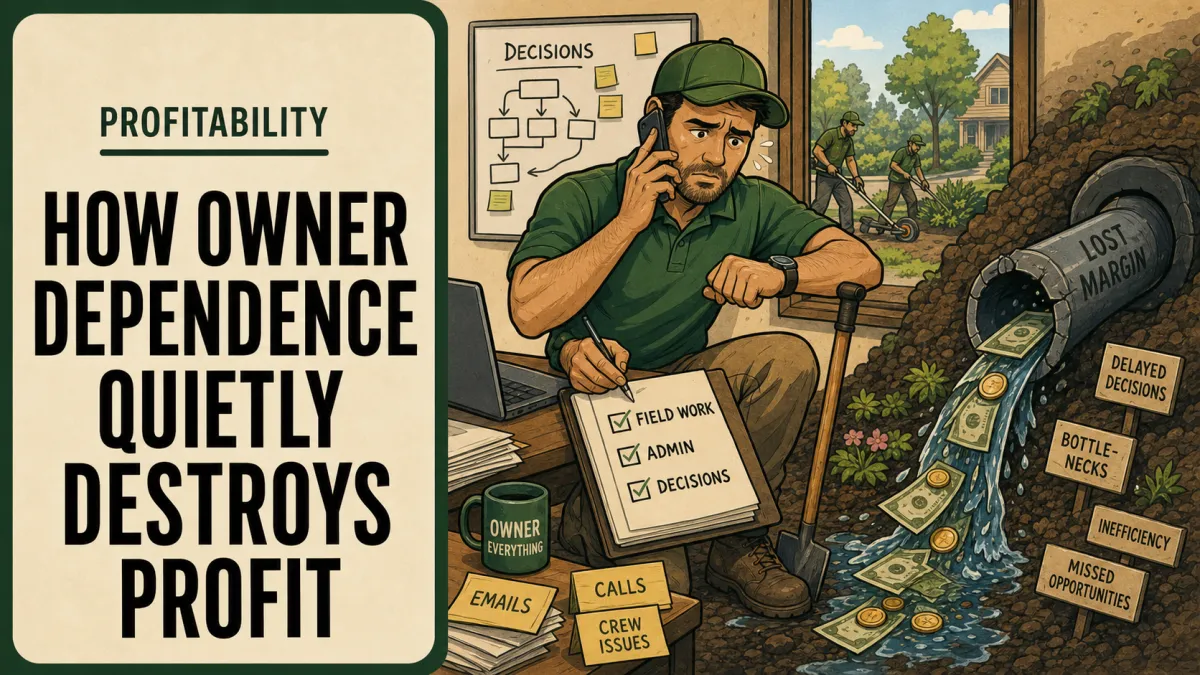
How Owner Dependence Can Hide Landscaping Job Costs
The biggest hidden costs in landscaping jobs come from the owner: unbilled field hours, crews waiting on decisions only you can make, rework you fix yourself, and materials you grab on the way and never code to the job. None of it shows up on the job ticket, so the margin looks better than it is. Record those four costs against the job and compare reported margin with true margin before you price the next one.
Updated October 9, 2026
Why owner involvement hides job costs
When a crew leader spends two extra hours on a job, the timesheet catches it. When you do, nothing catches it. You do not clock in, you do not ticket the edging you bought on your own card, and you do not log the forty minutes the crew stood around waiting for your answer.
So the job closes, the numbers look fine, and you price the next one off a margin that was never real. Repeat that across a season and every job looks profitable while the year-end number stays thin. That is a Profit Leak, and it grows with every job you personally touch.
You cannot decide what to hand off until you can see what your involvement costs. If you are not sure which kind of dependence you have, the three types of owner dependence will help you sort it.
The four hidden costs to record
Owner field labor. Every hour you spend on site, at the supplier, or driving out to check work. Put a rate on it for internal costing. How to set that rate is covered in the owner-labor costing guide; for this exercise, just record the hours.
Delayed decisions. Crew time spent waiting for you to approve a change, pick a plant, or confirm a price. Record minutes waited and people on the crew. If this one is large, read why crews wait for approval and how to set decision boundaries.
Rework. Return visits to fix grade, reset pavers, replace a dead shrub, or redo an edge. Owners often handle these personally on a Saturday, so they never get counted. Tracking callbacks and rework shows how to log them.
Untracked materials. Extra stone, fittings, fabric, or plants picked up by you and paid on a personal or general card. The expense lands somewhere in the books, just not on the job that used it.
Worked example: reported vs. true margin
Example: a $9,000 bed renovation and walkway job. The crew logged their hours and the office coded the main material order. The owner's involvement never reached the ticket.
| Cost line | Reported | True | Hidden |
|---|---|---|---|
| Crew labor (60 person-hours at $30) | $1,800 | $1,800 | $0 |
| Materials on the job ticket | $2,700 | $2,700 | $0 |
| Disposal and equipment | $300 | $300 | $0 |
| Owner field time (10 hours at $45) | $0 | $450 | $450 |
| Crew waiting on owner decisions (4.5 person-hours at $30) | $0 | $135 | $135 |
| Rework visit (6 person-hours at $30 plus $120 material) | $0 | $300 | $300 |
| Materials bought by owner, not coded to the job | $0 | $380 | $380 |
| Total cost | $4,800 | $6,065 | $1,265 |
| Gross margin | $4,200 (46.7%) | $2,935 (32.6%) | 14.1 points |
The job still made money, just $1,265 less than the report said, and the next estimate for this kind of work will be built on the 46.7% figure. If the company does 40 jobs a year with the same pattern, that is about $50,600 of cost that never shows up where you price from.
The $45 owner rate is an assumption for illustration. Apply your own rate consistently, and confirm with your accountant how owner time is treated in your books, since internal job costing and financial statements can differ.
How to capture hidden costs every week
Carry a job log. A phone note works: job name, hours, what you did, any material you bought.
Ask crew leaders to log waits. Add one line to the end-of-day report: minutes waited for a decision, and what the decision was.
Code every receipt to a job. Photo it with the job name before it leaves your hand. The office clears anything uncoded weekly.
Open a rework line on every job. Return visits get charged back to the original job, not to the job the crew was on that day.
Review it weekly. Bring the totals into your weekly landscaping profit review and compare reported and true margin on every job you touched.
After four to six weeks, one or two job types usually carry most of the hidden cost. That is where to hand off first.
Common mistakes that keep costs hidden
Counting your time as free. Every field hour is an hour not spent running the company or at home.
Recording it "roughly" at month end. Memory always shrinks owner hours. Log the same day.
Treating every hidden cost as a loss. Some owner time is good oversight. Keep measured cost and possible opportunity as two separate numbers.
Fixing the estimate without fixing the cause. Padding every bid by 15% just hides the problem. Find which of the four costs drives the gap and fix that.
For financial recordkeeping context, see the SBA business management resources. Apply consistent definitions with your accounting professional.
Frequently asked questions
What are the most common hidden costs in landscaping jobs?
Owner field time, crew time spent waiting on decisions, rework, and materials bought outside normal purchasing. None of them go through the timesheet or job ticket. Log them against the specific job to see the true margin.
Why should owner field time be recorded?
It shows the real resources a job needed and keeps you from pricing future work off an inflated margin. Confirm the accounting treatment of owner time with your accountant.
What is a practical first financial handoff?
Have a trained office person gather complete job records each week, including receipts, rework visits, and logged waits, and prepare a short exception report. You keep the review and approval.
Explore 7 Figure Landscape Network's business systems programs or book a strategy call to discuss the operating problem you want to work on. Learn about Jim Wertz and the network.
For the broader job costs and profitability process, use Landscaping Job Costing: A Worksheet and Worked Example as your starting guide, then return to the specific issue covered here.
