Landscaping Estimating: How to Build Accurate, Profitable Bids
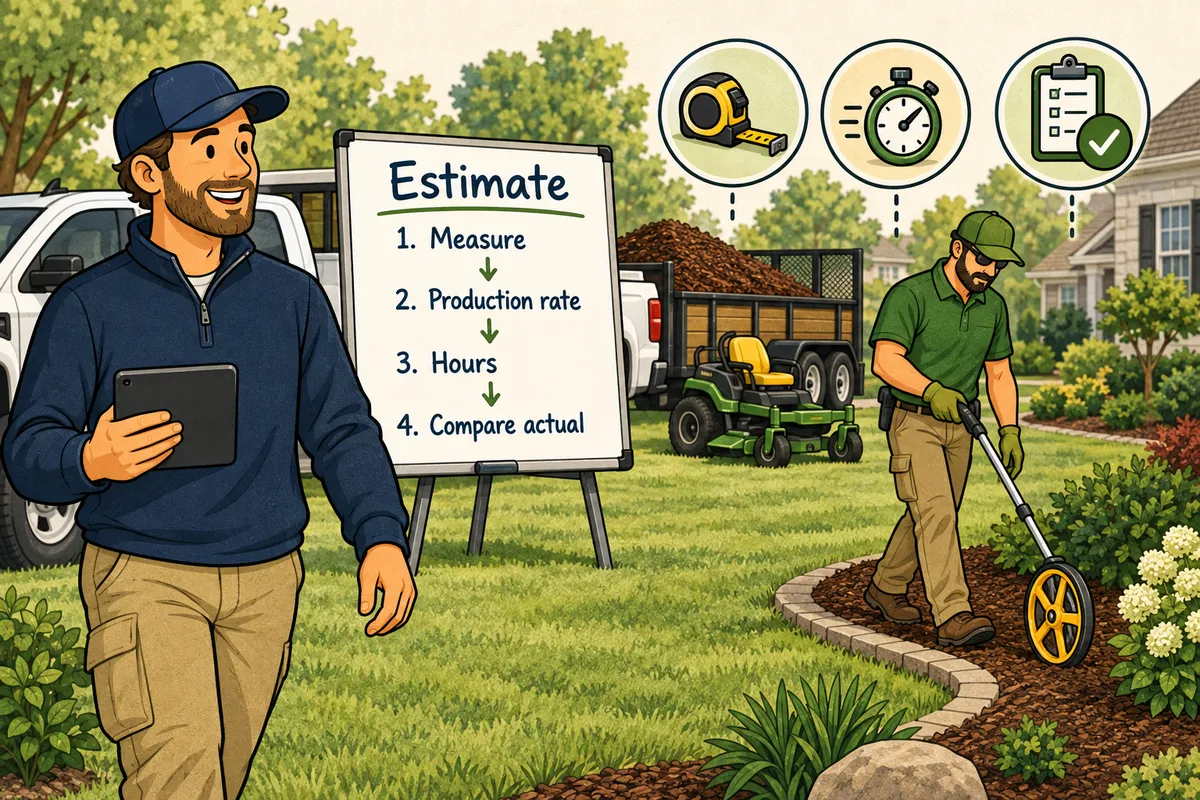
Accurate landscaping estimates come from measured quantities multiplied by production rates you have verified on your own crews, plus a written scope that says what is excluded. Guessing hours from experience produces bids that are 10 to 20 percent light, and that gap is the single biggest reason install work "makes money on paper" and loses it in the field. Build the estimate in four steps and close the loop against actual hours every week.
Updated October 14, 2026
Step 1: Measure everything on the site walk
An estimate built on "about 12 yards of mulch" is a guess with a decimal point. Measure. A measuring wheel, a tablet, and ten extra minutes on the walk remove most of the surprises your crew finds on install day.
- Bed square footage and depth for mulch, soil, and stone (length × width × depth ÷ 27 for cubic yards, plus 8 to 10 percent for settling and waste)
- Linear feet of edging, and whether it is new cut or re-cut
- Plant counts by size, with delivery distance from the supplier
- Access: gate width, slope, distance from truck to bed, whether a skid steer fits or it is wheelbarrow work
- Disposal: what comes out, where it goes, and the dump fee
- Site conditions that slow production: wet ground, roots, irrigation lines, existing hardscape to protect
Take photos and note them on the estimate. When a crew leader asks why the job has 26 hours instead of 20, the answer should be on the sheet, not in your head.
Step 2: Use production rates, not memory
A production rate is how much work one person completes in one hour under normal conditions. Build a library from your own job history, not from an industry chart, and adjust each rate for access and conditions.
| Task | Baseline rate | Adjust when |
|---|---|---|
| Spread mulch, wheelbarrow access | 1 cubic yard per person-hour | Long carry or slope: 0.6 to 0.7 |
| Spread mulch, skid steer access | 2 to 2.5 cubic yards per person-hour | Tight beds: 1.5 |
| Bed edging, new cut | 60 to 80 linear feet per person-hour | Rocky or root-bound soil: 40 |
| Install 3-gallon shrubs | 6 to 8 per person-hour including layout | Clay or amended beds: 4 to 5 |
| Install 15-gallon trees | 1 to 1.5 per person-hour | No machine access: 0.75 |
| Sod, prepared grade | 200 to 250 square feet per person-hour | Grading included: 120 |
Every rate in this table should be replaced by your own within a season. That is the point of the loop in the last section. Rates built from your crews on your soil are the only ones that hold.
Step 3: Convert to hours, cost, and price
Quantities divided by production rates give person-hours. Add fixed time that does not scale with quantity: load-out, drive, setup, cleanup, and the walkthrough with the client. Then cost the hours at your burdened rate and price with the method in how to price landscaping services.
| Line | Math | Person-hours |
|---|---|---|
| Mulch | 14 yards ÷ 0.7 (long carry) | 20.0 |
| Edging | 180 feet ÷ 60 | 3.0 |
| Shrubs | 20 ÷ 5 (clay) | 4.0 |
| Fixed time | Load, drive, setup, cleanup, walkthrough | 4.5 |
| Total labor | — | 31.5 hours |
| Labor cost | 31.5 × $32 burdened | $1,008 |
| Materials and disposal | Mulch, shrubs, edging, dump fee, 8 percent waste | $1,540 |
| Equipment | Truck and trailer 10 hours × $18 | $180 |
| Overhead recovery | 31.5 hours × $29 | $914 |
| Break-even | — | $3,642 |
| Price at 15 percent net | $3,642 ÷ 0.85 | $4,285 |
The owner who estimated this from memory at "a crew day, call it 24 hours" priced it at $3,600 and lost the overhead. The 7.5 hours of difference are the long carry and the clay, both visible on the site walk.
Step 4: Write a scope that protects the number
The estimate is only as good as the document the client signs. A one-line quote invites a free patio extension. Include:
- Quantities and specs: "14 cubic yards double-shredded hardwood mulch at 3 inches" rather than "mulch beds."
- Exclusions: irrigation repair, stump removal, permits, plant warranty beyond 30 days unless priced.
- Assumptions: gate access of at least 36 inches, water available on site, beds clear of debris.
- Change terms: additional work priced and approved in writing before it starts. Give the crew a change order process so they do not call you or, worse, do it for free.
- Payment schedule tied to milestones, and an expiry date on the price, because mulch and plants move.
Close the loop: estimate versus actual
Estimating gets accurate only when actual hours flow back into the rate library. Every job needs estimated hours on the run sheet and actual hours on the end-of-day report. Review the gap weekly by job type and by crew leader. Three questions: was the quantity wrong, was the rate wrong, or was the crew slow? Each has a different fix. Quantity errors mean a better site walk. Rate errors mean updating the library. Crew speed means a foreman conversation. Companies that run this loop for one season typically cut their estimate-to-actual gap from 15 percent to under 5, which on $600,000 of install work is $60,000 of labor you stop giving away. Tracking callbacks by job in the same review catches the estimates that were "accurate" only because the crew rushed.
Frequently asked questions
Should I charge for landscaping estimates?
For maintenance and small enhancements, no; the walk is a sales cost built into overhead. For design-build work above roughly $10,000, a paid design or consultation fee credited against the job filters out price shoppers and pays for the hours you spend measuring. State the policy up front so it does not feel like a surprise.
How much contingency should a landscaping estimate include?
Build contingency into the production rate adjustments rather than a blanket percentage, so it is tied to a visible risk. Where unknowns remain, such as unmarked utilities or unverified soil, add 5 to 10 percent to labor and say so in the assumptions. A blanket 20 percent hides bad estimating and loses bids.
What software should I use for landscaping estimates?
Any tool that stores your production rates, calculates person-hours from quantities, and lets you compare estimated to actual hours. A well-built spreadsheet does this; so do most field service platforms. The tool matters less than the discipline of feeding actuals back into it every week.
Explore 7 Figure Landscape Network's business systems programs or book a strategy call to discuss the operating problem you want to work on. Learn about Jim Wertz and the network.
For the broader job costing process, use Landscaping Job Costing: A Worksheet and Worked Example as your starting guide, then return to the specific issue covered here.
