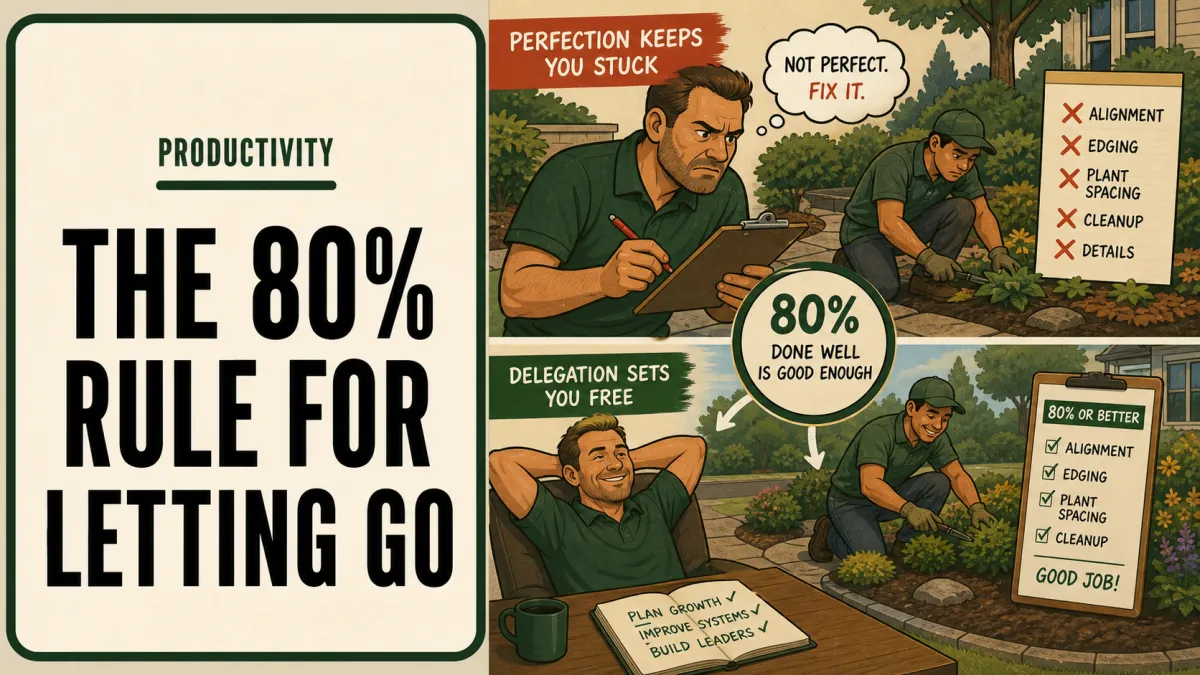
Delegating Landscaping Work: Set Standards Instead of an 80 Percent Rule
Delegation standards spell out what finished work must look like, so the person doing it and the person checking it judge against the same thing. The popular advice to accept work that's 80 percent as good as yours sounds freeing, but it gives nobody a target. Write the required result, show it with photos, set check-in points, and decide ahead of time when you correct and when you coach.
Updated October 9, 2026
Why the 80 percent rule fails
The rule assumes everyone knows which 20 percent is optional. Nobody does. Your 80 percent is a feeling in your head, and a crew leader can't hit a feeling.
So one of two things happens. You swallow small frustrations until one blows up, or you quietly take the work back. Either way the person never learns what "done" means, and you stay the only quality check in the company.
Worse, some of that missing 20 percent isn't optional at all. Safety checks, the approved specification, and what the customer was promised can't be traded for speed. A blanket percentage treats a crooked edge line and a skipped equipment inspection as the same kind of shortfall.
Write the standard: result, must-haves, photos
A useful standard separates three things: the required result, the must-haves that never flex, and the method, which usually can. Your preferred method stays out of it unless it protects safety or the spec.
| Element | Standard | Proof |
|---|---|---|
| Required result | Beds free of leaves, sticks, and weeds; clean edge at the lawn line | Wide photo of each bed after |
| Must-have | Edge depth about 2 inches, consistent along the whole run | Close-up photo of one edge section |
| Must-have | Debris hauled off; walks and drive blown clean | Photo of driveway and front walk |
| Must-have | Customer notes on the work order followed | Check box on closeout |
| Method (flexible) | Order of beds, tool choice, who does what | None needed |
Photos do most of the work. One picture of a finished bed that meets the standard teaches more than a paragraph. Keep two reference photos per service: one that passes and one that doesn't, with a sentence on why. Turn the must-haves into closeout items on a jobsite closeout checklist so they get checked every time.
Set check-in points instead of hovering
Hovering teaches people to wait for you. Check-ins at set points teach them to check their own work first. Match how often you check to the risk of the task and how much the person has shown you.
First job: do it together. Walk the standard on site, then let them finish.
Next three jobs: they work alone and send closeout photos. You review the same day.
Weeks two to four: spot-check one job in five.
After that: exceptions only, plus a monthly look.
Write the outcome, the authority, and each review point into the delegation handoff template so the person knows when you'll be looking and what you'll be looking at.
Correct or coach: a simple rule
When delegated work comes back different from how you'd do it, sort it before you react.
Correct now when a must-have is missed: safety, the spec, a customer commitment, or money. Be specific about which requirement and why it matters. Fix it today.
Coach later when the result meets the standard but the method cost extra time or will cause trouble at scale. Bring it up at the next check-in as a question: "What would make this faster next time?"
Leave it alone when the only difference is your preference. A crew leader may load the trailer in a different order and still secure everything and show up with every material. That's fine.
The third bucket is the hardest for owners. Leaving acceptable differences alone is how people build judgment. Developing crew leader judgment depends on it.
Never let a motivational rule lower safety or contractual requirements. If someone can't meet the standard yet, give them training, supervision, resources, or a different assignment. For task-specific safety planning, consult the OSHA landscaping resources alongside equipment instructions, and confirm what applies to you with the official source.
Roll out one standard at a time
Don't write a manual. Write one standard for the service that pulls you back in most often, use it for a month, then write the next.
Pick the service that generates the most callbacks or owner rework.
Write the result, the must-haves, and the proof on one page.
Take the pass and fail reference photos yourself.
Walk it with the crew leader on a real job.
Run the check-in schedule and adjust the wording where people misread it.
Once several standards exist, inspecting against them becomes its own system. That part lives in landscaping quality control without owner micromanagement. It also helps to know whose job each standard is, which starts with defining roles before you delegate.
Frequently asked questions
Should I accept work that is only 80 percent as good as mine?
Not as a blanket rule. Define the required result and the must-haves, then separate harmless method differences from failures involving safety, specifications, or customer commitments. Accept the first. Correct the second every time.
How do I avoid perfectionism when delegating?
Judge the result against a written standard instead of your personal preference. When you correct something, name the requirement it missed and the consequence. If you can't name one, it's probably a preference.
When should delegated work still be checked?
Base checks on task risk, the person's experience, and their track record. New or high-consequence work gets closer review, then checks taper to spot audits as the person proves consistent.
Explore 7 Figure Landscape Network's business systems programs or book a strategy call to discuss the operating problem you want to work on. Learn about Jim Wertz and the network.
For the broader owner time and office support process, use When to Hire an Office Administrator for Your Landscaping Business as your starting guide, then return to the specific issue covered here.
