What Should a Landscaping Business Owner Pay Themselves?
A landscaping business owner should pay themselves a market salary for every role they personally fill, typically $80,000 to $130,000 for running a $1M to $2M company, and take profit distributions on top of that, not instead of it. "I take what is left" is not a pay plan; it is the reason the P&L shows 12 percent net and the owner's bank account shows a 60-hour job at $19 an hour. Set the salary first, then price the business to afford it.
Updated October 21, 2026
Salary and profit are two different numbers
Salary is what the business pays for your work. Profit is what the business earns for your ownership. Most owners blend them, take an irregular draw when cash allows, and then cannot answer the only question that matters: does this company make money, or does it just pay me badly for a lot of hours?
Separate them. Put a fixed owner salary on payroll or a fixed monthly draw in the books. Whatever is left after that, after taxes and after a reserve, is profit. If profit is zero or negative once you pay yourself fairly, the business has a pricing problem, and hiding it inside your own underpayment does not fix it. See where landscaping profit actually goes for how to trace it.
Price the roles you actually fill
Your salary should reflect the jobs you would have to hire for if you stepped out. List them and price each at what you would pay a competent replacement in your market.
| Role you fill | Typical replacement cost | Hours a week you spend |
|---|---|---|
| General manager / operations | $75,000 to $110,000 | 15 to 25 |
| Sales and estimating | $60,000 to $90,000 plus commission | 10 to 15 |
| Foreman or field labor | $45,000 to $65,000 | 15 to 30 |
| Office and admin | $40,000 to $55,000 | 5 to 10 |
Add up the fractions of each role you cover. An owner spending 20 hours as GM, 10 in sales, 20 in the field, and 8 on admin is doing roughly 1.5 jobs and should be paid like it: around $110,000 to $130,000. That number belongs in overhead. If your prices cannot carry it, that is the leak, and the real math of owner labor shows how much of your field time is currently free.
Allocation targets by revenue
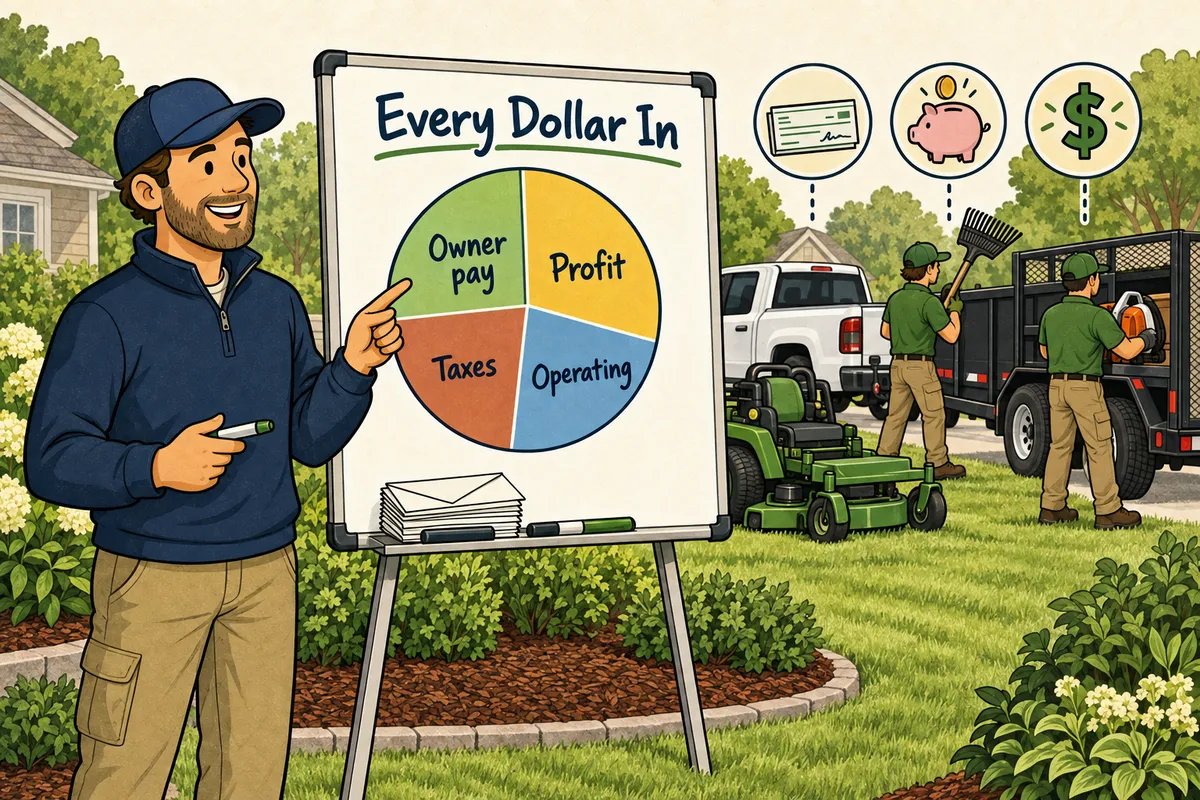
A simple discipline that works for landscaping companies: every deposit gets split by percentage into separate accounts before anyone spends it. The percentages shift as the company grows and the owner steps back from the field.
| Revenue | Owner pay | Profit | Tax reserve | Operating |
|---|---|---|---|---|
| $500K to $750K | 15 percent | 5 percent | 12 percent | 68 percent |
| $750K to $1.5M | 10 percent | 10 percent | 13 percent | 67 percent |
| $1.5M to $3M | 7 percent | 12 to 15 percent | 15 percent | 63 to 66 percent |
Owner pay as a percentage falls as revenue rises because a GM salary does not scale with revenue; profit rises because it should. Tax reserve depends on your entity type and state, so confirm it with your accountant. The IRS guidance on estimated taxes is the starting point. If operating cannot run the company on its share, the fix is pricing and labor, not raiding the profit account.
Worked example: a $1.2M company
| Line | Percent | Annual | Monthly |
|---|---|---|---|
| Owner salary | 10 percent | $120,000 | $10,000 |
| Profit distribution | 10 percent | $120,000 | $10,000 (paid quarterly) |
| Tax reserve | 13 percent | $156,000 | $13,000 |
| Operating | 67 percent | $804,000 | $67,000 |
The owner in this example earns $240,000 a year between salary and profit, pays taxes from a reserve that already exists, and can see in one glance whether the operating side is living within its share. The same owner "taking what is left" in a company with no allocation typically nets $90,000 to $110,000, works the same hours, and gets a tax surprise every April. The revenue did not change. The discipline did. If cash feels tight even when revenue is strong, this is usually why.
What a buyer sees in your pay
When you eventually sell, a buyer will rebuild your P&L with a market salary for whoever replaces you. If you paid yourself $40,000 and the business showed $150,000 of profit, the buyer sees $80,000 of profit after a $110,000 GM, and prices the company on that. Underpaying yourself does not raise the sale price. It just delays the bad news.
The reverse is also true. An owner who takes a fair salary, shows 15 percent net on top, and can demonstrate that the company runs on systems rather than on their 60 hours has a business worth three to five times EBITDA. That is the difference between a job and a transferable business, and it starts with paying yourself like an employee so the profit line tells the truth.
Frequently asked questions
How much do landscaping business owners make?
Owners of well-run $1M to $2M companies typically take $100,000 to $130,000 in salary plus $100,000 to $250,000 in profit. Owners of the same size company with no pricing model and no allocation often clear $60,000 to $100,000 total while working more hours. The difference is margin and structure, not revenue.
Should a landscaping owner take a salary or a draw?
That depends on your entity type: S-corporation owners generally must take a reasonable salary through payroll, while sole proprietors and single-member LLCs take draws. Either way, make the amount fixed and monthly, and confirm the structure with your accountant.
What if the business cannot afford to pay me a market salary?
Then the business is not yet profitable, and you have been subsidizing it with your own underpayment. Start the allocation at whatever percentage cash allows, even 5 percent, and raise it one point a quarter while you fix pricing and labor. The point is to make the shortfall visible so it gets solved instead of absorbed.
Explore 7 Figure Landscape Network's business systems programs or book a strategy call to discuss the operating problem you want to work on. Learn about Jim Wertz and the network.
For the broader job costing process, use Landscaping Job Costing: A Worksheet and Worked Example as your starting guide, then return to the specific issue covered here.
