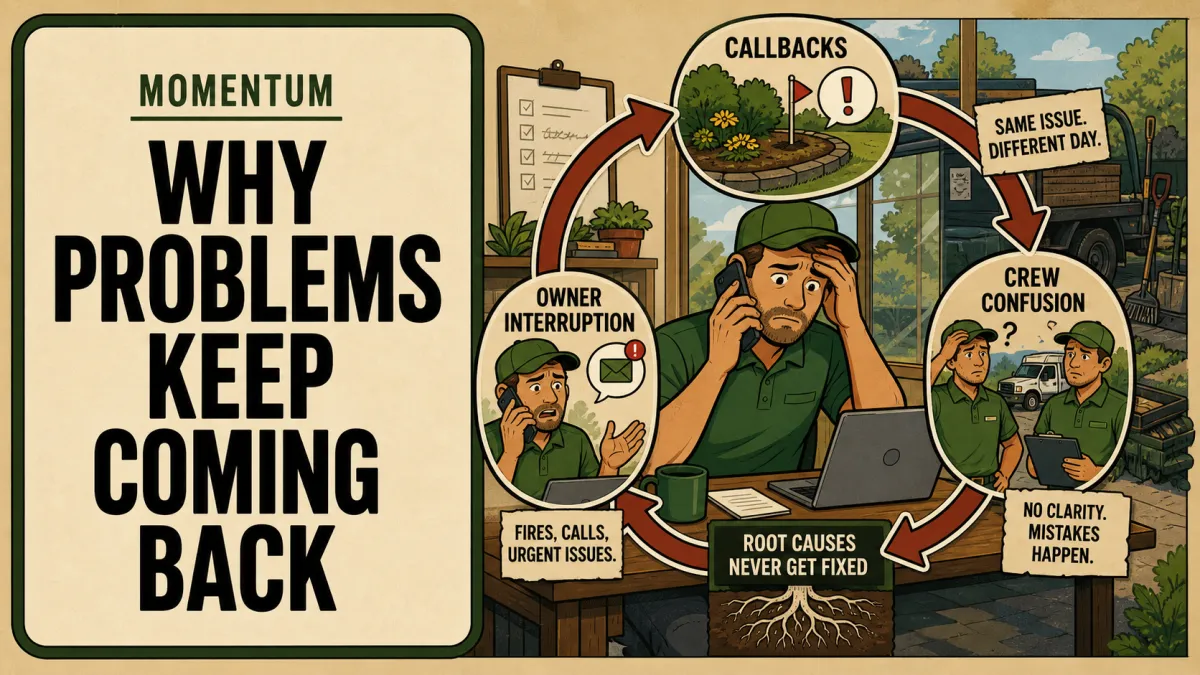
Recurring Landscaping Problems: A Practical Root-Cause Review
Root cause analysis for landscaping operations means asking why a problem happened until you reach a cause the company can change, then changing the process so the next crew does not hit it. A simple five-whys review, done with the crew leader within a couple of days, is enough for most recurring problems. If the same problem keeps coming back, the last fix only treated the symptom.
Updated October 9, 2026
Describe the problem before you explain it
Most recurring problems get handled the same way: someone fixes today's job and everyone moves on. A week later it happens again on another property.
Start the review by writing the event down plainly: which job, what was supposed to happen, what actually happened, when, and what evidence you have. Photos, timesheets, delivery tickets, and the estimate all count. Hold off on labels like "lazy crew" until the facts support a personnel conclusion. Those labels rarely lead to a fix.
Pick problems that repeat, cost real money, or carry real risk. A one-off event on an unusual site may not justify redesigning anything. If the problem shows up as repeat visits, track them first with landscaping callback and rework tracking so you know how often it happens and what it costs.
Five whys, adapted for crews
The five-whys method is simple: ask why, take the answer, and ask why again until you reach something you can change. On a landscaping crew it needs a few ground rules to stay useful:
Run it within 48 hours, with the crew leader who was on the job.
Check every answer against a record. If nobody can show it, mark it as a guess.
Trace the handoffs. Most field problems start upstream, in estimating, purchasing, dispatch, training, or inspection.
Stop at a cause the company controls. "The customer changed their mind" is a fact. "We had no way to approve the change on site" is a cause.
Allow for more than one branch. Two causes can combine, and the count does not have to be exactly five.
Worked example: the mulch shortage that kept happening
Example: on 4 of the last 10 mulch jobs, a crew ran short and had to make a second material run. Each extra run took two people about 1.5 hours, or 3 person-hours. At a loaded labor cost of $32 per person-hour that is $96, plus a $40 delivery fee, so $136 per run and $544 across those four jobs. If the same rate holds over a 60-job mulch season, that is 24 extra runs and about $3,264 that was never priced in.
| Why? | Answer | Evidence checked |
|---|---|---|
| 1. Why did the crew run short? | Only 6 yards were delivered. The beds took 9. | Delivery ticket and the crew leader's end-of-day report |
| 2. Why were only 6 yards delivered? | The order was copied straight from the estimate. | Purchase order matches the estimate line |
| 3. Why did the estimate say 6 yards? | It was calculated at 2 inches deep across all beds. | Estimate worksheet |
| 4. Why 2 inches? | The estimating sheet has one depth setting, built for top-dressing. Bare beds get 3 inches in the field. | Crew install standard says 3 inches on bare beds |
| 5. Why was the mismatch never caught? | Nobody compares material ordered with material installed after the job. | No such line on the closeout checklist |
The easy response is to order extra on every job. That adds cost everywhere and leaves bare-bed jobs underpriced. The real causes are an estimating sheet with one depth for two kinds of work and no check to catch it.
Turn the cause into an SOP or checklist change
A root-cause review is only finished when a process changes. In the mulch example, that meant three edits:
Estimating sheet: two depth lines, top-dress at 2 inches and bare bed at 3 inches, with the estimator required to pick one per bed.
Closeout checklist: one new line, yards ordered vs. yards installed, filled in by the crew leader. Add it to your landscaping jobsite closeout checklist rather than starting a new form.
Install standard: the written SOP updated so the depth rule lives in one place, and added to the team's knowledge base for repeat questions.
Keep the change small and testable, with one owner and a review date. Add a checklist line only when it targets a recurring or high-cost failure the crew can actually check.
Check the fix on the next jobs
Decide up front what will count as fixed. In the example, the measure is second material runs on the next ten mulch jobs. Zero or one means it worked. Three or more means the review missed something.
Bring the result to the weekly crew leader meeting so the whole team sees the problem closed with numbers. If the recurring problem is extra hours rather than materials, use the same review alongside a labor variance review by job type.
Watch for side effects too, such as a fix that adds twenty minutes of paperwork per job. Make follow-up specific with clear crew accountability standards, so every review ends with a named owner and a date.
Frequently asked questions
What is a root-cause review for a landscaping company?
It is a short, structured check of why an expected result failed, using job records and the handoffs between estimating, purchasing, dispatch, and the field. The output is a specific change to a process, a checklist, training, or resources.
How do I know whether a fix worked?
Set a measure before you make the change, then check the next comparable jobs over a defined period. Look at recurrence, cost, and any new problems the change created. A meeting where everyone agreed does not prove anything.
Should every mistake create a new checklist item?
No. Add a check when it addresses a recurring or costly failure and the crew can perform it meaningfully. Too many low-value checks bury the important ones and get skipped.
Explore 7 Figure Landscape Network's business systems programs or book a strategy call to discuss the operating problem you want to work on. Learn about Jim Wertz and the network.
For the broader team leadership and accountability process, use Landscaping Crew Accountability: Standards, Owners, and Reviews as your starting guide, then return to the specific issue covered here.
