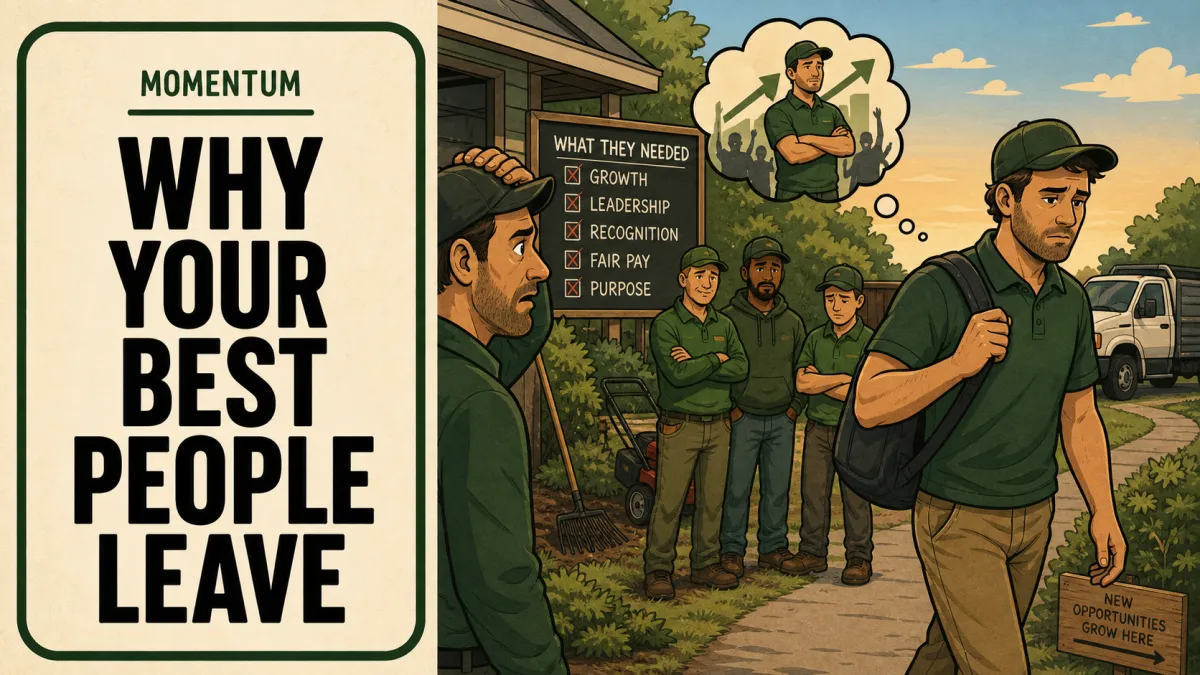
Why Good Landscaping Employees Leave: A Departure Review
Good landscaping exit interview questions find the gap between what the role promised and what the daily work actually delivered. Ask the same set of questions every time, log the answers, and sort each cause into fixable or unfixable. One departure tells you little. Three departures with the same pattern tell you exactly what to change.
Updated October 9, 2026
When and how to run the conversation
Hold the exit conversation during the employee's last week, not on the final afternoon while they are turning in gear. Keep it to 20 or 30 minutes in a private spot. If you were their direct supervisor and the relationship is strained, have someone else ask the questions, such as an office manager or a different crew leader. People are more honest with someone who is not part of the problem.
Set the tone at the start: you are trying to learn, not to argue or change their mind. Participation is voluntary. Write down what they say in their words, and keep confirmed facts separate from your guesses about motives. The moment you defend yourself, the honest information stops.
Keep notes professional and stored with other personnel records. If the departure involves a complaint about harassment, safety, or pay practices, treat it as its own issue and talk to your attorney or HR advisor before responding.
Landscaping exit interview questions
Use the same questions for every departure so you can compare answers over time:
What made you start looking, and when did that happen?
How did the job compare with what you expected when you were hired?
What part of a typical week was most frustrating?
Did you have what you needed to do the work well: equipment, materials, information, training?
How clear were your responsibilities and the decisions you were allowed to make?
How did your crew leader or manager help or get in the way?
Did you see a next step for yourself here? What would it have taken?
How does the new job compare on pay, hours, and schedule?
Was there a point where something could have changed your decision?
What would you tell a friend thinking about working here?
Question 9 is the most useful one. It tells you whether the departure was preventable and roughly when the window closed.
Separate fixable from unfixable causes
Not every departure is a failure. Sort what you hear into three groups:
Unfixable: moving out of state, family needs, going back to school, a career change. Log it and move on.
Fixable but not worth matching: a competitor offering pay your prices cannot support, or a role you do not need. Note it so you can watch the trend.
Fixable and within your control: unpredictable finish times, poor equipment, a supervisor problem, unclear authority, no development path. This is where the work is.
Watch for answers that sound unfixable but are not. "I found something closer to home" sometimes means "I was tired of 6 a.m. starts with no notice of when we'd finish." Ask one follow-up before you file it.
Also compare the stated reasons with the role history: changes in workload, pay, training, schedule, and manager over the last year. A capable crew leader may have accepted planning and customer communication while still being measured only on personal production. If the added work never came with time, authority, or recognition, fix the design of the position before advertising for someone else to absorb the same conflict.
A departure log template
Keep one simple log for every departure, voluntary or not. Here is an example of what a year might look like for a mid-sized crew company.
| Role | Tenure | Regretted? | Main stated reason | Category | Preventable? |
|---|---|---|---|---|---|
| Crew member | 3 weeks | No | Job harder than described | Hiring mismatch | Yes |
| Crew member | 7 weeks | Yes | Unpredictable finish times | Scheduling | Yes |
| Crew leader | 2 years | Yes | Responsible for everything, no authority | Role design | Yes |
| Crew member | 1 year | No | Moved out of state | Personal | No |
| Crew member | 6 weeks | Yes | Late finishes, no notice | Scheduling | Yes |
Two of five departures point at scheduling. That is a pattern worth fixing. The three-week departure points upstream at the interview, where the job was described too softly. Tighten that with a hiring process that defines the job before interviewing.
Turn patterns into changes
Review the log every quarter, or after any regretted departure.
Group departures by category and look for anything that shows up twice.
Pick one change supported by the evidence: supervisor coaching, clearer advancement criteria, more realistic scheduling, or a compensation review.
Dig past the symptom. Late finishes might come from bad estimates, poor material prep, or late scope additions. Use a root-cause review for recurring problems before deciding on a fix.
Assign an owner and a date, and give unresolved actions a regular review point in the weekly operations meeting.
Fold the result into a practical retention plan so the people still on your crews benefit.
The exit interview tells you what happened. For the broader reasons good crew members leave in the first place, see why landscaping employees quit.
Frequently asked questions
How is a departure review different from a stay interview?
A departure review looks at why someone left and what the company can learn from it. A stay interview asks current employees the same kinds of questions early enough to fix the problem before anyone resigns. Run both, and compare what you hear.
Should I make a counteroffer to keep a crew leader?
First find out what is actually driving the decision. More money rarely fixes unclear authority, workload, or a supervisor problem, and the person may leave a few months later anyway. Consider what the counteroffer signals to the rest of the team before you make it.
What should change after repeated good employees leave?
Look for patterns in your departure log across role design, supervision, scheduling, compensation, and development. Pick one concrete improvement, assign it, and check whether the experience actually changes for the people who stayed.
Explore 7 Figure Landscape Network's business systems programs or book a strategy call to discuss the operating problem you want to work on. Learn about Jim Wertz and the network.
For the broader team leadership and accountability process, use Landscaping Crew Accountability: Standards, Owners, and Reviews as your starting guide, then return to the specific issue covered here.
